


Are you trying to decide between classic asphalt shingles and newer composite (synthetic) shingles for your Brooklyn roof? Many homeowners want a roof that looks great, lasts long, and fits their budget, but choosing the right option can be confusing.
Both have key pros. Asphalt shingles are trusted and affordable. Composite shingles mimic slate or cedar, lasting much longer. Which is best for your Brooklyn home?
Let’s clear this confusion together!
Quick Comparison Table: Composite (Synthetic) Shingles vs Asphalt Shingles
| Factor | Asphalt Shingles | Composite (Synthetic) Shingles |
| Installed cost (NYC context) | ~$6–$10/sq ft typical NYC range; NY average shows ~$7.68/sq ft for asphalt. | ~$9–$20/sq ft depending on brand/profile; many guides cite $9–$12 and premium lines $15–$20. |
| Typical lifespan | ~20–30 years by type and climate (3-tab on the low end; architecturally higher). | Often 30–50+ years; many lines carry 50-year or lifetime limited warranties. |
| Weight (installed material) | About ~200–300 lbs per square for many architectural lines (example: GAF HDZ ~200 lbs/square). | Commonly ~182–356 lbs per square (DaVinci range); Brava Spanish Barrel lists ~281 lbs/100 sq ft. |
| Fire / Impact / Wind ratings | Class A assemblies available; impact-rated options to UL 2218 Class 4; wind classes ASTM D3161 F and ASTM D7158 up to Class H (150 mph) on select products. | Widely offered with Class A fire, UL 2218 Class 4 impact, and high wind listings; some brands post Miami-Dade HVHZ approvals. |
| Maintenance | Periodic checks; keep valleys/gutters clear; avoid pressure washing; algae control per ARMA. | Light routine checks; optional gentle cleaning; no maintenance required to keep DaVinci warranty. |
| Aesthetics | Broad color decks and profiles (3-tab, architectural, luxury) at budget-friendly tiers. | High-fidelity slate/shake/tile look from molded profiles that read authentic from the curb. |
What are asphalt shingles?
Asphalt shingles are the most common residential roofing in Brooklyn, NYC. They have three core layers: a fiberglass base mat (a flexible fabric providing strength), waterproofing asphalt (a sticky substance that repels water), and mineral granules on top for UV protection and color. This construction gives a roof that is light, durable, and affordable for most homes. Leading manufacturers and the Asphalt Roofing Manufacturers Association (ARMA) describe this same three-part anatomy.
What are composite (synthetic) shingles?
Composite shingles are man-made tiles that use engineered polymers (special plastics made for strength) or recycled plastics to mimic the look of slate, cedar, or tile. Manufacturers make molds from real materials, so the texture and shadow lines look natural from the street. The goal is high curb appeal with modern durability and less weight than stone or clay. Companies such as DaVinci and EcoStar describe them as long-life, low-maintenance choices.
Asphalt shingles vs. composite (synthetic) shingles
Asphalt wins on upfront price and wide availability; it suits many budgets. Composite wins on realism, impact resistance, and warranty length; it suits long-term owners who want a higher-end look. Asphalt lifespans often fall in the 20–30 year range by type and climate. Composite lines often carry 50-year or lifetime material warranties from major brands.
The curb appeal of asphalt shingles compared to composite (synthetic) shingles

Asphalt offers many colors and architectural profiles, so you can match most neighborhoods at a friendly price. It still looks like asphalt up close, even when styled to resemble wood or slate.
Composite shingles use high-fidelity molds from real slate or cedar, so edges, grain, and shadow lines read as authentic. From curb distance, they often pass for the real material and enhance premium homes.
Final result: For curb appeal, composite holds the edge when you want a true slate or shake look.
The lifespan of asphalt shingles vs. composite (synthetic) shingles
Standard asphalt roofs commonly last about 20–30 years, with three-tab on the lower end and architectural on the higher end under good conditions. Weather, ventilation, and installation quality can shorten or extend that range.
Composite roofs often pair a multi-decade service life with longer manufacturer coverage. Examples include DaVinci’s lifetime limited warranty and Brava’s 50-year limited warranty.
Final result: On longevity and durability, composite is usually the better long-term pick when budget allows.
Required Material for asphalt shingles and composite (synthetic) shingles
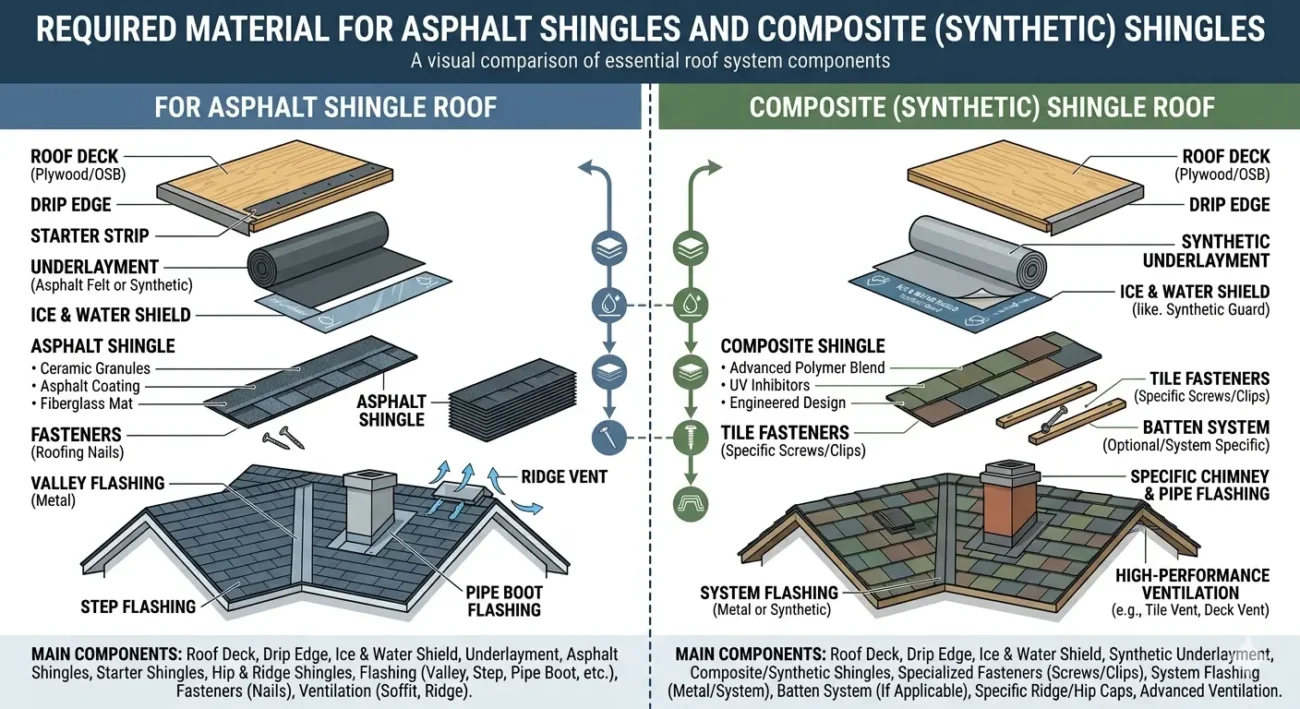
Let’s cover the essentials before prices. Both roofing systems need a basic kit so the roof works and meets code—a clear list you can show a contractor.
| Component | Asphalt shingles — what you need | Composite (synthetic) shingles — what you need |
| Underlayment | ASTM D226/D4869 felt or synthetic underlayment per maker specs. | Synthetic underlayment approved by the brand; follow the specific guide. |
| Ice & water shield | Peel-and-stick membrane at eaves, valleys, penetrations. | Same membrane locations per brand guide and local code. |
| Edges & metal | Drip edge at eaves/rakes; valley metal to spec. | Drip edge and formed valleys; corrosion-resistant metals recommended. |
| Starters | Factory starter strips at eaves and sometimes rakes. | Brand-specific starters for slate/shake profiles. |
| Field shingles/tiles | 3-tab or architectural shingles. | Polymer/composite slate or shake tiles. |
| Hip & ridge | Matching hip/ridge caps or cut caps. | Brand hip/ridge units sized for slope. |
| Fasteners | Roofing nails sized to deck; corrosion-resistant per maker. | Ring-shank, corrosion-resistant nails per brand spec. |
| Flashings | Step, counter, pipe boots, skylight kits. | Same flashing set, detailed per brand drawings. |
| Ventilation | Intake/exhaust (soffit + ridge or other). | Balanced ventilation per listing and guide. |
The cost of asphalt shingles vs. composite (synthetic) shingles for Brooklyn, NYC
Let’s use NYC numbers for accuracy. Asphalt is at the low end; composite costs more up front but lasts longer and looks stronger.
| Cost item (Brooklyn/NYC context) | Asphalt shingles | Composite / synthetic shingles |
| Installed cost (per sq ft) | ~$6–$10 typical NYC range; NYC averages around $7.68 for asphalt in current datasets; some sources show $4–$11 citywide. | $15–$20 for premium brands like DaVinci; synthetic slate averages $9–$12 nationwide, with NYC often near the top of the range. |
| Material cost (per sq ft) | Roughly $0.80–$3+ depending on grade and accessories. | Roughly $3.5–$12 depending on brand and profile. |
| Labor share of total | Often ~60% of the bill on steep-slope roofs; NYC tends to skew high. | Similar ~60% share; complex slopes and brand specifics can raise time and cost. |
| Repair cost (rule of thumb) | NYC repairs are often $5.50–$20/sq ft depending on damage; national asphalt repairs average $363–$1,930 per job. | Synthetic/slate repair jobs often price higher per sq ft; national slate/synthetic repairs average $784–$3,248, with synthetic cited ~$5–$13/sq ft in some reports. |
Environmental Impact
Asphalt shingles come from petroleum (oil-based) products and create major construction debris. EPA and industry sources estimate about 11–13 million tons of shingle tear-offs each year in the U.S.; recycling exists, but today only a small share gets reused in paving roads or other projects.
Composite shingles often use recycled plastics or rubber, and many can be recycled again at the end of their life; EcoStar, for example, states that their products have up to 80% post-industrial recycled content (reused leftover materials from manufacturing), and Brava promotes both recycled content and take-back (return for recycling) potential.
Final Result: Composite/synthetic is usually the more eco-friendly path for long life and recycled content, while asphalt improves as local recycling access grows.
Installation Process
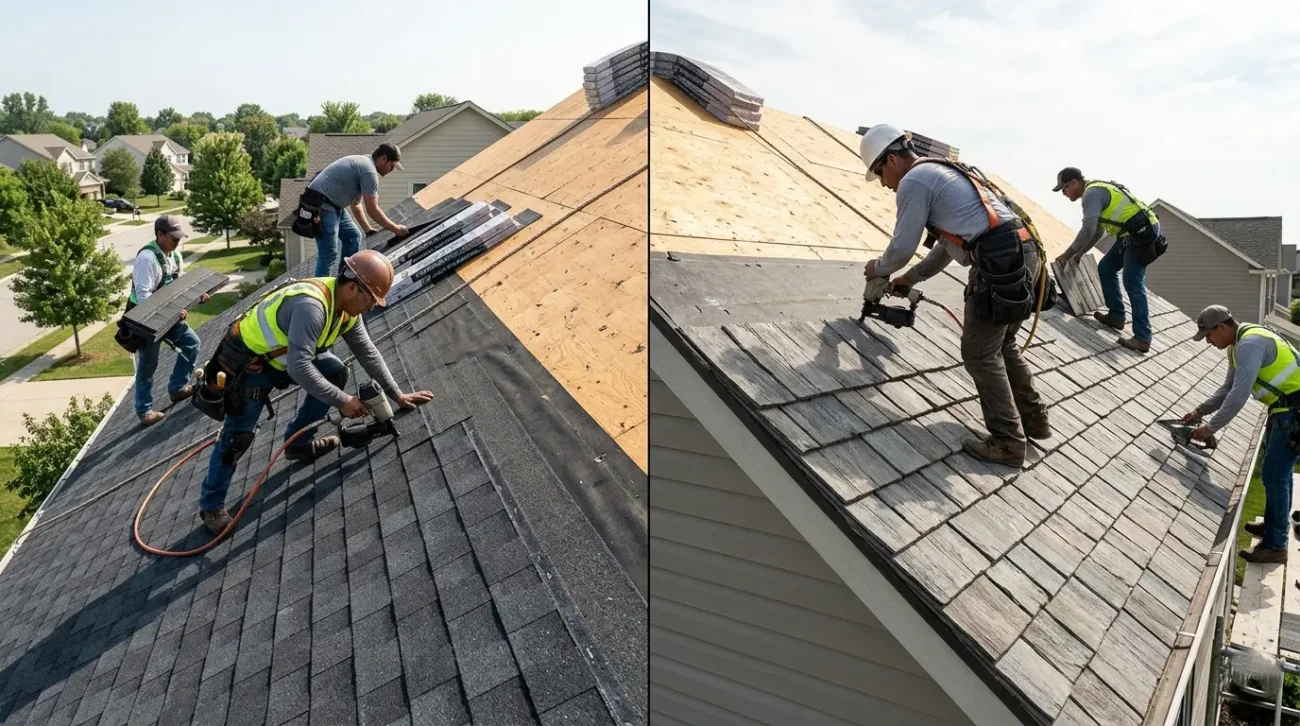
Here’s a simple summary to follow your crew’s plan.
Asphalt shingles
- Tear-off and deck check: Remove old layers and fix soft sheathing for a clean base.
- Underlayment and ice/water: Roll underlayment; add self-adhered membrane at eaves, valleys, and penetrations.
- Drip edge and valleys: Install metal at eaves/rakes and form valleys to spec.
- Starters and field courses: Set starters at eaves; nail shingles by pattern and exposure.
- Flashings and ventilation: Step/counter-flash walls and chimneys; finish with ridge vent.
Composite (synthetic) shingles
- Tear-off and prep: Confirm deck thickness and slope per brand spec.
- Underlayment and membrane: Install underlayment (a protective sheet between the roof and shingles) and ice barriers (waterproof layers at vulnerable areas) in critical spots.
- Starter, layout, nail pattern: Follow the brand’s nail zones (pre-set areas for nailing), coursing (shingle arrangement), and stagger rules (offsetting each row for strength), all of which help achieve wind ratings.
- Valleys, hips, ridges: Use brand details and matching hip/ridge units sized to pitch.
- Final flashings and vents: Close out per manufacturer drawings and local code.
Which is easier? Asphalt is simpler and faster for most NYC crews because methods are universal and material is lighter on the wallet. Synthetic is straightforward for trained installers but needs brand-specific details to protect warranty and ratings.
Maintenance Requirements
Here’s what upkeep actually involves.
Asphalt shingles
- Annual check after storms: Look for granule loss, lifted tabs, or cracked shingles.
- Keep gutters and valleys clear: Debris invites leaks and ice dams.
- Treat algae/moss as needed: Follow ARMA’s guidance for safe cleaning methods.
Composite (synthetic) shingles
- Light visual check yearly: Confirm no loose tiles or open flashings.
- Optional gentle wash for looks: Brands allow mild cleaners and low-pressure rinse when desired.
- Limit foot traffic: Walk only when needed and use proper safety.
Who needs more upkeep? Asphalt needs more attention over time due to granule wear and algae. Composite sits closer to “set it and forget it” for most homes in Brooklyn.
Design Options (Composite (Synthetic) Singles vs. Asphalt Shingles)

Here’s a quick look at style options for each roofing type.
Asphalt shingles—design choices you can pick
- 3-tab shingles: Flat, clean lines and the lowest price tier; a classic look across many bungalows and row houses. Widely stocked, so color matching is simple. Good for tight budgets.
- Architectural/Dimensional: Thicker profile with shadow lines for a wood-shake vibe. Better wind resistance than 3-tab in many lines. A strong mid-tier choice.
- Luxury/Designer: Heavier cuts that hint at slate or hand-split shake. Used on higher-end exteriors where depth matters. Often paired with upgraded warranties.
- Cool-color series: Lighter, reflective colors that meet cool-roof criteria in some programs. Useful for heat control on sunny exposures. Check CRRC values on the spec sheet.
- Broad color palettes: Large swatches and matched hip/ridge pieces from major brands. Easy to coordinate with siding and trim. Sampling is simple.
Composite (synthetic) shingles—design choices you can pick
- Slate look: Crisp edges and broken-cleft textures molded from real stone. Works well on brownstones and landmark-style facades. The profile reads “premium” from the curb.
- Cedar shake look: Split-grain detail and varied widths for a warm, rustic feel. You avoid rot and frequent treatments. A strong match for historic streetscapes.
- Spanish/Barrel tile look: Classic S-curve lines with far less weight than clay. Good where freeze–thaw hurts fired tile. Adds bold contours to gables and hips.
- Multi-color blends: Factory blurring and variegation for depth that mimics hand-laid slate or shake. Helps large roof planes avoid a flat look. Popular on corner lots.
- Cool-roof color options (select lines): Some composites carry cool-roof labels for better heat control. Look for the maker’s “Cool Roof” icon on color charts. Check CRRC values when you choose.
Which has more variety?
For sheer number of SKUs and colors at every price point, asphalt wins. For premium looks that copy slate, shake, and tile with high fidelity, composite wins on realism.
Weather Resistance
Brooklyn sits in Climate Zone 4A (mixed-humid), so roofs see summer heat, coastal storms, and freeze–thaw cycles in winter. Your pick should handle wind uplift, impact, and seasonal swings without drama.
- Asphalt shingles: Architectural shingles often carry ASTM D3161 Class F (tested to constant 110 mph winds for two hours) and ASTM D7158 ratings up to Class H on select products. Impact-rated asphalt shingles can reach UL 2218 Class 4 for hail. Performance still depends on correct installation and sealing.
- Composite (synthetic) shingles: Leading lines publish Class A fire, Class 4 impact, and 110 mph wind ratings, with some products tested for Miami-Dade HVHZ and even higher wind performance in specific assemblies. This combo suits gusty nor’easters and year-round swings.
Which one is better for weather resistance?
On balance, composite edges out asphalt in mixed-humid NYC conditions because of broader top-tier ratings across fire, impact, and wind in many product families. Always verify the exact listing for the model you pick.
Benefits of Asphalt Shingles

Here are the main advantages of asphalt for Brooklyn homes.
- Lowest upfront cost: Asphalt gives the most roof for the least cash across common pitches. High production volume and simple logistics keep prices low. That helps when you must replace fast.
- Fast, familiar installation: Most NYC crews work with asphalt every week. Methods are consistent across brands, so jobs move quickly. Less installation time can reduce disruption at your place.
- Plenty of styles and colors: You can choose 3-tab, architectural, or designer lines to match your block. Big color decks and matched accessories support a clean finish. Samples are easy to source.
- Solid code path and ratings: Asphalt lines offer Class A fire options and recognized wind classifications like D3161/D7158. Clear listings make permits smoother. Your contractor can point to the exact sheet.
- Readily available repairs: If a branch scuffs a slope, replacements are easier to find and to fit. You can swap small areas without a full tear-off. That keeps long-term costs in check.
- Proven track record: Asphalt has served North American homes for over a century. The category keeps evolving with algae-resistant granules and cool-color lines. Homeowners value that predictable baseline.
Benefits of Composite (Synthetic) Shingles

You want a roof that looks upscale and handles New York weather without drama. Composite shingles aim for both: classic slate or cedar style with modern performance.
- Strong weather ratings: Many composite lines publish Class A fire performance under UL 790 and Class 4 impact under UL 2218. Several products also carry high wind listings and HVHZ/Miami-Dade approvals. That mix fits stormy, mixed-humid NYC seasons.
- Long warranties and service life: Leading brands back products for decades. You will see lifetime limited (DaVinci) or 50-year limited (Brava) coverage when installed per spec. That support gives you confidence for the long term.
- Premium curb appeal: Tiles are molded from real slate or shake, so edges and grain read as authentic from the street. Color blends add depth on large roof planes. Your home gets a high-end look without stone weight.
- Lower weight than natural slate or clay: Composite profiles reduce dead load on older frames. Contractors often skip structural upgrades that real slate or clay could need. That saves time and cost at installation.
- Eco-forward options: Some composite lines use recycled content and publish Cool Roof colors. Higher reflectance can help cut cooling load in summer. Check each color’s CRRC data before you choose.
- Low routine upkeep: Yearly visual checks, clear valleys and gentle cleaning usually suffice. Brands provide simple care instructions for long life. Less ladder time helps you focus on the house, not the roof.
Which Roofing Option Is Right for Your Brooklyn Home?
If the budget runs tight or you plan a short hold, asphalt wins on upfront price. If you want top curb appeal and longer service in a mixed-humid coastal city, composite pulls ahead. Asphalt can meet NYC wind and fire listings with the right line and installation, yet composite often posts broader top-tier ratings. For long-term value in Brooklyn, composite is usually the better fit when your budget allows it.
Consider Asphalt shingles vs. composite (synthetic) shingles—NYC Local Codes
You want a roof that passes plan review and inspection the first time. Here are the NYC code points that matter for both materials.
- Fire classification (UL 790 / ASTM E108): Roof coverings and assemblies must be listed and labeled for fire class by an approved agency. Class A assemblies are defined in Section 1505 and are permitted on all construction types in NYC. Many asphalt and composite systems offer Class A when installed as a listed assembly.
- Wind classification for asphalt shingles: NYC adopts ASTM D7158 for asphalt shingle wind resistance. Packaging must show the D7158 class required by Table 1504. 1.1 for your site wind speed. Pick a line that meets or exceeds the table for your block.
- Minimum slope and underlayment for asphalt: Asphalt shingles are permitted only on slopes ≥ 2:12. From 2:12 to <4:12, the code calls for double underlayment; above that, one layer per section. Underlayment must comply with ASTM D226/D4869/D6757, and nails must meet ASTM F1667.
- Ice barrier at eaves: NYC requires an ice barrier at the eaves for steep-slope roofs prone to ice backup. It must extend at least 24 inches inside the exterior wall line; a self-adhered modified bitumen sheet that meets ASTM D1970 is acceptable. This applies to asphalt, slate/slate-type, and similar roof coverings.
- Flashing, metal thickness, drainage, and weather protection: Chapter 15 sets base rules for corrosion-resistant metal flashings, drainage and weather protection, all installed per manufacturer instructions and code. Your contractor should follow these details to keep approvals clean.
- Composite/synthetic shingles: Composite slate/shake systems must be installed per the product’s listing (evaluation report, Miami-Dade NOA, or equivalent) to achieve the stated fire, wind, and impact ratings. Manufacturers publish installation guides, CAD details, and third-party testing you can attach to filings.
- Permits in NYC: Most construction work requires a DOB permit. The City lists “non-structural roof repair” as permit-exempt, but full roof replacements and scopes that change materials or assemblies typically require permits. Always verify scope against DOB guidance before work.
- Landmarks (LPC) properties: If your home sits in a Historic District or is an Individual Landmark, LPC reviews roof material changes for visual appropriateness. The LPC Permit Guidebook explains how to apply through Portico and what staff look for during review and coordinates DOB and LPC filings in parallel.
Pro Tip: Choose a listed Class A assembly, match the wind class to NYC tables, meet slope and ice-barrier rules, and file the right permits (plus LPC if applicable). That path keeps your asphalt or composite roof compliant in Brooklyn.
Where to Find the Best Brooklyn Roofing Contractors
Are you looking for an expert roofing contractor in Brooklyn, NYC? SR General Construction has you covered! Our business is located at 8807 Avenue B, Brooklyn, NY 11236, United States, in the Canarsie area.
We proudly serve all areas of Brooklyn with high-quality, durable roofing solutions. From new installations to repairs and maintenance, we provide the best service at affordable prices. Contact us and experience why we’re Brooklyn’s roofing experts!
FAQ
1. What’s the basic difference between asphalt and composite (synthetic) shingles?
Asphalt shingles use a fiberglass mat with asphalt and mineral granules; they’re the most common residential roof in the U.S. Composite shingles are polymer/composite tiles (often with slate/cedar looks) engineered for higher impact, fire, and wind performance than basic asphalt.
2. Which lasts longer—composite or asphalt?
Architectural asphalt typically lasts ~20–30 years. Leading composite/slate-look products target multi-decade lifespans, with limited lifetime or 50-year material warranties.
3. How much more do composites cost than asphalt (installed)?
Nationwide, architectural asphalt commonly runs roughly in the mid-single digits per sq ft installed, while premium composites can land in the mid-teens to ~$20+/sq ft depending on brand and complexity. NYC projects trend higher due to access and labor.
4. Do composites handle hail better?
Many composite tiles carry UL 2218 Class 4 impact ratings, the highest commonly available for steep-slope products. Class 4 indicates strong resistance to hailstone impact compared with standard shingles.
5. What wind ratings do these shingles have?
Asphalt shingles are typically rated to ASTM D3161 Class F and/or D7158 Class H, which correlate to 110–150 mph test criteria. Composite brands often list high wind approvals per their evaluation reports.
6. Are composite shingles Class A fire-rated?
Many composite systems achieve a Class A roof assembly when installed with the specified underlayment/assembly. The NYC Building Code recognizes Class A/B/C per ASTM E108 or UL 790.
Грузоперевозки играют основополагающую функцию в экономике любой страны.
Эти услуги гарантируют бесперебойное снабжение складов и производств всеми нужными материалами.
Эффективная логистика позволяет уменьшать время и издержки на перемещение товаров, что увеличивает конкурентоспособность компаний.
Следовательно, транспортная отрасль представляют собой критическим элементом нынешней рыночной среды.
https://perevozimgruz.by/galereya/
Most of the time I feel the open web is in decline and then I find a site like this, and a stop at joltcloud reinforced that mood lift, the cumulative effect of finding occasional excellent independent content versus the cumulative effect of finding mostly mediocre content is real for the long term reader maintaining web habits today.
https://rekaoblaka.ru/
Qale forumdoshlar, men bu yerda qariyb besh oydan beri stavka qilaman, shuning uchun fikrimni yozib qo’yay dedim. To’g’risi, boshida ishonmagandim — bizda bunaqa saytlar to’lib yotibdi, yarmisi pul to’lamaydi. Lekin 888starz menda hozircha umuman aldamadi.
Slotlar tomonini aytsam, assortiment haqiqatan katta — nazarimda 5000dan ko’proq, aniq sanamadim. Ko’proq Pragmatic Play o’yinlarini tepaman: Gates of Olympus va Sweet Bonanza klassika, ba’zan Play’n GO ning Book of Dead ga o’tib turaman. NetEnt va Yggdrasil ham bor, lekin ularni siyrak ochaman. Live qismi yaxshi yig’ilgan — Evolution dan, tirik krupyelar, Crazy Time bo’lsa ishdan keyin vaqt o’tkazishga zo’r.
Bonus tomoni ancha munosib: birinchi depozitga 100% qo’shimcha plyus 150 bepul aylanish beriladi. Faqat shartga e’tibor bering — ko’pincha x40 atrofida, demak tezda chiqarolmaysiz, sabr kerak. O’zim avvaliga shartlarni to’liq ko’rmay olib yubordim va biroz kuyib qoldim. Amaldagi takliflarni [url=https://888starz-apk6.com]888starz skachat[/url] dan tekshirib olishingiz mumkin, ro’yxatdan o’tishdan oldin shu foydali bo’ladi.
Pul kirim-chiqimi bo’yicha: kartalar ishlaydi, Skrill bilan Neteller ham qo’shilgan, kripto orqali ham mumkin — o’zim ko’proq USDT dan foydalanaman, chunki kutish kam. Eng kam summa kichkina, deyarli 20 000 so’m atrofida bo’lsa kerak. Yaqinda chiqarib oldim — hamyonga yarim soatda keldi, kartaga esa sutkacha kutishga to’g’ri keldi.
Ilova to’g’risida ikki og’iz: rasmiy sahifadan ilovani yuklab olsa bo’ladi, Android da muammosiz ishlaydi, iPhone egalari ham variant bor, lekin sal murakkabroq. Brauzerda ham normal ishlaydi, dastur bo’lsa tezroq ko’rindi. Menga bezor qilgan narsa — verifikatsiya ancha sekin bo’ldi, uch kunga yaqin ovora bo’ldim, support esa ruscha yaxshi javob beradi, o’zbekchada gohida kechikadi. Litsenziya Curacao niki, demak odatdagi standart — ba’zilar bunga e’tiroz bildiradi, men uchun shu ham yetarli, chunki to’lovda hozircha aldanmadim.
Now feeling confident enough in this site to use it as a reference point for evaluating others on the same topic, and a look at blog66describe continued the comparison friendly quality, sites that serve as quality benchmarks for their topic are precious and this one has clearly become a benchmark for me on this particular subject area.
بصراحة أنا بقالي تقريباً نص سنة بلعب على المنصة دي ومش هقول إنها مثالية، لكن الحقيقة إن تجربتي كانت كويسة أكتر مما توقعت. أصلي من الإسكندرية والوجع الدايم عندنا كمصريين هي السحب والإيداع، وده كان أهم حاجة اختبرتها.
اللعبة اللي بدأت بيها هي Gates of Olympus بتاعة براجماتيك، ووبعد كده دخلت على Sweet Bonanza ووطبعاً Book of Dead بتاعة بلاي إن جو. الكتالوج ضخمة فعلاً — عندهم أكتر من ٧٠٠٠ لعبة ما بين NetEnt و Microgaming و Yggdrasil و Betsoft. النقطة الحلوة إن بيبقى اختلاف واضح مش نفس اللعبة بألف شكل.
الطاولات المباشرة اللي شغالة بـ Evolution بيبقى المكان اللي بضيع فيه فلوسي بصراحة. طاولات الروليت وبلاك جاك والكروبيهات بني آدمين فعلاً والبث نضيف حتى على بيانات الموبايل. Crazy Time بالذات إدمان والله — كسبت فيها مرة حاجة محترمة وبعد كده ضيعتها تاني، الحكاية دي معروفة.
في موضوع البونص: الترحيبي عندهم مضاعفة أول إيداع مع فري سبينز والحد الأدنى للإيداع بسيط جداً — دولار أو اتنين. بس خلي بالك من الـ wagering لأنها ٤٠ مرة واللي مش سهل. تقدر تشوف الشروط المحدثة في [url=https://bestmoneygoldap.com]888starz تحميل[/url] قبل ما تسجل. عملية التسجيل مخدتش أكتر من ٥ دقايق من غير تعقيد.
السحب في أول عملية أخد يومين بسبب الـ KYC، وده ضايقني شوية بس بعد كده أصبح أسرع بكتير. بحول USDT حالياً لأنه أسرع حاجة، رغم إن الفيزا والمحافظ الإلكترونية شغالين برضه. تطبيق الموبايل على الأندرويد مش تقيل و 888starz تحميل من الموقع الرسمي مش من متجر جوجل — نقطة لازم تنتبه لها. خدمة العملاء فيه شات بالعربي لكن أحياناً بياخد وقت وقت الذروة. الترخيص كوراساو، وده معناه مش MGA بس المنصة شغال من سنين ومحدش اشتكى.
mostbet ishchi mirror Oʻzbekiston [url=https://mostbet42102.help]mostbet ishchi mirror Oʻzbekiston[/url]
mostbet yutuq yechish [url=http://mostbet42102.help/]mostbet yutuq yechish[/url]
mostbet aviator o‘ynash [url=https://www.mostbet42102.help]https://www.mostbet42102.help[/url]
Siedze na tej stronie jakies szesciu miesiecy, w sumie najczesciej po pracy. Trafilem tam z polecenia kumpla, szukalem wtedy czegos, co ogarnia wplaty w PLN bez kombinowania. Szczerze mowiac — z poczatku nie mialem zaufania, bo w sieci pelno podobnych budek.
Automaty to w sumie to, po co tam siedze. Wisi tam kilka tysiecy pozycji, choc badzmy szczerzy polowy nikt nigdy nie odpali. Ja siedze glownie na Pragmatic Play — Gates of Olympus potrafi zrobic dzien, a z klasyki lece w Book of Dead. Jest tez NetEnt, Yggdrasil i Big Time Gaming, wiec naprawde jest w czym grzebac. Ostatnio coraz czesciej wchodze na stoly na zywo — Evolution robi to porzadnie, prowadzacy po angielsku, ale czasem trafiaja sie polskie stoly, a takie Crazy Time jest wciagajace, choc bardziej show niz gra.
Pakiet na start to 100% do pierwszego depozytu plus jakies jakies 30 darmowych spinow, tylko wymog obrotu x40 boli i trzeba sie w to wkrecic na spokojnie. Byl tez bonus bez depozytu, ale to sie zmienia co chwile, wiec najlepiej sprawdzic obecne promki na [url=https://888starz-casino12.pl]888starz[/url] zanim sie w cos wpakujesz. Minimalna wplata to grosze — u mnie wyszlo z 20 zl.
Rejestracja zajela mi doslownie minute, gorzej z doslaniem dokumentow — czekalem dwa dni, to standard w kazdym miejscu. Kase wyciagalem trzy razy: Skrill byl w kilka godzin, karta mielil sie dwa dni robocze, a BTC leci najsprawniej — doslownie kilkanascie minut. Maja tez Neteller, Mastercard i kilka lokalnych opcji.
To, co mnie realnie wkurza: obsluga na czacie odpisuje szybko, ale po polsku bywa roznie i trzeba czasem powtorzyc pytanie. Apka na Androida dziala bez zarzutu, tylko ze wazy swoje. Licencja sa z Curacao, wiec bez cudow — to nie jest polski operator z ministerialnym zezwoleniem. Poki co zostaje, choc nie wrzucam tam wiecej niz moge stracic.
Picked this up while looking for something else and ended up reading every paragraph because it was actually informative, and after logiccore I was sure I would come back, that does not happen often when most sites bury the useful parts under endless ads and pop ups today and across most categories online.
Тренинги для сотрудников помогают компании развивать навыки команды и повышать качество ежедневной работы. Такой формат подходит для руководителей, специалистов, отделов продаж, сервиса и проектных групп. Обучение персонала делает бизнес-процессы более понятными и результативными – обучение холодным звонкам
Казань, всем привет Брат снова сорвался Соседи стучат в стену В больницу тащить страшно Короче, врач приехал и поставил систему — нарколог на дом круглосуточно цены выгодные Приехал через 40 минут В общем, телефон и цены тут — вызов частного нарколога [url=https://lechenie.narkologicheskaya-pomoshh-v-kazani016.ru]https://lechenie.narkologicheskaya-pomoshh-v-kazani016.ru[/url] Звоните прямо сейчас Перешлите тем кто в такой же ситуации
والله بصراحة أنا لسه مسجل من حوالي ٤ شهور وحبيت أشارككم تجربتي. اللي عجبني من البداية عدد السلوتس — فيه فوق ٤٠٠٠ لعبة وده مش رقم متزوّق لأني قعدت أفلتر بالمزوّد. أغلبها Pragmatic Play وطبعًا NetEnt و Play’n GO، يعني Gates of Olympus و Sweet Bonanza و Book of Dead مش هتدوّر عليهم كتير.
طاولات الـlive هو اللي بضيّع فيه فلوسي بصراحة — Evolution هي اللي مشغّلاه والناس اللي قدامك حقيقية مش بوتات، والصورة واضحة جدًا بشرط الإنترنت يكون مستقر. Crazy Time دي حكاية تانية رغم إن النتيجة عشوائية جدًا. البلاك جاك والروليت متاحة بحدود مراهنة معقولة.
بخصوص العروض — بونص الترحيب بيوصل ١٠٠٪ على أول إيداع مع لفات مجانية على ألعاب معيّنة بس، بس خد بالك من متطلب المراهنة — في حدود ٣٥x-٤٠x وده مش سهل خالص. الحد الأدنى للإيداع بيبدأ من مبالغ بسيطة فمفيش مخاطرة كبيرة في التجربة. تقدر تتابع الأرقام الرسمية من خلال [url=https://brasme.com.mx]تنزيل 888starz للاندرويد[/url] قبل ما تسجّل، بدل ما تعتمد على ذاكرتي.
إنشاء الحساب مش محتاج مجهود والـKYC طلبوا صورة بطاقة وخلاص. طلبات السحب بتوصل عادة في ٢٤ ساعة على Skrill، بس الكارت البنكي فبتاخد ٢-٣ أيام. الـBitcoin بيوصل في دقايق وده حل كويس مع مشاكل التحويلات هنا.
الموبايل هو الأساس عندي — تنزيل 888starz للاندرويد مش من جوجل بلاي عشان قوانين المتجر، وده ممكن يخض حد أول مرة بس التطبيق فعلًا أسرع من الموقع. السبورت بيردّوا على الشات في دقايق والتواصل بالعربي متاح. الترخيص كوراساو — وده مستوى متوسط في رأيي، واللي عاش هناك من غير مشاكل يقول رأيه. اللي مضايقني فعلًا إن الواجهة مزدحمة شوية ومحتاجة تنظيم.
Honestly slowed down to read this carefully which is not my default, and a look at softfusion kept me in that careful reading mode, the kind of writing that demands attention by being worth attention is rare in a media environment full of content engineered to be skimmed not read with any real focus today.
Sprawdź recenzję Luckmore Casino. Poznaj bonus za rejestrację, gier, metody płatności, logowanie oraz opinie graczy Luckmore Casino
Different feel from the algorithmically optimised posts that dominate the topic, and a stop at vincentmorrison reinforced that human touch, you can tell when a site is being run by someone who reads what they publish versus someone just hitting submit and moving on quickly to the next assignment without checking the result.
A satisfying piece in the way that good meals are satisfying rather than just filling, and a look at blog33current extended that satisfaction, the metaphor between content and meals is one I find useful and this site reads as a satisfying meal rather than the empty calories that most content provides for casual readers.
Обзор Luckmore Casino: анализ лицензии, условий бонусов, слотов и скорости выплат казино. Узнайте особенности платформы перед регистрацией: Онлайн казино
Люди помогите Цены космос а качество мыло То кромка отваливается Короче, единственные кто не наваривается — кухни глория спб от производителя Цены ниже рынка В общем, сохраняйте в закладки — заказать кухню по индивидуальным размерам в спб [url=https://kuhni-spb-zmw.ru]https://kuhni-spb-zmw.ru[/url] Проверяйте производителя Сам мучался теперь делюсь
Gram tu jakies trzech miesiecy, przewaznie jak mam wolne pol godziny, wiec chyba moge napisac od siebie. Wszedlem tam z polecenia kumpla, bo szukalem kasyna z sensownym livem, a nie kolejnej sieczki z dziesiecioma grami.
Gier jest naprawde sporo — podobno ponad 4 tysiecy pozycji, chociaz szczerze i tak wracam do swoich ulubionych. Pragmatic Play dowozi Sweet Bonanze i Gates of Olympus, jest Play’n GO z Book of Dead, troche NetEnta, Yggdrasil, do tego Big Time Gaming jak ktos lubi megaways. Live to w wiekszosci Evolution — prawdziwi krupierzy, Crazy Time dziala bez zacinki nawet na slabszym necie.
Start jest ok: 100% do jakichs 1500 zl plus 150 free spinow, czasem lata tez cos bez depozytu na 50 obrotow. Tyle ze obrot — x40 potrafi zjesc caly bonus, za pierwszym razem nie wyrobilem. Swieze kody promocyjne zwykle podgladam na [url=https://888starz-opinie.com]888starz apk mod[/url] bo sie zmieniaja co miesiac.
Rejestracja zajela mi minute, min. depozyt to bodajze 20 zl. Robie przelewy Visa/Mastercard — kasa na e-portfel byla u mnie tego samego dnia, na karte czekalem dwa dni. Jest opcja z krypto, ale tego nie testowalem.
Jedyne co mnie denerwuje: weryfikacja. Poprosili o dokumenty dopiero przy pierwszej wyplacie i zeszlo prawie dobe. Support po polsku z lekkim opoznieniem, licencja to Curacao — wiec podatek i sprawy formalne rozliczacie sami. Aplikacja na iOS chodzi lepiej niz strona, choc trzeba ja sciagac z ich strony. Tak w skrocie — dalej tam klikam, z umiarem.
Gram na tym kasynie od jakichs czterech miechow, to chyba moge cos sensownego napisac. Znalazlem to przez jakis ranking, sam juz nie pamietam ktory, bo mnie juz zmeczyly starych miejscowek z ciaglymi problemami z wyplatami. Zakladanie konta to moze piec minut — standard, mail plus haslo, no i wybor PLN. Minimalna wplata wynosi 100 zl, w porzadku jak na polskie realia.
Slotow jest naprawde sporo — jakies 3500 pozycji, nie liczylem dokladnie. Ja lece przede wszystkim w Pragmatic Play, Gates of Olympus i Sweet Bonanza to moje codzienne. Znajdziesz tez Play’n GO z Book of Dead, NetEnt, kilka tytulow Yggdrasil, no i Big Time Gaming dla fanow megaways. Sekcja live stoi na Evolution i to jest chyba najmocniejsza czesc, Crazy Time i Lightning Roulette to u mnie standard.
Jesli chodzi o promocje — welcome daje 100% depozytu i setke spinow, ale uwaga na obrot. Krazy tez cos w stylu 50 zl bez depozytu — u mnie zadzialalo, ale trzeba bylo wklepac kod przy zakladaniu konta. Swieze kody promocyjne sprawdzisz na [url=https://bruce-bet-casino-opinie.com]kod promocyjny bruce bet[/url] zanim sie zarejestrujesz.
Wyplaty szly zwykle w ciagu doby. Skrill i Neteller poszly ekspresowo, krypto tez jest, BTC schodzi szybko. Jedno mnie zirytowalo: weryfikacja konta ciagnela sie dwa dni, a support odpowiadal dosc sucho. Czat dziala cala dobe, po polsku, ale czasem widac ze to tlumaczenie.
Z komorki gram najczesciej — osobnej apki nie potrzeba, wszystko sie skaluje normalnie. Licencja Curacao, wiec bez polskiej rejestracji, kazdy musi sam ocenic czy mu to pasuje. Jak dla mnie bruce bet opinie wypadaja na plus, choc bez fajerwerkow. Macie podobne doswiadczenia? Ciekawy jestem.
Adding to the bookmarks now before I forget, that is how good this is, and a look at queryqube confirmed the rest of the site is worth saving too, this is one of those rare finds that justifies the time spent searching the web for once which is a relief in the current environment.
Слушайте кто кухню заказывал Цены космос а качество мыло То сроки по полгода Короче, единственные кто не наваривается — кухни на заказ спб с доставкой Кромка немецкая В общем, смотрите сами по ссылке — заказать кухню от производителя [url=https://kuhni-spb-zmw.ru]https://kuhni-spb-zmw.ru[/url] Не ведитесь на салоны-прокладки Сам мучался теперь делюсь
Siedze na tym od jakichs pol roku, wiec chyba moge sobie pozwolic cos napisac. Zapisalem sie z polecenia kolegi, bez wiekszych oczekiwan. Od razu widac ze ilosc slotow — gdzies 5-6 tysiecy automatow, co brzmi absurdalnie, choc umowmy sie krecisz w kolko to samo.
Ze mnie klasyk — Book of Dead plus Sweet Bonanza, standard — to samo co wszedzie. Znajdziesz tez Play’n GO oraz Microgaming, wiec dostawcy sa ci znani, nie zadne krzaki. Crash gry typu Aviator sa, ja osobiscie do tego nigdy nie przekonalem. Na zywo obsluguje Evolution — Lightning Roulette jest po angielsku, krupierow po polsku jakos nie uswiadczylem, to akurat szkoda.
Bonus powitalny wynosi 100% do jakichs 1500 zl i do tego 150 darmowych spinow, rozlozone na raty. Warunek obrotu wynosi x40, standardowo, czyli realnie ciezko to wyciagnac — radze doczytac, serio. Widzialem tez drobny no deposit po potwierdzeniu konta, ale to zmienia sie co chwile — to co akurat leci sprawdzisz na [url=https://www.888starz-casino15.pl/registration]https://888starz-casino15.pl/registration[/url] zanim wplacisz.
Z wyplatami dzialaja przyzwoicie. Przez Skrilla wplata jest natychmiast, minimum to niecale 30 zl. Wyciagalem na e-portfel i szlo do godziny, karta juz wolniej, ze dwa dni. Sprawdzanie dokumentow niestety byla upierdliwa — pierwszy skan im nie pasowal, support na czacie reaguje w pare minut, choc pierwsze odpowiedzi sa szablonowe.
Apka na Androida dziala calkiem znosnie, jedyne ze sciagasz apk ze strony, bo w sklepie jej nie ma. Na iOS jest przez TestFlight. Formalnie Curacao, nie polska, zatem to nie jest licencjonowany operator w PL i o podatkach kazdy musi ogarnac na wlasna reke. Wiem, ze dla wielu to killer — ja tylko pisze jak jest. Na razie zostaje, choc bez zachwytu.
Obstawiam tu od jakichs czterech miesiecy, to chyba moge sobie pozwolic cos napisac. Zapisalem sie przez znajomego z pracy, szczerze mowiac bez entuzjazmu. Pierwsze co rzuca sie w oczy to ilosc slotow — gdzies 7 tysiecy automatow, co na papierze brzmi ladnie, ale realnie krecisz w kolko to samo.
Ze mnie klasyk — Sweet Bonanza plus Big Bass, no i to samo co wszedzie. Siedzi tam sporo od Yggdrasil i troche Microgaming, wiec dostawcy sa ci znani, nie zadne krzaki. Crash gry typu Aviator tez maja, mnie to nigdy nie przekonalem. Na zywo kreci Evolution — Monopoly Live po angielsku, polskich stolow nie widzialem, i to troche boli.
Pakiet powitalny jest w okolicach 100% do jakichs 1500 zl i do tego okolo 150 spinow, rozbite na kilka wplat. Wager wynosi x40, czyli trzeba sie napocic — radze doczytac, serio. Czasem wpada bonus bez depozytu za sama rejestracje, ale to zmienia sie co chwile — swieze kody promocyjne sprawdzisz na [url=https://888starz-casino19.pl/registration]888starz registration online login[/url] przed rejestracja.
Kasa — tu akurat nie narzekam. Przez Skrilla przelew leci w sekunde, prog wejscia to niecale 30 zl. Wyplacalem na Skrilla i schodzilo do godziny, przelew na karte potrafi trzymac dobe-dwie. Weryfikacja niestety trwala cztery dni — pierwszy skan im nie pasowal, obsluga jest po polsku i ogarnia, choc pierwsze odpowiedzi sa szablonowe.
Apka na Androida dziala i jest lzejsza od strony, jedyne ze instalujesz apk recznie, bo w sklepie jej nie ma. Na iOS bywa roznie. Formalnie Curacao, nie polska, zatem to nie jest licencjonowany operator w PL i kwestie podatku musisz rozwazyc samodzielnie. Komus to przeszkadza, komus nie — pisze co widze. Ogolnie siedze dalej, bez fajerwerkow.
Gram tu od jakichs trzech miesiecy, mysle ze moge sobie pozwolic cos napisac. Wszedlem tam przez znajomego z pracy, raczej sceptycznie. To co uderza na starcie to liczba gierek — gdzies 7 tysiecy pozycji, liczba robi wrazenie, w praktyce jednak czlowiek i tak siedzi na trzech ulubionych.
Ze mnie klasyk — Gates of Olympus plus Big Bass, standard — to samo co wszedzie. Znajdziesz tez Yggdrasil oraz Betsoft, wiec providerzy sa ci znani, nie zadne krzaki. Aviator oczywiscie tez sa, choc ja sie do tego jakos nie kreci. W dziale live to Evolution robi robote — Lightning Roulette jest po angielsku, stolow po polsku nie widzialem, to akurat szkoda.
Pakiet powitalny wynosi 100% pierwszego depozytu z dorzuconymi 150 darmowych spinow, dawkowane po kolei. Wager to x40, czyli trzeba sie napocic — radze doczytac, serio. Bywa tez cos bez depozytu za sama rejestracje, choc to rotuje — swieze kody promocyjne sprawdzisz na [url=https://888starz-casino21.pl/no-deposit-bonus]888starz no deposit bonus codes[/url] przed rejestracja.
Kasa — tu akurat nie narzekam. Przez Skrilla depozyt leci w sekunde, prog wejscia to jakies 20-25 zl. Zlecalem wyplate w krypto i schodzilo w kilka godzin, przelew na karte potrafi trzymac dobe-dwie. Sprawdzanie dokumentow to jednak mnie zmeczyla — selfie odrzucili raz, support na czacie odpisuje szybko, choc pierwsze odpowiedzi sa szablonowe.
Apka siedzi u mnie na telefonie i chodzi lepiej niz przegladarka, tylko ze nie ma jej w Google Play, co dla wielu jest czerwona lampka. Na iPhonie jest, ale przez TestFlight. Formalnie to Curacao, zatem 888starz dziala u nas w szarej strefie i rozliczenie kazdy musi rozwazyc samodzielnie. Komus to przeszkadza, komus nie — mowie jak jest. Na razie zostaje, na spokojnie.
Obstawiam tu z pol roku, to chyba mam prawo sie wypowiedziec. Wszedlem tam z polecenia kolegi, szczerze mowiac bez entuzjazmu. Pierwsze co rzuca sie w oczy to liczba gierek — jakies 6 tysiecy automatow, co na papierze brzmi ladnie, ale realnie i tak wracasz do tych samych pieciu.
U mnie to Sweet Bonanza i Gates of Olympus, czyli Pragmatic. Jest tez Yggdrasil i troche Play’n GO, wiec pod tym wzgledem sa normalni. Aviator tez maja, choc ja sie do tego nie przekonalem. Live obsluguje Evolution — Monopoly Live z angielskim krupierem, polskich stolow jakos nie uswiadczylem, i to troche boli.
Bonus powitalny to 100% pierwszego depozytu plus okolo 150 spinow, rozlozone na raty. Warunek obrotu wynosi x40, standardowo, co oznacza ze trzeba sie napocic — radze doczytac, serio. Czasem wpada drobny no deposit po potwierdzeniu konta, choc to akcje czasowe — aktualne kody widac na [url=https://888starz-casino20.pl/no-deposit-bonus]888starz no deposit bonus[/url] przed rejestracja.
Kasa to dla mnie plus. Karta wplata jest natychmiast, prog wejscia to okolo 20 zl. Wyciagalem na e-portfel — schodzilo do godziny, przelew na karte potrafi trzymac dobe-dwie. Weryfikacja jednak trwala cztery dni — selfie odrzucili raz, obsluga reaguje w pare minut, choc pierwsze odpowiedzi sa szablonowe.
Apka jest calkiem znosnie, z tym ze sciagasz apk ze strony, co czesc ludzi odstrasza. Pod iOS bywa roznie. Licencja Curacao, nie polska, wiec 888starz dziala u nas w szarej strefie i kwestie podatku trzeba ogarnac na wlasna reke. Komus to przeszkadza, komus nie — pisze co widze. Gram dalej, ale malymi stawkami, na spokojnie.
Hammaga salom, yarim yildan beri shu yerda tikaman, shuning uchun bir-ikki og’iz yozay dedim. Ochig’i, boshida unchalik ishonmagandim — bundan avval ikkita platformada yechib olishda nerv buzilgandi. Bu yerda esa ayni damda meni jiddiy asabga tegmadi.
Slotlar miqdori haqiqatan ham ko’p — hisoblamadim, biroq taxminan 7000 dan oshadi. Asosan Pragmaticning mashhur narsalarini bosaman: Sweet Bonanza bilan Gates of Olympus. Playn GOdan Book of Dead ham bor, Betsoftning yaxshi ishlari ham yetarli. Yagona narsa bezovta qiladi — qidiruv filtri biroz chala, kerakli o’yinni topguncha ancha aylanasan.
Jonli dilerlar bo’limi menga ko’proq yoqadi. Evolution Gamingning jonli stollari bor, tirik dilerlar bilan ruletka va blackjack, Crazy Time ham kechalari to’lib ketadi. Internetim shahar sharoitida barqaror, shu sabab lag sezmadim, ammo 4G da ba’zan video sekinlashadi. Yangi ro’yxatdan o’tganlarga birinchi depozitga 100% bonus hamda 150 ta bepul aylanish taklif qilinadi, aylantirish sharti 35x atrofida — ochig’i bu yengil shart emas, shuning uchun men ko’pincha bonussiz o’ynayman. Depozitsiz aksiyalar vaqti-vaqti bilan bo’ladi, hozirgi kodlarni [url=https://casagrandelsiurana.com]888starz uz[/url] da ko’rib olsangiz bo’ladi.
Ro’yxatdan o’tish bir daqiqada tugadi, eng kam to’ldirish juda past — o’zim bir necha dollarlik summa bilan sinab ko’rgandim. Pul kiritish-chiqarishda karta, Skrill, Neteller va Bitcoin va boshqa kripto bor. USDT bilan pul olish mening holimda 20-30 daqiqa davom etdi, kartaga esa bir sutkacha kutishga to’g’ri keldi. Hujjat tekshiruvi talab qilingan edi, albatta — pasport surati jo’natdim, tez ko’rib chiqishdi.
Smartfonda o’ynash qulay, Android-ga apk to’g’ridan-to’g’ri yuklab olinadi, sayt versiyasi ham yaxshi ishlaydi. Support onlayn chatda rus tilida tez javob beradi, o’zbekcha esa har doim ham emas — mana shu joyi biroz cho’ktiradi. Ruxsatnomasi Kyurasao, ya’ni bizda hammasi o’z mas’uliyatingizda — buni yodda tuting. O’zim oyiga budjet belgilab qo’yaman va shundan oshirmayman.
Hammaga salom, yarim yildan beri shu yerda o’ynayman, shu sababli bir-ikki og’iz yozay dedim. To’g’risini aytganda, avvaliga unchalik ishonmagandim — oldin ikkita platformada yechib olishda nerv buzilgandi. Bu yerda esa ayni damda meni ortiqcha asabga tegmadi.
O’yinlar miqdori haqiqatan ham kattagina — hisoblamadim, biroq chamasi 5000 ga yaqin. Asosan Pragmaticning tanish narsalarini aylantiraman: Gates of Olympus va Sweet Bonanza. Play’n GOdan Book of Dead klassikasi ham bor, Betsoftning eskirmagan ishlari ham yetarli. Yagona narsa jonimga tegdi — provayder bo’yicha saralash ozgina qo’pol ishlaydi, izlagan slotni topmaguncha ancha varaqlaysan.
Live bo’limi o’zi bir olam. Evolutionning jonli stollari ishlaydi, tirik dilerlar bilan blackjack, ruletka, Crazy Time ham oqshomlari odam ko’p. Internetim shahar sharoitida barqaror, shu sabab uzilish sezmadim, ammo mobil internetda goh-goh sifat pasayadi. Yangi kelganlar uchun birinchi to’ldirishga 100 foizli bonus va 150 ta bepul aylanish taklif qilinadi, otыgrыsh sharti 40x ga teng — ochig’i bu yengil shart emas, shu bois men bonusni ko’pincha rad etaman. Deposit qilmasdan aksiyalar ham chiqib turadi, aktual shartlarni [url=https://software.brandsmaking.com]888starz[/url] orqali tekshirib ko’ring.
Ro’yxatdan o’tish tez tugadi, eng kam to’ldirish arzimagan — o’zim bir necha dollarlik summa bilan sinab ko’rgandim. Pul kiritish-chiqarishda Visa va Mastercard, e-hamyonlar hamda kripto bor. Kripto orqali yechish mening holimda bir soatgacha oldi, kartaga esa bir sutkacha kutdim. Hujjat tekshiruvi talab qilingan edi, albatta — pasport surati jo’natdim, tez ko’rib chiqishdi.
Mobil ilovada ishlash normal, Android uchun apk saytdan yuklanadi, brauzer versiyasi ham yomon emas. Support chatda ruschada 10 daqiqada javob berdi, o’zbekcha esa har safar chiqmadi — aynan shu tomoni biroz cho’ktiradi. Litsenziyasi Curacao, demak O’zbekistonda hammasi o’z mas’uliyatingizda — buni bilib turing. Men oyiga qancha o’ynashimni oldindan belgilab olaman va shundan oshirmayman.
Assalomu alaykum, taxminan olti oydan beri shu yerda o’ynayman, shuning uchun tajribamni yozib qo’yay dedim. To’g’risini aytganda, avvaliga unchalik ishongan emasman — oldin ikkita platformada yechib olishda nerv buzilgandi. 888starz shu paytgacha meni ortiqcha boshog’riq qilmadi.
O’yinlar soni rostdan ham kattagina — hisoblamadim, biroq kamida 7000 dan oshadi. Ko’proq Pragmaticning tanish o’yinlarini aylantiraman: Gates of Olympus, Sweet Bonanza. Play’n GOdan Book of Dead ham bor, NetEntning eskirmagan ishlari ham yetarli. Yagona narsa g’ashimga tegadi — provayder bo’yicha saralash ozgina noqulay, izlagan slotni topmaguncha ancha varaqlaysan.
Live bo’limi alohida gap. Evolution Gamingning jonli stollari bor, haqiqiy dilerlar ishtirokida blackjack, ruletka, Crazy Time kabi shou-o’yinlar esa kechqurunlari to’lib ketadi. Aloqam Toshkentda barqaror, shu sabab uzilish sezmadim, ammo mobil internetda ba’zan sifat pasayadi. Yangi ro’yxatdan o’tganlarga birinchi depozitga 100% bonus hamda 200 ta bepul aylanish beriladi, wager 35x atrofida — rostini aytsam bu oson emas, shuning uchun men ko’pincha bonussiz o’ynayman. Deposit qilmasdan promo ham chiqib turadi, hozirgi kodlarni [url=https://sonmezteks.com]888starz uz[/url] orqali tekshirib ko’ring.
Ro’yxatdan o’tish ikki daqiqada tugadi, minimal depozit kichkina — men bir necha dollarlik summa bilan sinab ko’rgandim. Pul kiritish-chiqarishda Visa va Mastercard, e-hamyonlar va Bitcoin va boshqa kripto ishlaydi. USDT bilan pul olish mening holimda bir soatgacha davom etdi, kartaga esa bir sutkacha kutishga to’g’ri keldi. Verifikatsiya talab qilingan edi — pasport surati yubordim, ertasiga tasdiqlashdi.
Telefonda ishlash yomon emas, Android uchun ilova saytdan yuklanadi, brauzer versiyasi ham yomon emas. Qo’llab-quvvatlash chatda ruschada 10 daqiqada javob berdi, o’zbekcha bo’lsa har doim topilmaydi — mana shu joyi ozgina yoqmadi. Ruxsatnomasi Kyurasao, demak bizda hammasi o’z mas’uliyatingizda — buni bilib turing. Men oyiga qancha o’ynashimni oldindan belgilab olaman va shundan oshirmayman.
Assalomu alaykum, to’rt-besh oydan buyon shu yerda tikaman, shu sababli fikrimni bo’lishmoqchiman. Rostini aytsam, boshida unchalik ishonmagandim — bundan avval ikkita konторada yechib olishda nerv buzilgandi. Bu yerda esa ayni damda meni jiddiy asabga tegmadi.
Slotlar miqdori haqiqatan ham ko’pchilikni hayratda qoldiradi — men sanamadim, lekin taxminan 6000 dan oshadi. Ko’proq Pragmaticning mashhur o’yinlarini bosaman: Sweet Bonanza bilan Gates of Olympus. Playn GOdan Book of Dead ham bor, Betsoftning yaxshi ishlari ham uchraydi. Faqat bitta narsa jonimga tegdi — provayder bo’yicha saralash biroz noqulay, izlagan slotni topmaguncha ancha aylanasan.
Jonli dilerlar bo’limi alohida gap. Evolution Gamingning jonli stollari bor, haqiqiy krupyelar ishtirokida blackjack, ruletka, Crazy Time kabi shou-o’yinlar esa kechqurunlari odam ko’p. Aloqam Toshkentda barqaror, shu sabab lag sezmadim, ammo 4G da goh-goh sifat pasayadi. Yangi ro’yxatdan o’tganlarga birinchi to’ldirishga 100 foizli bonus va 100 ta bepul aylanish taklif qilinadi, aylantirish sharti 40x atrofida — ochig’i osonlikcha yopilmaydi, shu bois men bonusni ko’pincha rad etaman. Depozitsiz promo ham chiqib turadi, hozirgi kodlarni [url=https://sohailkaswani.com]888starz uz[/url] dan qarab qo’ying.
Ro’yxatdan o’tish bir daqiqada bo’ldi, minimal depozit kichkina — o’zim 10 000 so’m chamasida boshlagandim. Pul kiritish-chiqarishda karta, Skrill, Neteller va Bitcoin va boshqa kripto bor. USDT bilan yechish menda 20-30 daqiqa davom etdi, karta bilan esa bir sutkacha kutishga to’g’ri keldi. Verifikatsiya so’ralgan edi, albatta — pasport surati jo’natdim, tez ko’rib chiqishdi.
Telefonda o’ynash yomon emas, Android-ga apk to’g’ridan-to’g’ri yuklab olinadi, brauzer versiyasi ham yomon emas. Qo’llab-quvvatlash onlayn chatda ruschada 10 daqiqada javob berdi, o’zbekcha esa har doim topilmaydi — aynan shu joyi biroz yoqmadi. Litsenziyasi Kyurasao, ya’ni O’zbekistonda hammasi o’z mas’uliyatingizda — shuni hisobga oling. Men oyiga qancha o’ynashimni oldindan belgilab olaman va shundan oshirmayman.
Здорова, народ Брат снова сорвался Соседи стучат в стену В больницу тащить страшно Короче, только это реально спасло — оказание наркологической помощи профессионально Приехал через 40 минут В общем, вся инфа по ссылке — вызвать врача нарколога [url=https://klinika.narkologicheskaya-pomoshh-v-kazani016.ru]https://klinika.narkologicheskaya-pomoshh-v-kazani016.ru[/url] Звоните прямо сейчас Перешлите тем кто в такой же ситуации
Вот лично мой случай — когда изучал материалы, заметил важную деталь. Лучше сразу смотреть живые примеры. Между прочим, именно там можно посмотреть цены. каталог кухонь для заказа в СПб [url=https://zakazat-kuhnyu-hxm.ru]https://zakazat-kuhnyu-hxm.ru[/url] Там и комплектации расписаны — в общем, хорошая база для старта. Мне такой подход помог: сначала изучил ассортимент, уточнил детали по замерам, и только после этого принял решение. Не ведитесь на первую же цену, а потратьте вечер на анализ. Поверьте, результат того стоит. Удачи с выбором!
Looking at the surface design and the substance together this site has both right, and a look at appafluent reinforced that integrated quality, sites where presentation and content reinforce each other rather than fighting are sites with full editorial coherence and this one has clearly invested in both layers in a balanced way.
Да уж, ремонт — это та еще эпопея, особенно когда доходит до гарнитура. Сам недавно выбирал, поэтому отлично понимаю ваши терзания. Друг расхваливал частную мастерскую, но я решил копнуть глубже. Если честно, когда встал вопрос как выбрать производителя, я выяснил, что адекватный вариант — сразу у производителя. Согласитесь: цены ниже, да и отвечают за результат напрямую. Я например — когда листал портфолио, понял, что фото обманчивы. Лучше сразу смотреть живые примеры. Кстати, вот тут как раз можно посмотреть цены. кухни на заказ СПб каталог Глория [url=https://zakazat-kuhnyu-hxm.ru]https://zakazat-kuhnyu-hxm.ru[/url] Там и комплектации расписаны — достойный ориентир. Я лично так и делал: сначала изучил ассортимент, спросил про акции, и остановился на конкретном варианте. Главное — не дергаться, а подойдите к вопросу вдумчиво. Экономия нервов и денег обеспечена. Надеюсь, найдете свой идеал!
Sprawdź, które Legalne Polskie Kasyno Online działa zgodnie z przepisami. Porównujemy licencje, metody płatności i ofertę gier w legalne casino online: legalne kasyna w polsce
The conclusions felt earned rather than tacked on at the end like an afterthought, and a look at blog66fish kept that careful structure going, you can tell when a writer has thought about the shape of their post versus just letting it ramble out and hoping for the best at the end which most do.
Организовать сюрприз для близкого человека можно во время прогулки на яхте в Сочи. Романтическую программу легко дополнить ужином, цветами, музыкой и фотосессией на фоне моря. Особенно эффектно выглядят вечерние выходы, позволяющие встретить закат прямо на борту – https://arenda-yacht-katerov.ru/
A modest masterpiece in its own quiet way, and a look at orbitcloud confirmed the same quiet quality across the rest of the site, calling something a masterpiece is usually overstating but for content this carefully crafted the word feels appropriate even if the writers themselves would probably resist the label honestly.
Казань, всем привет Близкий человек уже несколько дней в запое Жена в истерике Таблетки не помогают Короче, только это реально спасло — вызвать нарколога цена фиксированная Приехал через 40 минут В общем, жмите чтобы сохранить — вызов врача нарколога на дом [url=https://lechenie.narkologicheskaya-pomoshh-v-kazani016.ru]вызов врача нарколога на дом[/url] Звоните прямо сейчас Перешлите тем кто в такой же ситуации
I usually skim posts like these but this one held my attention all the way through, and a stop at blog44civil did the same, that is a strong endorsement coming from me because I am usually quick to bounce when content gets repetitive or fails to deliver on its initial promise made in the headline.
Obstawiam tu od jakichs trzech miesiecy, przewaznie jak mam wolne pol godziny, wiec moge cos napisac od siebie. Trafilem tam przez znajomego, bo chcialem znalezc miejsca gdzie jest crash i normalne sloty, a nie klona tych wszystkich stron.
Automatow jest masa — podobno jakies 6 tys. pozycji, no ale w praktyce i tak siedze na tych samych kilku. Pragmatic Play ma tu Sweet Bonanze i Gates of Olympus, sa tez Play’n GO z Book of Dead, troche NetEnta, Yggdrasil, do tego Big Time Gaming jak ktos lubi megaways. Live to w wiekszosci Evolution — normalni krupierzy, Crazy Time dziala bez zacinki nawet na slabszym necie.
Powitalny pakiet wyglada przyzwoicie: 100% do jakichs 1500 zl + 150 darmowych spinow, widzialem tez drobny bonus bez depozytu. Tylko uwazajcie na obrot — 40x to nie jest spacerek, ja za pierwszym razem nie wyrobilem. Swieze kody promocyjne sprawdzam na [url=https://888starz-opinie.com]888starz aviator[/url] zanim wplace.
Zakladanie konta zajela mi doslownie chwile, min. depozyt to bodajze 20 zl. Place karta — wyplata na e-portfel przyszla w niecale pol godziny, karta troche wolniej, dzien-dwa. Jest opcja z krypto, ale tego nie testowalem.
To co mnie wkurzylo: weryfikacja. Poprosili o dokumenty przy pierwszym cashoucie i czekalem prawie dobe. Czat odpowiada po polsku z lekkim opoznieniem, curacao — kwestia legalnosci w PL sami wiecie jak jest. Aplikacja na androida chodzi szybciej niz przegladarka, choc nie ma jej w sklepie. Tyle ode mnie — gram dalej, z umiarem.
Refreshing to read something where the words actually mean something instead of filling space, and a stop at blog44investment kept that going, the writing here trusts the reader to follow along without endless repetition or constant reminders of what was already said earlier in the post which I appreciate.
Слушайте кто сталкивался Брат снова сорвался Родственники не знают что делать Таблетки не помогают Короче, единственный кто реально помог — нарколог на дом недорого с опытом Дал рекомендации и успокоил семью В общем, вся инфа по ссылке — вызов психиатра нарколога на дом [url=https://kodirovanie.narkolog-na-dom-volgograd013.ru]https://kodirovanie.narkolog-na-dom-volgograd013.ru[/url] Нарколог на дом — это реальный выход Перешлите тем кто в такой же ситуации
Отдых на яхте в Сочи можно организовать как на несколько часов, так и на более продолжительное время. Подходящее судно выбирается с учетом количества гостей и формата мероприятия. На борту можно провести праздник, фотосессию, рыбалку, ужин или спокойную семейную прогулку https://arenda-yacht-katerov.ru/
Вечерняя прогулка по морю станет красивым завершением насыщенного дня в Сочи. На яхте можно встретить закат, поужинать, послушать музыку и провести время в спокойной атмосфере. Для особого случая можно заказать цветы, оформление борта, напитки и профессиональную фотосессию, https://arenda-yacht-katerov.ru/
Аренда яхты позволяет самостоятельно выбрать формат отдыха в Сочи. Это может быть спокойная прогулка, семейный выход в море, романтическое свидание или полноценный праздник. В программу можно включить ужин, кейтеринг, купание, музыку, фотографа и другие развлечения – аренда яхты с капитаном в Сочи
Appreciated how the post felt complete without overstaying its welcome, and a stop at blog33actually confirmed that economical approach runs across the site, knowing when to stop is a skill many writers never develop but here the discipline is obvious and welcome from the perspective of a busy reader trying to learn things efficiently.
Siedze na tym od jakichs trzech miesiecy, mysle ze mam prawo wrzucic pare slow. Wszedlem tam przypadkiem, przez reklame na Telegramie, szczerze mowiac bez entuzjazmu. To co uderza na starcie to liczba gierek — cos kolo 5-6 tysiecy pozycji, co na papierze brzmi ladnie, choc umowmy sie czlowiek i tak siedzi na trzech ulubionych.
Ze mnie klasyk — Sweet Bonanza oraz Big Bass, czyli Pragmatic. Siedzi tam sporo od NetEnt i troche Betsoft, wiec pod tym wzgledem to nie jakies podrobki. Crash gry typu Aviator oczywiscie tez sa, choc ja sie do tego nie przekonalem. Live obsluguje Evolution — Lightning Roulette z angielskim krupierem, polskich stolow jakos nie uswiadczylem, i to troche boli.
Powitalny jest w okolicach 100% pierwszego depozytu plus paczka free spinow, dawkowane po kolei. Warunek obrotu wynosi x40, standardowo, czyli trzeba sie napocic — radze doczytac, serio. Czasem wpada cos bez depozytu po potwierdzeniu konta, choc to zmienia sie co chwile — aktualne kody widac na [url=https://888starz-casino15.pl/promotions]888starz kody[/url] jesli ci zalezy.
Z wyplatami — tu akurat nie narzekam. Przez Skrilla depozyt wchodzi od reki, minimum to niecale 30 zl. Wyplacalem na Skrilla i schodzilo do godziny, na karte juz wolniej, ze dwa dni. Weryfikacja to jednak trwala cztery dni — dowod wrzucalem dwa razy, support na czacie reaguje w pare minut, ale gadasz troche z automatem.
Aplikacja mobilna siedzi u mnie na telefonie calkiem znosnie, z tym ze instalujesz apk recznie, bo w sklepie jej nie ma. Na iPhonie jest, ale przez TestFlight. Formalnie to Curacao, zatem 888starz dziala u nas w szarej strefie i o podatkach kazdy musi rozwazyc samodzielnie. Wiem, ze dla wielu to killer — mowie jak jest. Ogolnie siedze dalej, bez fajerwerkow.
Gram na tym kasynie od jakichs pieciu miechow, to chyba moge cos sensownego napisac. Trafilem tu przypadkiem, szukajac czegos nowego, bo mnie juz zmeczyly kilku innych stron gdzie wyplaty ciagnely sie tydzien. Zakladanie konta to jakies trzy minuty — standard, mail plus haslo, no i wybor PLN. Minimalna wplata wynosi 100 zl, nic strasznego.
Slotow jest naprawde sporo — jakies 3500 tytulow, przynajmniej tak podaja. Najczesciej odpalam Pragmatic Play, klasyka czyli Gates of Olympus i Sweet Bonanza to moje codzienne. Znajdziesz tez Play’n GO — Book of Dead oczywiscie jest, NetEnt, Betsoft i Yggdrasil, a do tego Big Time Gaming dla fanow megaways. Sekcja live stoi na Evolution i to widac, Crazy Time i Lightning Roulette to u mnie standard.
Jesli chodzi o promocje — pakiet powitalny daje 100% depozytu i setke spinow, tylko obrot x40 potrafi zabolec. Widzialem tez oferte typu 50 FS na Diamond Jungle za sama rejestracje — u mnie zadzialalo, ale trzeba bylo wklepac kod przy zakladaniu konta. Aktualne kody i warunki sprawdzisz na [url=https://bruce-bet-casino-opinie.com]bruce bet casinospiele[/url] jesli chcesz porownac.
Wyplaty szly od kilku godzin do doby. Skrill i Neteller poszly ekspresowo, karta Visa/Mastercard to juz dwa dni robocze. Jedno mnie zirytowalo: weryfikacja dokumentow trwala prawie tydzien, a konsultant na czacie odpisywal szablonami. Support jest 24/7, niby po polsku, choc czasem jezyk troche kanciasty.
Z komorki odpalam przez przegladarke — osobnej apki nie potrzeba, dziala plynnie nawet na slabszym sprzecie. Na dole strony jest licencja Curacao, co dla czesci osob bedzie minusem, dla mnie ok. Moje bruce bet opinie mam raczej pozytywne, choc bez fajerwerkow. Ktos jeszcze tu gra? Dajcie znac.
Реутов, всем привет Брат снова сорвался Родственники не знают что делать Нужен врач прямо сейчас Короче, врач приехал и поставил систему — вызов нарколога на дом реутов быстро Дал рекомендации и успокоил семью В общем, не потеряйте контакты — нарколог на дом в реутове [url=https://czena.narkolog-na-dom-moskva-pcr.ru]https://czena.narkolog-na-dom-moskva-pcr.ru[/url] Нарколог на дом — это реальный выход Перешлите тем кто в такой же ситуации
Hammaga salom, to’rt-besh oydan buyon shu yerda vaqt o’tkazaman, shu sababli bir-ikki og’iz yozay dedim. To’g’risini aytganda, dastlab unchalik ishongan emasman — bundan avval ikkita saytda yechib olishda nerv buzilgandi. Bu yerda esa hozircha meni jiddiy boshog’riq qilmadi.
Slotlar miqdori rostdan ham kattagina — hisoblamadim, biroq taxminan 7000 atrofida bor. Asosan Pragmaticning tanish narsalarini aylantiraman: Gates of Olympus, Sweet Bonanza. Playn GOdan Book of Dead ham turibdi, NetEntning eskirmagan slotlari ham uchraydi. Yagona narsa bezovta qiladi — provayder bo’yicha saralash anchagina chala, kerakli o’yinni topguncha ancha aylanasan.
Live bo’limi alohida gap. Evolutionning jonli stollari ishlaydi, haqiqiy krupyelar bilan ruletka va blackjack, Crazy Time esa oqshomlari to’lib ketadi. Aloqam Toshkentda yaxshi, shuning uchun uzilish sezmadim, ammo mobil internetda goh-goh sifat pasayadi. Yangi ro’yxatdan o’tganlarga birinchi to’ldirishga 100% bonus hamda 100 bepul spin taklif qilinadi, aylantirish sharti 40x atrofida — rostini aytsam osonlikcha yopilmaydi, shu bois men bonusni ko’pincha rad etaman. Depozitsiz aksiyalar ham chiqib turadi, hozirgi kodlarni [url=https://software.brandsmaking.com]888starz[/url] dan qarab qo’ying.
Ro’yxatdan o’tish ikki daqiqada bo’ldi, minimal depozit arzimagan — o’zim 10 000 so’m chamasida sinab ko’rgandim. Pul kiritish-chiqarishda karta, e-hamyonlar hamda kripto bor. Kripto orqali yechish menda yarim soat davom etdi, kartaga esa bir sutkacha kutishga to’g’ri keldi. Verifikatsiya so’ralgan edi — pasport surati yubordim, ertasiga tasdiqlashdi.
Smartfonda o’ynash normal, Android-ga apk saytdan yuklanadi, brauzer versiyasi ham yomon emas. Qo’llab-quvvatlash chatda rus tilida tez javob beradi, o’zbek tilida esa har doim ham emas — mana shu tomoni biroz cho’ktiradi. Litsenziyasi Curacao, demak bizda rasmiy tartibga solinmagan — buni yodda tuting. Men oyiga budjet belgilab qo’yaman va undan chiqmaslikka harakat qilaman.
Glad to find something on this topic that does not start with three paragraphs of throat clearing before getting to the point, and a stop at kodekraft also dives right in, respect for the readers time shows up in small editorial choices like this and they add up to a real difference quickly.
Gram tu od jakichs czterech miesiecy, to chyba mam prawo wrzucic pare slow. Zapisalem sie przez znajomego z pracy, bez wiekszych oczekiwan. Od razu widac ze ilosc slotow — jakies 6 tysiecy tytulow, co na papierze brzmi ladnie, choc umowmy sie czlowiek i tak siedzi na trzech ulubionych.
U mnie to Sweet Bonanza i Gates of Olympus, standard — to samo co wszedzie. Jest tez Play’n GO i Betsoft, wiec dostawcy to nie jakies podrobki. Crash gry typu Aviator oczywiscie tez sa, ja osobiscie do tego nigdy nie przekonalem. Live to Evolution robi robote — Crazy Time po angielsku, krupierow po polsku niestety brak, to akurat szkoda.
Pakiet powitalny to 100% pierwszego depozytu z dorzuconymi okolo 150 spinow, dawkowane po kolei. Obrot to x40, standardowo, czyli nie ma cudow — radze doczytac, serio. Czasem wpada cos bez depozytu za sama rejestracje, tylko ze to rotuje — aktualne kody widac na [url=https://888starz-casino21.pl/app-android]888starz freebet[/url] jesli ci zalezy.
Wyplaty to dla mnie plus. Przez Skrilla depozyt wchodzi od reki, minimalny depozyt jakies 20-25 zl. Wyplacalem w krypto — schodzilo w kilka godzin, karta to juz inna bajka, dwa dni. Sprawdzanie dokumentow to jednak trwala cztery dni — dowod wrzucalem dwa razy, obsluga odpisuje szybko, ale gadasz troche z automatem.
Apka siedzi u mnie na telefonie calkiem znosnie, jedyne ze sciagasz apk ze strony, co dla wielu jest czerwona lampka. Na iOS bywa roznie. Licencja to Curacao, zatem to nie jest licencjonowany operator w PL i kwestie podatku musisz pomyslec sam. Wiem, ze dla wielu to killer — ja tylko pisze jak jest. Na razie zostaje, choc bez zachwytu.
Siedze na tym od jakichs pol roku, to chyba mam prawo sie wypowiedziec. Wszedlem tam przypadkiem, przez reklame na Telegramie, bez wiekszych oczekiwan. Od razu widac ze rozmiar biblioteki — cos kolo 5-6 tysiecy tytulow, co na papierze brzmi ladnie, w praktyce jednak i tak wracasz do tych samych pieciu.
Nic odkrywczego: Sweet Bonanza oraz Gates of Olympus, czyli to samo co wszedzie. Jest tez Yggdrasil i Microgaming, wiec providerzy to nie jakies podrobki. Crash gry typu Aviator tez maja, ja osobiscie do tego jakos nie kreci. Live obsluguje Evolution — Lightning Roulette jest po angielsku, stolow po polsku niestety brak, i to troche boli.
Powitalny wynosi 100% do okolo 1500 zl i do tego paczka free spinow, rozlozone na raty. Warunek obrotu wynosi x40, co oznacza ze trzeba sie napocic — przeczytaj regulamin zanim klikniesz. Bywa tez bonus bez depozytu po weryfikacji, tylko ze to akcje czasowe — swieze kody promocyjne sa wypisane na [url=https://888starz-casino20.pl/sign-up-bonus]888starz bonus za rejestrację[/url] jesli ci zalezy.
Z wyplatami dzialaja przyzwoicie. Karta przelew wchodzi od reki, prog wejscia to jakies 20-25 zl. Zlecalem wyplate na Skrilla i szlo w kilka godzin, karta potrafi trzymac dobe-dwie. Sprawdzanie dokumentow to jednak trwala cztery dni — selfie odrzucili raz, obsluga jest po polsku i ogarnia, tylko czasem czujesz bota.
Aplikacja mobilna jest i chodzi lepiej niz przegladarka, jedyne ze sciagasz apk ze strony, co czesc ludzi odstrasza. Na iOS bywa roznie. Formalnie Curacao, nie polska, wiec to nie jest licencjonowany operator w PL i rozliczenie kazdy musi rozwazyc samodzielnie. Wiem, ze dla wielu to killer — mowie jak jest. Ogolnie siedze dalej, bez fajerwerkow.
mostbet qaydalar və şərtlər [url=https://mostbet97069.shop]https://mostbet97069.shop[/url]
Solid recommendation from me to anyone working in the area, the perspective here is grounded, and a look at honeyhollow adds even more useful angles, the kind of site that becomes a reference rather than just a one time read which is a higher bar than most blogs ever reach today on the modern web.
Honestly informative, the writer covers the ground without showing off, and a look at elvarose reflected the same humility, content that respects the reader rather than trying to dazzle them is something I always appreciate and rarely come across in this corner of the internet today across the topics I usually read.
Honestly the simplicity of the explanation made the topic click for me in a way other writeups had not, and a look at calveria continued that clarity into related areas, when a writer gets the level of explanation right the reader does the heavy lifting themselves and the post just enables it.
Honest take is that I will probably forget most of what I read online today but this post is one I will remember, and a stop at pantryparlor kept that same memorable quality going, certain writing leaves a residue in the mind in a way most content simply does not manage.
Just dropping by to say thanks for the effort, it does not go unnoticed when a writer cares this much about the reader, and after I went through petparadisetrail I was certain this is one of the better corners of the internet for this particular kind of content which is genuinely refreshing.
Walked away with a clearer head than I had before reading this, and a quick visit to softgrid only sharpened that, the writing has a way of cutting through the noise that surrounds most topics online which is something I will definitely remember the next time I am searching for an answer to anything.
Reading carefully here has reminded me what reading carefully feels like, and a look at cutandsew extended that reminder, the experience of careful reading versus skimming is different in ways I had partially forgotten and this site has clearly refreshed my memory of what attention feels like when content rewards it consistently.
The tone stayed consistent across the whole post which is harder than it looks for longer pieces, and a look at vantavalley continued the same voice, this kind of editorial consistency is a sign of either a single careful writer or a tightly run team and either is impressive today across the broader media environment.
Reading this gave me a small framework I expect to use going forward, and a stop at bowlboutique extended that framework, content that produces transferable mental models rather than just specific facts is content with multiplicative value and this site is providing those models at a rate that justifies extra attention from me regularly.
Felt the writer did the homework before publishing, the references hold up, and a look at filterfactory continued that documented care, content with traceable claims rather than vague assertions is the kind I trust and the lack of bald assertion in this post is one of its quietly impressive qualities for me.
Now noticing that the post did not mention the writer at all, focus stayed on the topic, and a look at tooltower continued that author absent quality, content that disappears the writer to focus on the substance is a particular kind of generosity and this site has clearly chosen the substance over the personality consistently.
Solid stuff, the kind of post that I will probably refer back to later this month when the topic comes up again, and a look at softbounty only confirmed I should bookmark the site as a whole rather than just this single page for future reference and use across coming weeks.
Stands apart from similar pages by actually being useful, that is high praise these days, and a look at caldoria kept that standard going, you can tell when a site is built around the reader versus around metrics and this one clearly belongs to the first category for sure based on what I read.
Glad to find something on this topic that does not start with three paragraphs of throat clearing before getting to the point, and a stop at zephvane also dives right in, respect for the readers time shows up in small editorial choices like this and they add up to a real difference quickly.
A piece that handled multiple complications without becoming confused, and a look at questqube continued that organisational clarity, holding multiple threads in a single piece without losing any of them is a sign of skilled writing and this site has clearly developed the editorial discipline to manage complexity without sacrificing readability throughout.
During the time spent here I noticed the absence of the usual distractions, and a stop at winkwagon extended that distraction free experience, content that does not fight my attention with pop ups and modals and aggressive prompts is content that respects me and this site has clearly chosen the respectful approach throughout.
Spent a few minutes here and came away with a clearer picture of the topic, the writing keeps things simple without dumbing them down, and after a stop at havenhub the rest of the points lined up neatly which is something I appreciate when I am short on time and need answers fast.
Felt this in a way I cannot quite explain, the topic just hit different here, and a stop at devpalm continued in that vein, sometimes you find a site whose perspective lines up with how you have been thinking and reading their work feels like a small relief which I appreciated more than I expected.
Found the section structure particularly thoughtful, and a stop at andreadaniels suggested the same care across the broader site, structural choices guide the reader through the material in ways most people do not consciously notice but feel the absence of when those choices are made carelessly or not at all.
Looking back on this reading session it stands as one of the better ones recently, and a look at animeavenue extended that ranking, the informal ranking of reading sessions against each other is something I do mentally and this session ranks high largely because of this site and a couple of related pages here.
Started reading without much expectation and ended on a high note, and a look at prismporter continued that arc, content that builds rather than peaks early is a sign of a writer who knows how to structure a piece for sustained reader engagement rather than relying on a strong hook to do all the work.
Well done, the kind of post that makes you slow down and actually read instead of skimming for keywords, and a look at vpsvillage kept me reading carefully too, that is a sign of writing that has been crafted rather than churned out for an algorithm to see today and tomorrow.
Felt the writer respected the topic without being precious about it, and a look at ardenluxe continued that respectful but unfussy treatment, finding the right register for serious topics is hard and this site has clearly figured out how to take the topic seriously while still being readable for casual visitors regularly.
Decided to set a calendar reminder to revisit, and a stop at cozycarton extended that revisit list, calendar entries for content are a level of commitment I rarely make but when I do they signal a higher regard than a simple bookmark and this site has earned that calendar tier of relationship from me today.
Reading this slowly to give it the attention it deserved, and a stop at willowwharf earned the same slow read, choosing to read slowly is a small act of respect for content quality and very few sites earn that respect from me but this one did so without any explicit ask which is the cleanest way.
Quietly enjoying that I have found a new site to follow for the topic, and a look at kovalyn reinforced the small pleasure of the find, the discovery of new high quality sources is one of the more durable pleasures of careful internet reading and this site has been generating that discovery pleasure at multiple points already today.
Easy to recommend without reservations, the site delivers on every promise it implicitly makes, and a look at kovaria kept that same standard going, the kind of consistency that earns trust over time rather than chasing it through aggressive marketing is what I see here and it is appreciated greatly by this particular reader today.
Probably the kind of site that should be more widely read than it appears to be, and a look at radiantnet reinforced that quiet wish, the gap between a sites quality and its apparent reach is sometimes large and that gap exists for this site in a way that makes me want to mention it more.
Decided to write a short note to the author if there is contact info anywhere, and a stop at goldenget extended that intention, the urge to thank the writer directly is a strong signal of content quality and this site has triggered that urge in me today which is a fairly rare event for my reading.
Skipped lunch to finish reading, which says something, and a stop at clovecrest kept me at my desk longer than planned, when content beats the lunch impulse the writer has done something genuinely impressive in an attention environment full of immediately satisfying alternatives competing for the same finite block of reader time.
Generally my attention drifts on long posts but this one held it through the end, and a stop at blog66at earned the same sustained focus, content that defeats my drift tendency is content with substantive pulling power and this site has demonstrated that pulling power across multiple pieces in a session that has now run quite long actually.
Reading this confirmed something I had been suspecting about the topic, and a look at apptreasure pushed that confirmation toward greater confidence, content that lines up with independently held intuitions earns a special kind of trust and I will return to writers who consistently land that way for me without overselling positions.
Bookmark added with a small note about why, and a look at blog44him prompted another bookmark with another note, the bookmarks I annotate are the ones I expect to return to deliberately rather than stumble into and this site is generating annotated bookmarks at a higher rate than my usual content sources by some margin.
High quality writing, no marketing speak and no buzzwords that mean nothing, and a stop at benjaminross kept that going, simple direct content that actually communicates something is harder to find than it should be and this is one of the rare places that gets it right consistently across many different posts.
Now adding the writer to a small mental list of voices I want to follow, and a look at fetchfolio reinforced that follow intention, the few writers whose work I actively track are writers who have demonstrated sustained quality and this writer has clearly demonstrated that sustained quality across the pieces I have sampled here today.
The pacing of the post was just right, never rushed and never dragged out unnecessarily, and a look at quadquesty maintained the same rhythm, you can tell the writer has experience because the difficult skill of pacing is something only practiced writers manage to handle well in long form content over time and across formats.
Felt the post had been quietly polished rather than aggressively styled, and a look at blog33pull confirmed the same understated polish, sites whose quality reveals itself slowly rather than announcing itself loudly are the kind I trust more deeply because the trust is not based on first impressions of marketing but actual substance.
Came back to this twice now in the same week which is unusual for me, and a look at blog33career suggested I will keep coming back, the kind of post that earns repeated visits rather than one and done reading is the gold standard for content quality and this site clearly hit that standard.
A thoughtful piece that did not strain to be thoughtful, and a look at gardengalleon continued that effortless quality, when thinking shows up in writing without the writer drawing attention to it you know you are reading something genuinely considered rather than something performing the appearance of consideration which is also common online.
Reading this between meetings turned out to be the most useful thing I did all afternoon, and a stop at traceroot kept that productivity feeling going, content can sometimes outperform actual work in terms of what gets accomplished mentally and this site managed that today which is genuinely a high bar to clear consistently.
Decided not to comment because the post said what needed saying, and a stop at signalstation continued that complete feel, content that does not invite obvious additions or corrections from readers is content that has been carefully considered and this site appears to consistently produce pieces that satisfy rather than provoke unnecessary follow ups.
Reading this site over the past week has changed how I evaluate content in this space, and a look at astrevio extended that recalibration, the standards I bring to reading on the topic have shifted upward as a direct result of regular exposure to this kind of work and that shift will outlast any single reading session.
A piece that earned its conclusions through the body rather than asserting them at the end, and a look at blog66haves maintained the same earned quality, conclusions that follow from what came before are more persuasive than declarations and this site has clearly internalised that principle in how it constructs arguments throughout pieces.
Once you start reading carefully here it is hard to go back to lower quality alternatives, and a stop at cypresschic reinforced that ratchet effect, the way good content raises standards is real over time and this site has clearly contributed to raising my expectations for what is possible in writing on the topic generally.
Comfortable read, finished it without realising how much time had passed, and a look at blog66investment pulled me into more pages the same way, the absence of friction in good content lets time disappear and that is one of the highest compliments I can pay any piece of writing I find online during a regular search session.
Took something from this I did not expect to find, and a stop at violetvault added another unexpected useful piece, content that exceeds expectations rather than just meeting them is the kind that builds enthusiasm and earns repeat visits without any explicit ask from the writer or platform behind the work being read.
Worth saying this site reads better than most paid newsletters I have tried, and a stop at quoralia confirmed that comparison, the bar for free content is often lower than for paid but this site clears the paid bar consistently and that says something about the editorial approach behind the work being published here regularly.
Picked up on several small touches that suggest a careful editor, and a look at datasavanna suggested the same hand at work across the broader site, editorial consistency at a granular level is one of the strongest signs that an operation is serious rather than just hobbyist and this site reads as serious throughout.
Felt the post had been quietly polished rather than aggressively styled, and a look at blog66beautiful confirmed the same understated polish, sites whose quality reveals itself slowly rather than announcing itself loudly are the kind I trust more deeply because the trust is not based on first impressions of marketing but actual substance.
Just want to recognise that someone clearly cared about how this turned out, and a look at truvora confirmed that care extends across the broader site, you can feel the difference between content shipped to hit a deadline and content released because the writer was actually proud of the result for once.
Quality you can feel from the first paragraph, the writer clearly knows the topic and how to share it, and a quick look at blog66finally confirmed the same depth runs throughout the rest of the site as well which is rare and worth pointing out when it happens online for any reader passing through.
Reading this prompted me to send the link to two different people for two different reasons, and a stop at silverscout provided ammunition for a third share, content that suits multiple audiences without being generic enough to be useless to any of them is genuinely valuable and this site has that multi audience quality clearly.
Bookmark earned and shared the link with one specific person who would care, and a look at islamabadimports got the same targeted share, sharing carefully rather than broadcasting is a discipline I try to maintain and this site is generating shares from me at a sustainable rate rather than the spam rate of viral content.
Started forming counter examples to test the claims and the post handled most of them implicitly, and a look at traceengine continued that anticipatory style, writers who think two steps ahead of the critical reader save themselves from a lot of follow up work and this writer has clearly internalised that habit consistently.
Really like the way the post resists reaching for cliches that would have made it feel generic, and a quick visit to orbitolive kept that fresh feel going, original phrasing and unexpected metaphors are signs that the writer is actually thinking rather than just stitching together familiar phrases into the appearance of content.
Now appreciating the small but real way this post improved my afternoon, and a stop at radarhaven extended that small improvement effect, content that produces measurable positive impact on the texture of a reading day is content with real value and this site is producing those small positive impacts at a sustainable rate apparently.
The pacing of the post was just right, never rushed and never dragged out unnecessarily, and a look at vastunit maintained the same rhythm, you can tell the writer has experience because the difficult skill of pacing is something only practiced writers manage to handle well in long form content over time and across formats.
Speaking from the perspective of having read widely on the topic this site offers something distinct, and a look at datayield reinforced that distinctness, the rare site that contributes something genuinely original to a saturated topic is the rare site worth following carefully and this one has demonstrated that original contribution capability today.
Left me wanting to read more rather than feeling burned out, that is a good sign, and a look at utilityunit confirmed there is plenty more here to explore, the kind of writing that builds appetite rather than killing it which is a rare quality on the modern open internet today across most categories of content.
Reading this in pieces during a long afternoon and finding it consistently rewarding, and a stop at henvoria fit naturally into the same fragmented reading pattern, sites whose posts can be read in segments without losing the thread are well suited to how I actually read these days and this one is built well.
Glad the writer did not feel the need to argue with imaginary critics in the post itself, and a stop at datazen kept the same focused approach going, defensive writing wastes the reader time and confidence on positions that did not need defending and this post has clearly avoided that common failure.
Thank you for the genuine effort here, it shows in every paragraph and not just the headline, and after my visit to kidkismet I was sure this site cares about getting things right rather than chasing clicks, which is the main reason I will come back later this week to read more.
Found this through a search that was generic enough I did not expect quality results, and a look at brightbloomy continued the surprisingly good experience, search engines occasionally still surface excellent independent content if you scroll past the obvious paid and high authority results which is reassuring to remember sometimes.
Now recognising the editorial wisdom of letting some questions remain open at the end, and a look at appmagnate continued that intellectual honesty, content that does not force closure on contested questions is content that respects the limits of knowledge and this site has clearly developed the maturity to know when to leave space.
Quietly the writers approach to the topic differs from the dominant takes I have been encountering, and a stop at blog33open extended that distinctive approach, content that maintains a different perspective without explicitly arguing against the dominant ones is content with confident editorial identity and this site has that confidence throughout pieces.
Got pulled in by the headline and stayed because the content actually delivered on the promise, and a stop at tactspot kept that trust intact, when a site lives up to its own framing it earns the right to keep showing up in my browser tabs going forward indefinitely from here on out really.
If I had to summarise the editorial sensibility of this site in a few words it would be careful and human, and a look at rebeccasbrown extended that summary feeling, capturing the essence of a sites approach in brief is hard but this site has a clear enough identity that the summary comes naturally enough.
Reading this between meetings turned out to be the most useful thing I did all afternoon, and a stop at boldbasketry kept that productivity feeling going, content can sometimes outperform actual work in terms of what gets accomplished mentally and this site managed that today which is genuinely a high bar to clear consistently.
Generally my attention drifts on long posts but this one held it through the end, and a stop at mysterymuse earned the same sustained focus, content that defeats my drift tendency is content with substantive pulling power and this site has demonstrated that pulling power across multiple pieces in a session that has now run quite long actually.
A piece that suggested careful editing without showing the marks of the editing, and a look at glamgarrison continued that invisible polish, the best editing disappears into the prose and this site reads as having been edited with skill that does not announce itself which is the highest compliment I can offer any blog content.
Worth recognising the specific care that went into how this post ended, and a look at neonnotch maintained the same careful conclusions, endings are where most blog content falls apart and this site has clearly invested in the closing stretches of its pieces rather than letting them simply trail off when energy fades.
Closed my email tab so I could read this without interruption, and a stop at vividvendor earned the same protected attention, when content is good enough to defend against the usual digital distractions you know it deserves better than the half attention most online reading gets in a typical busy day.
A piece that handled multiple complications without becoming confused, and a look at softriches continued that organisational clarity, holding multiple threads in a single piece without losing any of them is a sign of skilled writing and this site has clearly developed the editorial discipline to manage complexity without sacrificing readability throughout.
A piece that did not try to be timeless and ended up reading as durable anyway, and a look at venvira extended that durable feel, content that stays useful past its publication date without straining for permanence is content that ages well and this site has the kind of evergreen quality that I value highly today.
Now thinking about how to apply some of this to a project I have been planning, and a look at roamgrid added more material for the planning, content that connects to my actual creative work rather than just being interesting in the abstract is the kind that earns priority placement in my reading rotation consistently going forward.
Adding this to my list of go to references for the topic, and a stop at velvetvalley confirmed the rest of the site deserves the same, definitely the kind of resource that earns its place rather than getting forgotten the moment the next interesting article shows up in my feed somewhere else on the web.
Really appreciate this kind of writing, no shouting and no clickbait headlines just steady useful content, and a quick look at glamgrocer kept that going, definitely a site I will be returning to whenever I need a sensible take on similar topics in the days ahead and also during slower work weeks.
Speaking honestly this is among the better discoveries of my recent browsing, and a stop at versaview reinforced that discovery quality, the ranking of recent discoveries is informal but meaningful and this site has placed near the top of that ranking based on the consistency of quality across what I have already read carefully.
Now feeling confident enough in this site to use it as a reference point for evaluating others on the same topic, and a look at questperk continued the comparison friendly quality, sites that serve as quality benchmarks for their topic are precious and this one has clearly become a benchmark for me on this particular subject area.
Thanks for the breakdown, it gave me a clearer picture of something I had been confused about for a while now, and a stop at soothesail closed the remaining gaps in my understanding nicely, no need to hunt around twenty other articles to put the pieces together which is a real time saver.
Worth recognising that the post handled a familiar topic without reaching for any of the obvious hot takes, and a stop at blog44chair continued that fresh treatment, sites that find new angles on subjects others have exhausted are sites worth following carefully and this one has clearly developed that exploratory instinct through patient practice.
Coming to this with low expectations and being pleasantly surprised by the substance, and a stop at blog66page continued exceeding expectations, the recalibration of expectations upward across multiple positive readings is one of the actual rewards of careful browsing and this site is providing that recalibration at a steady rate apparently.
Picked up something useful for a side project, and a look at devafluent added another piece I will incorporate, content that connects to specific projects I am working on is content with practical utility and the practical utility of this site is showing up across multiple posts I have read in the last hour or so.
Now planning to come back when I have the right kind of attention to read carefully, and a stop at blog66hospital reinforced that plan, choosing the right moment to read certain content is a quiet form of respect for the work and this site is generating those careful planning behaviours from me consistently as a reader.
Came away feeling slightly smarter than I was when I started, that is a real win, and a stop at cardamomcove added a bit more to that, the rare site that actually transfers some of its knowledge to the reader in a way that sticks rather than just creating an illusion of learning briefly.
Left me wanting to read more rather than feeling burned out, that is a good sign, and a look at blog33none confirmed there is plenty more here to explore, the kind of writing that builds appetite rather than killing it which is a rare quality on the modern open internet today across most categories of content.
Reading this fit naturally into my afternoon walk because I was reading on my phone, and a stop at mossmingle continued well in that walking format, content that survives mobile reading without becoming awkward is content with format flexibility and this site has clearly thought about how it reads across different devices today.
Now planning to write about the topic myself eventually using this post as a reference, and a look at blog66focuss would also serve in that future piece, content that becomes raw material for my own writing rather than just informing my reading is content with multiplicative value and this site is generating that multiplicative effect.
My professional context would benefit from having this kind of resource available, and a look at hormonehelp extended the professional applicability, the rare site that contributes meaningfully to professional work rather than just personal interest is content with multiplied value and this one is providing that professional utility consistently across multiple pieces.
Now I want to find more sites like this but I suspect they are rare, and a look at zappyzeny extended that thought, the few sites that meet this quality bar are precious specifically because they are rare and finding others like them is one of the ongoing projects of careful internet curation across the years.
Liked the careful word choice throughout, every term seemed picked for a reason rather than thrown in casually, and a stop at velvetvendor2 continued that precise style, this kind of attention to small details is what separates careful writing from the usual rushed content that dominates blog spaces today across pretty much every topic I follow.
A piece that did not waste any of its substance on sales or promotion, and a look at devharbor continued that pure content focus, sites that resist the urge to monetise every paragraph are increasingly rare and this one has clearly made the editorial choice to keep the writing clean from commercial intrusion which I value highly.
Reading carefully here has reminded me what reading carefully feels like, and a look at proteinpantry extended that reminder, the experience of careful reading versus skimming is different in ways I had partially forgotten and this site has clearly refreshed my memory of what attention feels like when content rewards it consistently.
Really liked the calm tone running through the post, no shouting and no urgency forced into the writing, and a look at jasperjoy kept that quiet confidence going, the kind of voice that makes the reader feel respected rather than yelled at which is depressingly common across most modern blog content these days.
Honestly this hits the sweet spot between detail and brevity, no rambling and no shortcuts, and a quick visit to retailrocket kept that going across the related pages, the kind of place that respects your attention without trying to grab it through cheap tactics or attention seeking design choices that get tired fast.
Different in a good way from the cookie cutter content that fills most blogs covering this area, and a stop at blog66least kept showing me why, original thoughtful writing exists if you know where to look and this site has earned a place on my short list of those rare exceptions worth defending.
A particular kind of restraint shows up in the writing, and a look at blog33beyond maintained the same restraint across pages, knowing what not to say is just as important as knowing what to say and this site has clearly developed strong instincts on both sides of that editorial line throughout pieces I have read.
Now feeling the small relief of finding writing that does not condescend, and a stop at cinemacrate extended that respect for readers, content that treats its audience as capable adults rather than as people to be managed produces a different reading experience and this site has clearly chosen the respectful approach across all pieces.
My friends would appreciate a few of these posts and I will be sending links accordingly, and a look at dorvani added more pages to my share queue, content that earns shares to specific people in specific contexts is content with social utility and this site is generating those targeted shares from me consistently lately.
Now planning a longer reading session for the archives, and a stop at pillowpier confirmed the archives are worth that longer commitment, sites with archives I want to read deliberately rather than just sample are rare and this one has clearly earned that level of interest based on the consistency of what I have already read.
Top tier post, the kind that makes you want to share the link with friends working in the same area, and a stop at blog33past only made me more confident in doing that, this site is one of the better resources I have seen on the topic recently across both new and older posts.
Genuine pleasure to read, and that is not something I say often after a casual click through, and a quick visit to zappyzeny kept the same feeling going across the rest of the site, finding writing that actually feels good to spend time with rather than just functional is increasingly rare on the open web.
Worth recognising that the post did not pretend to be the final word on the topic, and a stop at exploreember continued that humility, content that admits its own scope and limits is more trustworthy than content that overreaches and this site has clearly developed the editorial maturity to know what it can and cannot claim well.
Now adding this site to a small mental group of recommendations I keep ready for specific kinds of inquiries, and a stop at blog44hang extended the recommendation readiness, content that I can confidently point friends and colleagues toward in specific contexts is content with real social utility and this site has that utility clearly.
Considered alongside other sources I have been reading this one consistently rises to the top, and a stop at jubaylstore maintained that top ranking, the informal ongoing comparison between sources is something I do whenever reading on a topic and this site keeps coming out near the top of those comparisons over many sessions.
Now appreciating the way the post avoided the temptation to be longer than necessary, and a look at jerrybell continued that lean approach, content with the discipline to stop when finished rather than padding for length is content that respects both itself and its readers and this site has that disciplined editorial culture clearly throughout.
Reading this gave me material for a conversation I needed to have anyway, and a stop at contentcircuit added even more talking points, content that connects to upcoming social or professional needs rather than just being interesting in the abstract is the kind that earns priority placement in my attention these days routinely.
Looking at this objectively the editorial quality is hard to deny even setting aside personal taste, and a stop at deltastack maintained the same objective quality, the gap between what I personally enjoy and what is objectively well crafted exists and this site clears both bars simultaneously which is rarer than it sounds.
A piece that suggested careful editing without showing the marks of the editing, and a look at logiclane continued that invisible polish, the best editing disappears into the prose and this site reads as having been edited with skill that does not announce itself which is the highest compliment I can offer any blog content.
If I had to summarise the editorial sensibility of this site in a few words it would be careful and human, and a look at vpnreview extended that summary feeling, capturing the essence of a sites approach in brief is hard but this site has a clear enough identity that the summary comes naturally enough.
Reading this in a quiet coffee shop matched the calm energy of the writing, and a stop at peonyport extended that environmental match, content that has its own ambient quality which can match or clash with surroundings is content with a personality and this site has the kind of personality that suits calm reading.
Thanks for laying this out in a way that someone newer to the topic can follow, and a stop at blog33pain kept that accessibility going, writing that meets readers at different experience levels without condescending is hard to do well and the writers here have clearly thought about who they are writing for.
A piece that brought a sense of order to a topic I had been finding chaotic, and a look at invoiceisle continued that organising effect, content that imposes useful structure on messy subjects is doing genuine intellectual work and this site is providing that organisational function across multiple posts I have read recently here.
Halfway through reading I knew this would be one to bookmark, and a look at shorestitch confirmed that early intuition, when bookmark intent forms before finishing a post you know the writing has cleared a quality bar that most content fails to clear and this site has cleared it on multiple visits already.
Following the post through to the end without my attention drifting once, and a look at blog44worker earned the same uninterrupted attention, content that holds attention without manipulating it is content with substantive pull and this site has demonstrated that substantive pull across multiple pieces in a single reading session reliably here today.
Reading this slowly in the morning before opening email, and a stop at posterpalace extended that protected attention, content that earns the prime morning reading slot before the daily distractions begin is content with elevated status and this site has earned that prime slot consistently in my recent reading habits clearly.
Just one of those reads that left me feeling slightly more capable rather than overwhelmed, and a look at wagonwildflower kept that empowering feel going, the difference between content that builds the reader up and content that intimidates them is huge and this site clearly knows which side of that line to stand.
Now placing this in the same category as a few other sites I have come to trust, and a look at devorchard continued the placement decision, the small category of fully trusted sites is one I extend rarely and only after multiple positive reading sessions and this site has earned the category placement methodically over time.
Worth flagging that this approach to the topic is fresh without being contrarian, and a stop at juniperjoy extended the same fresh angle, finding original perspective on familiar subjects is rare and this site has clearly developed its own way of seeing rather than echoing the dominant takes from elsewhere consistently.
Picked a single sentence from this post to remember, and a look at kovelune gave me another to keep, content that produces memorable lines is doing more than just transferring information and the small selection of sentences I keep from each reading session is one of the actual returns I get from reading carefully.
Granted I am giving this site more credit than I usually give new finds, and a look at partyparlor continued earning that credit, the calibration of how much trust to extend after limited exposure is something I do carefully and this site has earned more trust on shorter exposure than most due to consistent quality across.
Just enjoyed the experience without needing to think about why, and a look at palvion kept that effortless feeling going, sometimes the best content is invisible in the sense that you forget you are reading until you reach the end and realise time has passed without you noticing it pass naturally.
Now noticing the careful balance the post struck between confidence and humility, and a stop at blog33describe maintained the same balance, finding the line between asserting and admitting is hard and this site has clearly developed the calibration to walk that line consistently which produces a more persuasive reading experience for me.
Decided to set a calendar reminder to revisit, and a stop at mintmariner extended that revisit list, calendar entries for content are a level of commitment I rarely make but when I do they signal a higher regard than a simple bookmark and this site has earned that calendar tier of relationship from me today.
A clear case of writing that does not try to do too much in one post, and a look at graphflow maintained the same scoped discipline, posts that try to cover too much end up covering nothing well and this site has clearly chosen scope discipline as a core editorial principle which shows up clearly in what I read.
Felt the post had been quietly polished rather than aggressively styled, and a look at devpasture confirmed the same understated polish, sites whose quality reveals itself slowly rather than announcing itself loudly are the kind I trust more deeply because the trust is not based on first impressions of marketing but actual substance.
A quiet kind of confidence runs through the writing, and a look at appmeadow carried that same understated assurance, confidence without bragging is the most attractive register for online writing and the writers here have clearly developed it through practice rather than affecting it through stylistic tricks that would feel hollow eventually.
Stayed longer than planned because each section earned the next, and a look at edwardrowe kept that pulling effect going across more pages, the kind of subtle pull that good writing exerts on attention is something I find harder and harder to resist when I encounter it on the open web today.
Genuinely changed how I think about a small piece of the topic, which does not happen often online, and a look at versaspot added another nudge in the same direction, the kind of writing that earns a small mental shift rather than just confirming what you already thought before reading is a sign of careful thought.
This actually answered the question I had been searching for, and after I checked wellnesswharf I had a few more pieces I had not realised I needed, that is the sign of a site that knows what its readers want before they even know how to ask it which is impressive.
Most of the time I feel the open web is in decline and then I find a site like this, and a stop at pixelgrid reinforced that mood lift, the cumulative effect of finding occasional excellent independent content versus the cumulative effect of finding mostly mediocre content is real for the long term reader maintaining web habits today.
Skipped the social share buttons but might come back to actually use one later, and a stop at blog66explain extended that share urge, content that triggers genuine sharing impulses rather than performative ones is content that has actually moved me and not many posts in a typical week do that for me actually.
Definitely a recommend from me, anyone curious about the topic should check this out, and a look at betabright adds even more reason for that, the depth and quality combine to make this site one I will be pointing people toward whenever similar conversations come up over the months ahead at work or socially.
Stayed longer than planned because each section earned the next, and a look at pearldash kept that pulling effect going across more pages, the kind of subtle pull that good writing exerts on attention is something I find harder and harder to resist when I encounter it on the open web today.
Reading this in my last reading slot of the day was a good way to end, and a stop at techpacktoolkit provided a satisfying close to the reading session, content that ends a day well rather than agitating it before sleep is the kind I value increasingly and this site fits that role for me consistently now.
Most attempts at writing on this topic feel like they are missing something and this post finally identified what was missing, and a look at ryzenrealm extended that diagnostic clarity, content that names what is wrong with adjacent treatments while doing better itself is content with both critical and constructive value and this site has both.
Looking back on this reading session it stands as one of the better ones recently, and a look at blog44around extended that ranking, the informal ranking of reading sessions against each other is something I do mentally and this session ranks high largely because of this site and a couple of related pages here.
Liked that there was nothing performative about the writing, and a stop at zappyzone continued that genuine quality, performative writing tries to be witnessed rather than read and the difference between performance and substance is huge for the careful reader and this site has clearly chosen substance every time clearly.
The tone stayed consistent across the whole post which is harder than it looks for longer pieces, and a look at teaterminal continued the same voice, this kind of editorial consistency is a sign of either a single careful writer or a tightly run team and either is impressive today across the broader media environment.
Walked away with a clearer head than I had before reading this, and a quick visit to palvanta only sharpened that, the writing has a way of cutting through the noise that surrounds most topics online which is something I will definitely remember the next time I am searching for an answer to anything.
Liked that there was nothing performative about the writing, and a stop at blog44generation continued that genuine quality, performative writing tries to be witnessed rather than read and the difference between performance and substance is huge for the careful reader and this site has clearly chosen substance every time clearly.
Worth saying that this is one of the better things I have read on the topic in months, and a stop at blog33rate reinforced that ranking, the topic is well covered by many sources but few do it with this level of care and the few that do deserve to be flagged so other readers can find them.
The examples really helped me grasp the points faster than abstract descriptions would have, and a stop at gammagrid added a few more practical illustrations that drove the message home, the kind of writing that knows its readers learn better through concrete situations rather than vague generalities is rare and worth recognising clearly.
A handful of memorable phrases from this one I will probably use later, and a look at workwelly added a couple more, content that contributes language to my own communication rather than just facts is content with a different kind of utility and this site is providing that linguistic utility consistently across what I read.
Reading this brought back the satisfaction I used to get from blogs ten years ago, and a stop at cloudcloak kept that nostalgic quality alive, sites that capture what was good about an earlier era of internet writing are increasingly precious and this one is doing that without feeling like a deliberate throwback at all.
Found a couple of useful angles in here I had not considered before reading carefully, and a quick stop at ravennet added more, this is one of those sites where the value compounds the more you read rather than peaking at one viral post and then offering nothing else of substance afterwards which is common.
Felt mildly happier after reading, which sounds silly but is true, and a look at brondyra extended that small mood lift, content that improves rather than degrades my mental state is content I want more of and the cumulative effect of reading sites that lift versus sites that drag is real over time.
Felt like I was reading something written by someone who actually thinks about the topic rather than reciting it, and a look at ridgegrid reinforced that impression, the difference between recited content and considered content is huge and this site clearly belongs to the latter category which I appreciate as a careful reader looking for substance.
Speaking from the perspective of having read widely on the topic this site offers something distinct, and a look at trendtally reinforced that distinctness, the rare site that contributes something genuinely original to a saturated topic is the rare site worth following carefully and this one has demonstrated that original contribution capability today.
Top quality material, deserves more attention than it probably gets, and a look at icewigs reflected the same effort across the site, a hidden gem in the modern web where most attention goes to whoever shouts loudest rather than whoever actually delivers the best content for their readers without much marketing fanfare.
Felt the writer respected me as a reader without making a show of doing so, and a look at stylestitchery continued that quiet respect, this is the kind of small but meaningful detail that separates the sites I bookmark from the ones I close after a single skim and never return to again no matter how interesting the headline.
Compared to the usual results for this kind of search this site stands well above the average, and a quick visit to jonathangiles kept the standard high, you can tell within seconds whether a site is going to waste your time or actually deliver and this one clearly delivers without any false starts.
Did not expect much when I clicked through but ended up reading the whole thing carefully, and a stop at webvalley kept that engagement going, sometimes the unassuming sites turn out to deliver more than the flashy ones which is something I have learned to look out for over time online lately and across topics.
Honest assessment is that this is one of the better short reads I have had this week, and a look at blog33mouth reinforced that, the bar for short content is low because most of it sacrifices substance for brevity but this site manages both at once which is harder than it sounds for most writers attempting it.
Going to come back when I have more time to read carefully, the post deserves more than a quick scan, and a stop at victorkelly reinforced that, this is the kind of site that rewards a slower read which is hard to find in this fast paced corner of the internet but really worthwhile.
Came in skeptical and left mostly convinced, that is the highest praise I can offer, and a look at voxsync pushed me further in the same direction, content that survives a critical first read is rare and worth recognising because most blog posts crumble under any real scrutiny these days when you actually pay attention closely.
A piece that demonstrated competence without performing it, and a look at calmcrest maintained the same self assured but unshowy register, the gap between competence and performance of competence is one I track and this site has clearly chosen to demonstrate rather than perform which I find much more persuasive as a reader.
Now feeling mildly impressed in a way I do not quite remember feeling about a blog in a while, and a stop at blog66approach extended that mild impression, content that produces specific positive emotional responses rather than just neutral information transfer is content with extra dimensions and this site has those extra dimensions clearly.
A quiet piece that did not try to compete on volume, and a look at goofysfood maintained that selective approach, sites that publish less but better are increasingly rare in an environment that rewards volume and this one has clearly chosen quality cadence over quantity which is a brave editorial decision in current conditions.
This one is staying open in a tab for the rest of the day so I can come back and re read certain parts, and a look at computecradle suggests I will be doing the same with a few more pages here too, this is going to be a deep dive over the coming hours.
Genuinely well crafted writing, the kind that makes the topic look easier than it actually is, and a look at sunnyshopline added even more depth, you can feel the experience behind every line which is something only writers who have been at this for a while can pull off with this level of grace.
Great work on keeping things readable, the post never drags or repeats itself which I really appreciate, and a stop at readypixel added a bit more context that fit naturally with what was already said here, no need to read everything twice to get the point being made today.
Comfortable read, finished it without realising how much time had passed, and a look at rapidrunway pulled me into more pages the same way, the absence of friction in good content lets time disappear and that is one of the highest compliments I can pay any piece of writing I find online during a regular search session.
Bookmark earned, calendar reminder set, share queued, all from one good post, and a look at amberarmor did the same, when a single reading session triggers multiple downstream actions you know the content has actually moved me beyond the page and this site is moving me at that higher level reliably.
A piece that prompted a small mental rearrangement of how I order related ideas, and a look at chiccheckout extended that rearranging effect, content that affects the structure of my thinking rather than just adding to it is content with the deepest kind of impact and this site is reaching that depth for me today.
Quietly the writers approach to the topic differs from the dominant takes I have been encountering, and a stop at dalvanta extended that distinctive approach, content that maintains a different perspective without explicitly arguing against the dominant ones is content with confident editorial identity and this site has that confidence throughout pieces.
Will share this on a forum I am part of where it will be appreciated by others working in the same area, and a look at dataolive suggests there is more here worth passing along too, definitely a generous resource that deserves a wider audience than it probably has today across the open internet.
Reading this confirmed that my time researching the topic in other places had not been wasted, and a stop at snugnook extended the confirmation, when independent sources agree that is a useful signal and this site is one of the more reliable sources I have found for cross checking what I read elsewhere on similar subjects.
A piece that did not lean on the writer credentials or institutional backing, and a look at blog44wait maintained the same focus on substance, content that earns trust through quality rather than through name dropping is the kind I find most persuasive and this site is clearly playing on the substance side of that distinction.
Decided this was the kind of site I would defend in a discussion about good blog content, and a stop at featureds reinforced that, very few sites earn active defence rather than passive consumption and this one has clearly crossed that threshold for me without needing any explicit pitch from the writers themselves either.
Now noticing that the post did not mention the writer at all, focus stayed on the topic, and a look at eclatpearl continued that author absent quality, content that disappears the writer to focus on the substance is a particular kind of generosity and this site has clearly chosen the substance over the personality consistently.
My professional context would benefit from having this kind of resource available, and a look at visionaryvista extended the professional applicability, the rare site that contributes meaningfully to professional work rather than just personal interest is content with multiplied value and this one is providing that professional utility consistently across multiple pieces.
Worth pointing out that the writer made the topic feel more interesting than I had been expecting, and a look at powerplugshop continued that elevation effect, content that improves the apparent quality of its subject through skilled treatment is doing something real and this site has clearly developed that kind of editorial alchemy throughout.
Glad I gave this a chance instead of bouncing on the headline, and after kaylachung I was certain I had made the right call, snap judgements based on titles miss a lot of good content and this is a reminder to slow down and check things out before scrolling past in a hurry.
Will be back, that is the simplest way to say it, and a quick visit to jefferyschmidt reinforced the decision, this site has earned a spot in my regular rotation alongside a few other reliable places I check when I want something genuinely informative without all the usual modern web noise getting in the way.
Bookmark earned and shared the link with one specific person who would care, and a look at blog66authors got the same targeted share, sharing carefully rather than broadcasting is a discipline I try to maintain and this site is generating shares from me at a sustainable rate rather than the spam rate of viral content.
Came in skeptical of the angle and left mostly persuaded, and a stop at quantaquill pushed me a bit further in the same direction, content that can move a critical reader by argument rather than rhetoric is rare and worth pointing out because it indicates real substance underneath the surface presentation here.
Considered as a whole this site has developed a coherent point of view that comes through in individual pieces, and a look at telehealthtools continued displaying that coherence, sites with a unified perspective rather than a grab bag of takes are sites with editorial maturity and this one has clearly developed that maturity through years of work.
After several visits I am now confident this site is one to follow seriously, and a stop at musclemyth reinforced that confidence, the gradual building of trust through repeated quality exposures is the only sustainable way to develop reader loyalty and this site is building that loyalty in me through patient consistent work consistently.
Decent post that improved my afternoon a small amount, and a look at blog44within added a bit more to that, sometimes the small wins online add up over time and a useful site like this one is the kind of place that contributes consistently to those small wins for me lately across many different topics I follow.
Now planning to share the link with a small group of readers I trust, and a look at ztbpm51m suggested more material to share with the same group, recommending content into a curated circle requires confidence in the recommendation and this site is making me confident in those personal recommendations on multiple separate occasions now.
Solid information that lines up with what I have been hearing from other reliable sources, and after my visit to blog66behavior I was even more certain of that, this site checks out which is something I value highly when so many places online play loose with the facts to chase a quick click.
Worth recognising the specific care that went into how this post ended, and a look at blog66as maintained the same careful conclusions, endings are where most blog content falls apart and this site has clearly invested in the closing stretches of its pieces rather than letting them simply trail off when energy fades.
Now noticing that the post benefited from being neither too short nor too long for its content, and a look at devfortune continued that calibration of length, sites that match length to content rather than padding to hit some target are sites that respect both their material and their readers and this site does both.
Felt the writer respected me as a reader without making a show of doing so, and a look at truecrimecrate continued that quiet respect, this is the kind of small but meaningful detail that separates the sites I bookmark from the ones I close after a single skim and never return to again no matter how interesting the headline.
Reading this triggered a small but real correction in something I had assumed, and a stop at metrodash extended that corrective effect, content that updates my beliefs through evidence rather than rhetoric is content with intellectual integrity and this site has earned that label consistently across the pieces I have read so far today.
Now I want to find more sites like this but I suspect they are rare, and a look at synapsekit extended that thought, the few sites that meet this quality bar are precious specifically because they are rare and finding others like them is one of the ongoing projects of careful internet curation across the years.
Now planning to recommend this site in a context where my recommendations are taken seriously, and a stop at softplateau confirmed I should make that recommendation soon, the small but real act of recommending content into spaces where my taste matters is something I take seriously and this site is worth the recommendation.
Now considering carefully how to share this site with the right audience rather than broadcasting widely, and a look at blog66marriages extended that careful sharing impulse, content worth sharing carefully rather than spamming is content that has earned a higher kind of recommendation and this site has earned that careful shareability throughout pieces.
Glad I gave this fifteen minutes rather than the usual three minute skim, and a look at vizwave earned the same investment, time spent on quality content is rarely wasted but the reverse is also true and learning which sites deserve which kind of attention is part of being a careful online reader.
Now feeling mildly impressed in a way I do not quite remember feeling about a blog in a while, and a stop at microcloud extended that mild impression, content that produces specific positive emotional responses rather than just neutral information transfer is content with extra dimensions and this site has those extra dimensions clearly.
However selective I am about new bookmarks this one made it past my filter, and a look at blog44hair confirmed the bookmark was worth the slot, the precious slots in my permanent bookmark folder are difficult to earn and this site earned one without making me think twice about whether the slot was justified by the quality.
Skipped the TLDR thinking I would read everything anyway, and ended up enjoying the path through the full post, and a stop at devriver similarly rewarded the patient read, summaries are useful but the journey through good writing is part of what makes the destination feel earned rather than just delivered cleanly.
Decided to read more before commenting and the more I read the more I wanted to say something, and a stop at arcloom pushed that impulse further, when content provokes the urge to participate rather than just consume it is doing something quite specific and worth recognising clearly when it happens during reading.
Came across this through a roundabout path and now it is on my regular rotation, and a stop at bathbreeze sealed that decision, the open web still produces serendipitous discoveries when you let the citations and references guide you rather than relying purely on algorithmic feeds for new content recommendations always.
Reading this gave me a small mental break from the heavier reading I had been doing, and a stop at prismviva extended that lighter feel, content that provides relief without becoming trivial is harder to produce than people realise and this site has clearly figured out how to be light without being shallow at all.
Easy to recommend without reservations, the site delivers on every promise it implicitly makes, and a look at tubecraze kept that same standard going, the kind of consistency that earns trust over time rather than chasing it through aggressive marketing is what I see here and it is appreciated greatly by this particular reader today.
Liked how the post handled an objection I was forming as I read, and a stop at shopserenity similarly anticipated where my thinking was going next, the rare writer who can predict reader concerns and address them in advance is doing something most online content fails to do despite that being basic editorial work.
Now I want to find more sites like this but I suspect they are rare, and a look at softsapling extended that thought, the few sites that meet this quality bar are precious specifically because they are rare and finding others like them is one of the ongoing projects of careful internet curation across the years.
Found this via a link from another piece I was reading and the click was worth it, and a stop at suavebasket extended the value across more material, the open web still rewards clicking through citations when the underlying writers care about each other work and this site clearly belongs to that network.
Top notch writing, every paragraph carries weight and nothing feels like filler, and a stop at blog44kill reflected that same care, a rare thing on the open web these days where most pages exist for clicks rather than actual reader value or anything close to that which is honestly a real shame.
Bookmark earned and the bookmark feels like a permanent addition rather than a maybe, and a look at devatoll confirmed that permanent status, the difference between durable bookmarks and ephemeral ones is something I have learned to feel quickly and this site triggered the durable feeling almost immediately during my first read here.
If the topic interests you at all this is a place to spend time, and a look at blog44ground reinforced that recommendation, the broader question of where to invest topical reading time is one this site answers convincingly through the consistent quality across multiple pieces I have sampled during the current reading session today.
Reading this in the time it took to drink half a cup of coffee, and a stop at datanode fit naturally into the second half, content that respects the rhythms of a typical morning is content with practical fit and this site has the kind of length and pacing that works for the way I actually read.
Now thinking about how this post will age over the coming years, and a stop at echoengine suggested the same durability, content built to age well rather than to capture the attention of the moment is content with a different kind of value and this site has clearly chosen the long horizon over the short one.
Skipped the TLDR thinking I would read everything anyway, and ended up enjoying the path through the full post, and a stop at blog33nice similarly rewarded the patient read, summaries are useful but the journey through good writing is part of what makes the destination feel earned rather than just delivered cleanly.
A clean piece that knew exactly what it wanted to say and said it, and a look at devbrook maintained the same clarity of intention, knowing the goal of a piece before writing is something most blog content lacks and the clarity of purpose here shows up in every paragraph for any careful reader to notice.
Reading this in my last reading slot of the day was a good way to end, and a stop at vistawave provided a satisfying close to the reading session, content that ends a day well rather than agitating it before sleep is the kind I value increasingly and this site fits that role for me consistently now.
Thank you for being clear and direct, that simple approach saves so much frustration on the reader’s end, and a stop at blog66approach only made me more sure of it, the rest of the content seems to follow the same pattern which is a great sign of consistent editorial care behind the scenes.
A clean piece that knew exactly what it wanted to say and said it, and a look at blog33church maintained the same clarity of intention, knowing the goal of a piece before writing is something most blog content lacks and the clarity of purpose here shows up in every paragraph for any careful reader to notice.
Glad I clicked through from where I did because this turned out to be worth the time spent, and after truesync I had a fuller picture, the kind of content that earns its visitors through delivering value rather than chasing them through aggressive advertising or constant pop ups appearing everywhere on the screen lately.
Came across this through a roundabout path and now it is on my regular rotation, and a stop at barbellbay sealed that decision, the open web still produces serendipitous discoveries when you let the citations and references guide you rather than relying purely on algorithmic feeds for new content recommendations always.
Liked how the writer used real examples instead of theoretical ones to make the points stick, and a stop at cablecraft added even more concrete examples, this is the kind of practical approach that respects readers who actually want to apply what they learn rather than just nodding along passively without doing anything useful.
Worth saying that this is one of the better things I have read on the topic in months, and a stop at softatoll reinforced that ranking, the topic is well covered by many sources but few do it with this level of care and the few that do deserve to be flagged so other readers can find them.
Now considering writing a longer note about the post somewhere, and a look at richardking added more material for that note, content that prompts me to write rather than just consume is content with generative energy and this site is producing that generative effect for me at a higher rate than most sources.
Coming to this with low expectations and being pleasantly surprised by the substance, and a stop at softpeak continued exceeding expectations, the recalibration of expectations upward across multiple positive readings is one of the actual rewards of careful browsing and this site is providing that recalibration at a steady rate apparently.
Skipped a meeting reminder to finish the post, and a stop at blog33partner held me past another reminder, when content beats meetings the writer is doing something extraordinary because meetings have institutional support behind them and yet good writing can still occasionally win that competition for attention which I find heartening today.
Generally my comment to other readers about new sites is to wait and see but for this one I would jump to recommend now, and a look at blog44hand reinforced that early recommendation, the speed at which a site earns my recommendation is itself a quality signal and this one has earned mine quickly clearly.
Found this via a link from another piece I was reading and the click was worth it, and a stop at blog66authors extended the value across more material, the open web still rewards clicking through citations when the underlying writers care about each other work and this site clearly belongs to that network.
Bookmark folder created specifically for this site, and a look at bbqhot confirmed the dedicated folder was the right call, dedicated folders for individual sites are a level of organisation I rarely deploy and this site has earned that level of dedicated tracking based on the consistency I have seen so far across sessions.
Reading this prompted me to subscribe to my first newsletter in months, and a stop at logiccloud confirmed the subscribe was the right call, content that earns a newsletter signup is content that has cleared a higher trust bar than a casual visit and this site has clearly earned that level of commitment from me.
My friends would appreciate a few of these posts and I will be sending links accordingly, and a look at gaminggarage added more pages to my share queue, content that earns shares to specific people in specific contexts is content with social utility and this site is generating those targeted shares from me consistently lately.
If I had encountered this site five years ago I would have been telling everyone about it, and a look at kindkit extended that retrospective enthusiasm, the version of me who used to recommend favourite blogs frequently would have made sure friends knew about this one and that earlier enthusiasm is partially returning to me here.
Now recognising the editorial wisdom of letting some questions remain open at the end, and a look at kinetkey continued that intellectual honesty, content that does not force closure on contested questions is content that respects the limits of knowledge and this site has clearly developed the maturity to know when to leave space.
Took a few notes from this post, the points are easy to remember without needing to come back and check, and a look at patriciareed added a couple more, the kind of place that sticks in the memory long after the browser tab has been closed for the day which says a lot really.
If the topic interests you at all this is a place to spend time, and a look at softgiant reinforced that recommendation, the broader question of where to invest topical reading time is one this site answers convincingly through the consistent quality across multiple pieces I have sampled during the current reading session today.
Useful reading material, the kind I can hand off to someone newer to the topic without worrying about confusing them, and a quick look at sandracraig confirmed the same beginner friendly tone runs throughout the site which is great for sharing with people just starting their learning journey on this particular topic.
Started taking notes about halfway through because the points were stacking up, and a look at baybiscuit added enough material that my notes file grew further, content that demands note taking from a passive reader is content with substance and the writers here are clearly producing that kind of work consistently across topics.
Now adding the writer to a small mental list of voices I want to follow, and a look at quantumq reinforced that follow intention, the few writers whose work I actively track are writers who have demonstrated sustained quality and this writer has clearly demonstrated that sustained quality across the pieces I have sampled here today.
Started imagining how I would explain the topic to someone else after reading, and a look at blog66behavior gave me more material for that imagined explanation, content that improves my own ability to discuss a topic is content that has actually transferred knowledge rather than just decorating my screen for a few minutes.
Closed the laptop after this and let the ideas settle for a few hours, and a stop at metrodeskz similarly rewarded reflective time, content that benefits from sitting with rather than racing past is the kind I want more of and the kind that this site appears to consistently produce week after week here.
Now recognising the specific pleasure of reading writing that shows real care for sentence shapes, and a look at synapseflow extended that craft pleasure, sentence level writing quality is something most blog content ignores entirely and this site has clearly invested in the prose layer alongside the substance which is rare today.
Closed the post with a small satisfied sigh, and a stop at swiftshoppery produced the same gentle exhale, content that ends well is content that respects the rhythm of reading and the writers here have clearly thought about how their pieces close rather than just trailing off when they run out of things to say.
Thanks for the simple approach, too many sites bury the actual point under layers of unnecessary words, but here every line earns its place, and a look at pantrypebble showed the same care for the reader which is something I will remember the next time I need answers on a topic.
A piece that handled multiple complications without becoming confused, and a look at xvmade continued that organisational clarity, holding multiple threads in a single piece without losing any of them is a sign of skilled writing and this site has clearly developed the editorial discipline to manage complexity without sacrificing readability throughout.
Honest assessment after reading this twice is that it holds up under careful attention, and a look at coralcrate extended that durability across more pages, content that survives a second read without revealing weak spots is rarer than the average reader probably realises and this site clearly cleared that bar.
The conclusions felt earned rather than tacked on at the end like an afterthought, and a look at blog44marriages kept that careful structure going, you can tell when a writer has thought about the shape of their post versus just letting it ramble out and hoping for the best at the end which most do.
Comfortable read, finished it without realising how much time had passed, and a look at shiftsync pulled me into more pages the same way, the absence of friction in good content lets time disappear and that is one of the highest compliments I can pay any piece of writing I find online during a regular search session.
Genuinely useful read, the points are practical and easy to apply right away, and a quick look at youtubeyard confirmed that this site is consistent in that approach, looking forward to digging through the rest of it when I get the chance to sit down properly later in the week or this weekend.
Decided not to comment because the post said what needed saying, and a stop at appcanyon continued that complete feel, content that does not invite obvious additions or corrections from readers is content that has been carefully considered and this site appears to consistently produce pieces that satisfy rather than provoke unnecessary follow ups.
Time spent here today felt productive in the way that good reading sessions sometimes do, and a stop at warewell extended that productive feeling across the rest of the morning, the difference between productive reading and merely passing time is real and this site is consistently on the productive side for me lately.
Thanks for the practical examples scattered through the post rather than abstract theory only, and a look at blog33natural continued that grounded style, abstract points are easier to remember when paired with concrete situations and the writers here clearly understand how readers actually retain information from blog content reading sessions.
Now leaving a small mental note to recommend this when the topic comes up in conversation, and a look at blog33morning extended that recommend ready feeling, content that arms me with shareable references for likely future conversations is content with social value and this site is providing that conversational ammunition consistently for me lately.
A piece that handled the topic with appropriate weight without becoming portentous, and a look at jiveink continued that calibrated seriousness, content that takes itself seriously without becoming pompous is something this site has clearly figured out and the balance shows up in every piece I have read across multiple sessions now.
Closed and reopened the tab three times before finally finishing, and a stop at sparkrunway held my attention straight through, sometimes content fights for time against my own distraction and the times it wins say something positive about its quality and this post clearly won that fight today afternoon for me.
Quietly building a case in my head for why this site deserves more attention than it currently seems to receive, and a look at datameadow reinforced the case, the gap between quality and recognition is a recurring frustration in independent online content and this site is one of the cases that seems particularly egregious to me today.
Now adding this to a list of sites I want to see flourish, and a stop at emailessentials reinforced that wish, the few sites I actively root for are sites that produce the kind of work I want more of in the world and this one has joined that small list based on what I have read so far.
Comfortable reading experience throughout, no jarring tone shifts and no awkward formatting, and a look at truetrove kept that smooth feel going, the kind of editorial polish that goes unnoticed when present but glaring when absent is something this site has clearly invested in across the broader content as well which deserves recognition.
Beyond the topic at hand this site reads as a small ongoing project of taking writing seriously, and a look at synapsekit reinforced that project quality, sites that treat publishing as an ongoing serious practice rather than as content production for traffic are sites worth supporting and this one has clearly chosen the serious approach.
Genuine reaction is that I will probably think about this on and off for a few days, and a look at nearbyneeds added fuel to that, the best content lingers in your head after you close the tab rather than evaporating immediately and this site clearly knows how to write that kind of memorable content.
I really like the calm tone here, it does not push anything on the reader, and after I went through monarchmotive I felt the same way, just steady useful content laid out without drama, which is exactly what someone trying to learn something quickly needs to find rather than aggressive marketing.
Reading this in the time it took to drink half a cup of coffee, and a stop at ideaink fit naturally into the second half, content that respects the rhythms of a typical morning is content with practical fit and this site has the kind of length and pacing that works for the way I actually read.
Took a screenshot of one section to come back to later, and a stop at formdomain prompted another saved tab, the urge to capture and revisit specific pieces of content is something I rarely feel but when I do it tells me the work is worth more than the average passing read for sure.
Refreshing change from the usual sites covering this topic, no clickbait and no padding, and a stop at sparkroot confirmed the difference, this place clearly has its own voice rather than copying the formulas everyone else uses to chase clicks online which is becoming increasingly rare these days across nearly every popular subject.
A clear cut above the usual noise on the subject, and a look at sparkengine only made that gap wider in my view, the kind of place that earns its visitors through quality rather than through aggressive marketing or sponsored placements which is increasingly the only way most sites stay afloat across the modern web.
A memorable post for me on a topic I had thought I was tired of, and a look at blog33size suggested the same site can refresh other tired topics, sites that can revive my interest in subjects I had written off as exhausted are doing rare work and this one is clearly doing that for me today.
Liked the careful selection of which details to include and which to skip, and a stop at shiftspot reflected the same editorial judgement, knowing what to leave out is just as important as knowing what to include and this site has clearly figured out where that line sits for the topics it covers regularly.
The whole experience of reading this was pleasant from start to finish, no pop ups and no annoying interruptions, and a look at softsapling continued that clean experience, technical choices about page design matter for the reader and this site clearly cares about the small details that add up to comfort across multiple visits.
Held my interest from the opening line through to the closing thought, and a stop at glintvogue did the same, content that earns sustained attention in an environment full of distractions is doing something right and this site is clearly doing several things right rather than just one or two which I really appreciate.
Coming to this with low expectations and being pleasantly surprised by the substance, and a stop at blog33particularly continued exceeding expectations, the recalibration of expectations upward across multiple positive readings is one of the actual rewards of careful browsing and this site is providing that recalibration at a steady rate apparently.
Thank you for not assuming the reader already knows everything, the explanations meet me where I am, and a look at formdeskz did the same, that consideration is what makes a site feel welcoming rather than gatekeepy which is sadly the default mood across the modern web today for most subjects covered.
The depth of coverage felt about right for the format, neither shallow nor overwhelming, and a look at orbitoutlet kept that calibration going, getting the depth right for blog format is genuinely difficult because too shallow loses experts and too deep loses beginners but this site nailed it nicely which I really do appreciate.
Glad to find a site whose links lead somewhere worth going rather than back to itself for SEO juice, and a stop at hostinghaven kept that generous outbound feel, citing other peoples work with real respect rather than just for ranking signals is a sign of an honest operation worth supporting going forward.
Appreciated that the writer trusted the reader to follow along without constant restating of earlier points, and a look at rotiandrice continued that respect for the reader, treating an audience as capable adults rather than as people to be hand held through every paragraph is something I notice and value highly across the open internet today.
The use of plain language without dumbing down the topic was really well done, and a look at webcube continued in that same accessible style, this is something many technical writers fail at because they either confuse their readers or condescend to them but here neither problem appears at all which is impressive really.
Thanks for the practical examples scattered through the post rather than abstract theory only, and a look at srmmela continued that grounded style, abstract points are easier to remember when paired with concrete situations and the writers here clearly understand how readers actually retain information from blog content reading sessions.
Speaking carefully because I do not want to overstate things this site is genuinely above average across multiple measurements, and a stop at echostack continued the above average performance, the calibration of judgement against potential overstatement is something I take seriously and this site clears the higher bar even after that calibration applies.
Thanks for treating the topic with the seriousness it deserves without becoming pompous about it, and a stop at weborchard continued that balanced treatment, the gap between earnest and self serious is huge and writers who can stay on the right side of it earn my respect when I find them online today.
Reading this triggered a small reorganisation of my own thinking on the topic, and a stop at orderswift furthered that reorganisation, content that affects the shape of my mental model rather than just decorating it with new facts is content with structural rather than informational impact and this site provides that.
Skipped the TLDR thinking I would read everything anyway, and ended up enjoying the path through the full post, and a stop at primepickings similarly rewarded the patient read, summaries are useful but the journey through good writing is part of what makes the destination feel earned rather than just delivered cleanly.
Thanks for the breakdown, it gave me a clearer picture of something I had been confused about for a while now, and a stop at pearlnet closed the remaining gaps in my understanding nicely, no need to hunt around twenty other articles to put the pieces together which is a real time saver.
Reading this brought back an idea I had set aside months ago, and a stop at omniordery added more substance to that idea, content that revives dormant projects in my own thinking is content with serious creative value and this site is contributing to my own work in ways I had not expected when first clicking through.
Bookmark added with a small note about why, and a look at blog33church prompted another bookmark with another note, the bookmarks I annotate are the ones I expect to return to deliberately rather than stumble into and this site is generating annotated bookmarks at a higher rate than my usual content sources by some margin.
Felt like the post had been edited rather than just drafted and published, and a stop at blog44hard suggested the same care across the site, the difference between edited and unedited content is enormous for the reader and this site has clearly invested in the editing pass that most blogs skip entirely which really does show up.
Reading this prompted a small note in my reference file, and a stop at stackspot prompted another, the rare site that contributes useful nuggets to my own working knowledge rather than just consuming my attention is worth the time investment many times over compared to the usual pile of forgettable scroll content.
Took me back a step or two on an assumption I had been making, and a stop at blog33along pushed that reconsideration further, writing that gently corrects the reader without being aggressive about it is a rare diplomatic skill and the team here clearly knows how to land critical points without turning readers off.
Looking back on this reading session it stands as one of the better ones recently, and a look at cedarceleste extended that ranking, the informal ranking of reading sessions against each other is something I do mentally and this session ranks high largely because of this site and a couple of related pages here.
Learned something from this without having to dig through layers of fluff, and a stop at questqode added a bit more context that helped tie things together for me, definitely a useful corner of the internet for anyone who wants real information without the usual marketing nonsense around it that often ruins similar pages.
Well crafted post, the structure flows naturally from one point to the next without forcing transitions, and a stop at poplarprime kept the same flow going, you can tell when a writer has thought about how their content reads rather than just what it contains and this is one of those examples.
Genuinely well crafted writing, the kind that makes the topic look easier than it actually is, and a look at choicezone added even more depth, you can feel the experience behind every line which is something only writers who have been at this for a while can pull off with this level of grace.
Now understanding why someone recommended this site to me a while back, and a stop at darktales explained the recommendation, sometimes recommendations make sense only after experience and this site has finally clicked into place as the kind of resource I now understand was being recommended for sound editorial reasons by my friend.
Looking through the archives suggests this site has been doing this for a while at this level, and a look at mimosamarket confirmed the long term consistency, sites that have maintained quality across years rather than just a recent stretch are sites with serious editorial discipline and this one has clearly been at it for a while.
If I were grading sites on this topic this one would receive high marks, and a stop at kodegrid continued earning those high marks, the informal grading I do mentally for content sources is something I take seriously even though it is informal and this site has been receiving consistent high marks across multiple sessions today.
A quiet kind of confidence runs through the writing, and a look at blog33be carried that same understated assurance, confidence without bragging is the most attractive register for online writing and the writers here have clearly developed it through practice rather than affecting it through stylistic tricks that would feel hollow eventually.
Кто недавно заказывал накрутку эмодзи в тг оптом на канал. Нужны были живые реакции без ботов. Работают тут: [url=https://nakrutka-reakcij-v-tg-474.ru]nakrutka-reakcij-v-tg-474.ru[/url]. Заказал — цена адекватная. Норм вариант.
Took something from this I did not expect to find, and a stop at hubgrid added another unexpected useful piece, content that exceeds expectations rather than just meeting them is the kind that builds enthusiasm and earns repeat visits without any explicit ask from the writer or platform behind the work being read.
Skipped the TLDR thinking I would read everything anyway, and ended up enjoying the path through the full post, and a stop at auroriv similarly rewarded the patient read, summaries are useful but the journey through good writing is part of what makes the destination feel earned rather than just delivered cleanly.
Found this really helpful, the explanations are simple but they actually answer the questions a normal reader would have, and after I followed modernmarble I had a clearer sense of the topic, no extra fluff just useful points laid out in a sensible order that made the time worth it.
Walked away in a slightly better mood than when I started reading, that says something about the writing, and a stop at stackspoty kept that going, content that leaves you feeling more capable rather than overwhelmed is the kind I keep coming back to again and again over the years and across many topics.
Кто делает накрутку эмодзи телеграм. Оптом. Смотрел несколько, посоветовали этот: [url=https://nakrutka-reakcij-v-tg-833.ru]nakrutka-reakcij-v-tg-833.ru[/url]. Реакции держатся. На канал пойдёт.
Honestly enjoyed every minute spent here, that is not something I say lightly, and a look at truereach confirmed I will be back, the bar for spending time online is high for me these days but this site clears it without effort which is high praise indeed from this reader who is usually rather demanding.
Посоветуйте сервис накрутку реакций телеграм быстро. Нужны были реакции на посты. Посоветовали: [url=https://nakrutka-reakcij-v-tg-474.ru]nakrutka-reakcij-v-tg-474.ru[/url]. Оплатил — без нареканий. Норм вариант.
Nice to see a post that does not try to overcomplicate the basics for the sake of looking smart, and once I looked at webcube the same direct tone was there too, which honestly makes a difference when you are short on time and want answers without long pointless intros.
Once I had read three posts the editorial pattern was clear, and a look at telehealthtools confirmed the pattern from a fourth angle, sites where the underlying approach reveals itself through accumulated reading rather than being announced are sites with real depth and this one has that quality clearly visible across multiple pieces consistently.
Worth recommending broadly to anyone who reads on the topic, and a look at blog44hand only confirms that, the rare combination of accessibility and depth in this site makes it suitable for both newcomers and people who already know the area which is hard to pull off in any blog format today and rarely managed.
Going to come back when I have more time to read carefully, the post deserves more than a quick scan, and a stop at blog44environments reinforced that, this is the kind of site that rewards a slower read which is hard to find in this fast paced corner of the internet but really worthwhile.
Glad the writer did not feel the need to argue with imaginary critics in the post itself, and a stop at ukurban kept the same focused approach going, defensive writing wastes the reader time and confidence on positions that did not need defending and this post has clearly avoided that common failure.
Reading this in the time it took to drink half a cup of coffee, and a stop at greenguild fit naturally into the second half, content that respects the rhythms of a typical morning is content with practical fit and this site has the kind of length and pacing that works for the way I actually read.
Picked this for my morning read because the topic seemed worth the time, and a look at dashboarddock confirmed the choice was right, my morning reading slot is precious and giving it to this site felt like a good investment rather than a waste which is a higher endorsement than I usually offer for content.
A thoughtful read in a week that has been mostly noisy, and a look at foundflow carried that thoughtful quality across more pages, finding pockets of considered writing in a week of distractions is one of the small wins of careful curation and this site is providing those pockets at a sustainable rate.
Now recognising the specific pleasure of reading writing that shows real care for sentence shapes, and a look at michaelmatthews extended that craft pleasure, sentence level writing quality is something most blog content ignores entirely and this site has clearly invested in the prose layer alongside the substance which is rare today.
Skipped the comments to avoid spoilers and came back later to find them genuinely worth reading, and a stop at yonderzone extended that surprised respect, when the discussion below a post matches the quality of the post itself you have found something special and this site appears to attract that kind of audience.
Quality writing that respects the reader’s intelligence without overloading them, and a quick look at pendantport reflected that approach, a balanced thoughtful site that earns trust by being consistent rather than by shouting about how trustworthy it is which is the usual approach online sadly across most content categories.
Now appreciating the small but real way this post improved my afternoon, and a stop at monarchmotive extended that small improvement effect, content that produces measurable positive impact on the texture of a reading day is content with real value and this site is producing those small positive impacts at a sustainable rate apparently.
Solid little post, the kind that does not need to be flashy because the substance is doing the work, and a look at sandracraig kept that quiet confidence going across the site, this is what writing looks like when the writer trusts the content to land on its own without theatrics or unnecessary attention seeking behaviour.
Now recognising the specific pleasure of reading writing that shows real care for sentence shapes, and a look at appimperial extended that craft pleasure, sentence level writing quality is something most blog content ignores entirely and this site has clearly invested in the prose layer alongside the substance which is rare today.
Reading this on a phone at a coffee shop and finding it perfectly suited to that context, and a stop at rovnero continued the comfortable mobile experience, content that works across reading conditions without compromising on substance is increasingly important and this site has clearly thought about the whole reader experience here.
This filled in a gap in my understanding that I had not even noticed was there, and a stop at blanketbay did the same, the kind of post that gives you more than you expected when you first clicked through from somewhere else, a real find for anyone curious about the area covered here.
A genuinely unexpected highlight of my reading week, and a look at cleanaircorner extended that pattern, the surprise of finding excellent content rather than the predictable mediocre is one of the few real pleasures of casual web browsing and this site delivered that surprise cleanly today which I really do appreciate.
Worth every minute of the time spent reading, and a stop at wellnessward extends that value across more pages, in a media environment where most content is engineered to waste attention this site stands out by treating reader time as something valuable rather than something to be exploited and stretched as far as possible.
Decided to write a short note to the author if there is contact info anywhere, and a stop at webharvest extended that intention, the urge to thank the writer directly is a strong signal of content quality and this site has triggered that urge in me today which is a fairly rare event for my reading.
A piece that did exactly what it promised in the headline without overshooting or underdelivering, and a look at macrolink continued that calibration, alignment between promise and delivery is a basic editorial virtue that many sites fail at and this site has clearly mastered the matching of expectation and substance throughout pieces.
Bookmarked the page and the homepage too because clearly there is more to explore here, and a quick stop at softnode only made that more obvious, this is the kind of place I want to dig through over a weekend rather than rushing through during a coffee break tomorrow morning before getting back to work.
The depth of coverage felt about right for the format, neither shallow nor overwhelming, and a look at mousely kept that calibration going, getting the depth right for blog format is genuinely difficult because too shallow loses experts and too deep loses beginners but this site nailed it nicely which I really do appreciate.
Solid little post, the kind that does not need to be flashy because the substance is doing the work, and a look at blog33reflect kept that quiet confidence going across the site, this is what writing looks like when the writer trusts the content to land on its own without theatrics or unnecessary attention seeking behaviour.
Reading this prompted me to subscribe to my first newsletter in months, and a stop at truedash confirmed the subscribe was the right call, content that earns a newsletter signup is content that has cleared a higher trust bar than a casual visit and this site has clearly earned that level of commitment from me.
Quietly enthusiastic about this site after the past few hours of reading, and a stop at revenueharbor extended that enthusiasm, the calibration of enthusiasm to evidence is something I try to maintain and this site has earned a calibrated quiet enthusiasm rather than the loud excitement that usually fades within a day or two of finding something.
Speaking from the perspective of having read widely on the topic this site offers something distinct, and a look at gzcopy reinforced that distinctness, the rare site that contributes something genuinely original to a saturated topic is the rare site worth following carefully and this one has demonstrated that original contribution capability today.
The depth of coverage felt about right for the format, neither shallow nor overwhelming, and a look at mensmodevault kept that calibration going, getting the depth right for blog format is genuinely difficult because too shallow loses experts and too deep loses beginners but this site nailed it nicely which I really do appreciate.
Reading this gave me a small framework I expect to use going forward, and a stop at datameadow extended that framework, content that produces transferable mental models rather than just specific facts is content with multiplicative value and this site is providing those models at a rate that justifies extra attention from me regularly.
Honest take is that I will probably forget most of what I read online today but this post is one I will remember, and a stop at tabtastic kept that same memorable quality going, certain writing leaves a residue in the mind in a way most content simply does not manage.
In the middle of an otherwise scattered day this post landed as a moment of focus, and a stop at blog33return extended that focused feeling across more pages, content that anchors a fragmented day rather than contributing to the fragmentation is content with real centring effect and this site is providing that anchoring function for me.
Felt slightly impressed without being able to point to one specific reason, and a look at althiasapparel continued that diffuse positive feeling, when content works at a level you cannot easily articulate the writer is doing something with craft rather than just delivering information and that is something I have learned to recognise.
Liked that there was nothing performative about the writing, and a stop at looplogic continued that genuine quality, performative writing tries to be witnessed rather than read and the difference between performance and substance is huge for the careful reader and this site has clearly chosen substance every time clearly.
Bookmark earned, share earned, return visit earned, all from one reading session, and a look at aislealchemy did the same, the trifecta of bookmark and share and return is rare in a single visit and represents the highest level of engagement I tend to offer any piece of online content these days here.
Picked this site to mention to a colleague who would benefit, and a look at stylerivo added more material I will pass along, recommending sites to colleagues is a higher bar than recommending to friends because the professional context demands more careful curation and this site cleared the professional bar without me having to think.
Quietly the writers approach to the topic differs from the dominant takes I have been encountering, and a stop at devalpha extended that distinctive approach, content that maintains a different perspective without explicitly arguing against the dominant ones is content with confident editorial identity and this site has that confidence throughout pieces.
Came in skeptical and left mostly convinced, that is the highest praise I can offer, and a look at neoniche pushed me further in the same direction, content that survives a critical first read is rare and worth recognising because most blog posts crumble under any real scrutiny these days when you actually pay attention closely.
Skimmed first and then went back to read carefully, and the careful read paid off in places I had missed, and a stop at blog33personal got the same treatment, the rare site whose content rewards a second pass is content I want more of in my regular rotation rather than disposable single read articles.
Felt the writer respected the topic without being precious about it, and a look at softnoble continued that respectful but unfussy treatment, finding the right register for serious topics is hard and this site has clearly figured out how to take the topic seriously while still being readable for casual visitors regularly.
If I were to recommend a starting point for the topic this site would be near the top of my list, and a stop at leashlane reinforced that recommendation status, the small list of starting point recommendations I keep for friends asking about topics is short and this site is now firmly on it.
Decided this was the kind of site I would defend in a discussion about good blog content, and a stop at williammarquez reinforced that, very few sites earn active defence rather than passive consumption and this one has clearly crossed that threshold for me without needing any explicit pitch from the writers themselves either.
Worth flagging this site to a few specific friends who would appreciate the editorial sensibility, and a look at sparkpixel added more pages I will mention to them, recommending sites to specific people requires understanding both the site and the person and this site is making those personalised recommendations easy and natural for me.
Most of the time I bounce off similar pages within seconds, and a stop at backlinkbazaar held me longer than I would have predicted, the ability to convert a likely bouncing visitor into an engaged reader is a quality signal and this site has demonstrated that conversion ability across multiple visits where I expected to bounce.
Picked this site to mention to a colleague who would benefit, and a look at passportpocket added more material I will pass along, recommending sites to colleagues is a higher bar than recommending to friends because the professional context demands more careful curation and this site cleared the professional bar without me having to think.
Bookmark added in three places to make sure I do not lose the link, and a look at evarica got the same redundant treatment, sites I am afraid to lose are the rare keepers and this is clearly one of them based on what I have read so far across this and a couple of related posts.
Felt the post had been written without looking over its shoulder, and a look at ideaink continued that confident posture, content written for its own sake rather than against imagined critics has a different quality and this site reads as written from a place of confidence rather than defensive justification of every claim.
Felt the post had been written without looking over its shoulder, and a look at fixitfactory continued that confident posture, content written for its own sake rather than against imagined critics has a different quality and this site reads as written from a place of confidence rather than defensive justification of every claim.
Over the course of reading several posts here a pattern of quality has emerged, and a stop at logiclens confirmed the pattern, the difference between sites that hit quality occasionally and sites that hit it consistently is huge and this site has clearly demonstrated the consistent kind through what I have read this morning.
Will be passing this along to a few people who would benefit from the perspective shared here, and a stop at blog33or only added to what I will be sharing, this kind of generous content deserves to circulate widely rather than getting buried in some search engine algorithm tweak that pushes it down the rankings.
Thank you for keeping the writing honest and the points easy to verify against your own experience, and a stop at liftlighthouse reflected the same approach, no exaggeration just steady useful content that I can take with me into my own work without second guessing every sentence I happen to read here.
Worth pointing out that the writer made the topic feel more interesting than I had been expecting, and a look at pinoyflix continued that elevation effect, content that improves the apparent quality of its subject through skilled treatment is doing something real and this site has clearly developed that kind of editorial alchemy throughout.
Now planning to come back when I have the right kind of attention to read carefully, and a stop at webharbor reinforced that plan, choosing the right moment to read certain content is a quiet form of respect for the work and this site is generating those careful planning behaviours from me consistently as a reader.
Appreciate the practical examples, they made the abstract points easier to grasp, and a stop at puzzlepalace33 added more of the same, this site clearly understands that real examples beat empty theory every single time which is the mark of a writer who knows their audience well and respects their time.
Now feeling the quiet pleasure of finding writing that takes itself seriously without being self serious, and a stop at marqvella extended that subtle pleasure, the gap between earnest and pretentious is fine and this site has clearly chosen to land on the earnest side without slipping over into pretentious which is impressive.
The whole experience of reading this was pleasant from start to finish, no pop ups and no annoying interruptions, and a look at fontfoundry continued that clean experience, technical choices about page design matter for the reader and this site clearly cares about the small details that add up to comfort across multiple visits.
Once I trust a site this much I tend to read everything they publish and that is the trajectory I am on with this one, and a stop at urbanmixo confirmed the trajectory, the rare progression from interested reader to comprehensive reader is something only certain sites earn and this one is earning that progression rapidly.
Worth recognising that the post did not pretend to be the final word on the topic, and a stop at airfryerables continued that humility, content that admits its own scope and limits is more trustworthy than content that overreaches and this site has clearly developed the editorial maturity to know what it can and cannot claim well.
Going to share this with a friend who has been asking the same questions for a while now, and a stop at blog33particularly added a few more pages I will pass along too, this is the kind of generous information that earns a small thank you from me right now and again later this week.
Spent a few minutes here and came away with a clearer picture of the topic, the writing keeps things simple without dumbing them down, and after a stop at kyliesbrown the rest of the points lined up neatly which is something I appreciate when I am short on time and need answers fast.
Quality work here, the post reads cleanly and the points stay focused throughout, and a stop at goldgrid kept the standard high, you can tell the writer cares about the final result rather than just hitting publish for the sake of having something new on the page to feed the search engines.
Thanks for the honest framing without exaggerated claims that the topic will change my life, and a stop at vividvalue kept the same modest tone, restraint in marketing language signals trustworthiness and the writers here are clearly playing the long game by building credibility rather than chasing immediate clicks through hyperbole.
If I had to defend the time I spend reading independent blogs this site would feature in the defence, and a look at toasttrek reinforced that defensive utility, the ongoing case for non algorithmic reading is one I make to myself periodically and sites like this one provide the actual evidence that supports the case clearly.
Started thinking about my own writing differently after reading, and a look at mealprepmarket continued that reflective effect, content that influences how I work rather than just informing what I know is content with the highest kind of impact and this site has triggered some of that reflective influence today on me.
Thank you for the genuine effort here, it shows in every paragraph and not just the headline, and after my visit to metricmart I was sure this site cares about getting things right rather than chasing clicks, which is the main reason I will come back later this week to read more.
Glad to have another reliable bookmark for this topic, and a look at ravenpath suggested several more pages I will be marking too, building a personal library of trustworthy resources is one of the actual rewards of careful browsing and this site is earning a place on my permanent shortlist for the topic.
Closed the tab and immediately reopened it ten minutes later because I wanted to reread a part, and a stop at devtitan drew the same return, content that pulls you back after closing it is doing something well beyond the average and worth marking as exceptional in my mental catalogue of reliable sites.
Picked up two new ideas that I expect will come up in conversations this week, and a look at sheetstudio added another, content that arms me with talking points rather than just filling time is the kind that provides ongoing value beyond the moment of reading and this site is generating that kind of ongoing value.
Now feeling confident that this site will continue producing work I will want to read, and a look at engineemporium extended that confidence into the future, projecting forward from current quality to expected future quality is something I do for sites I genuinely follow and this one has earned that forward looking trust clearly today.
Reading this confirmed that the topic deserves more careful attention than it usually gets, and a stop at globalgearshop extended that elevated framing, content that raises the appropriate weight of a subject without being preachy about it is serving a quiet but important editorial function for the broader cultural conversation about it.
Genuinely changed how I think about a small piece of the topic, which does not happen often online, and a look at yottayard added another nudge in the same direction, the kind of writing that earns a small mental shift rather than just confirming what you already thought before reading is a sign of careful thought.
A piece that did not try to be timeless and ended up reading as durable anyway, and a look at chicchisel extended that durable feel, content that stays useful past its publication date without straining for permanence is content that ages well and this site has the kind of evergreen quality that I value highly today.
Now adjusting my expectations upward for the topic based on this post, and a stop at clevercheckout continued that bar raising effect, content that resets what I think is possible on a subject is doing real work in shaping my standards and this site is providing those bar raising experiences at a notable rate during sessions.
Solid little post, the kind that does not need to be flashy because the substance is doing the work, and a look at valzino kept that quiet confidence going across the site, this is what writing looks like when the writer trusts the content to land on its own without theatrics or unnecessary attention seeking behaviour.
Worth saying that the post fit naturally into a rhythm of careful reading, and a stop at ignitehub extended the same rhythm, content that pairs well with how I actually read rather than demanding a different mode is content well calibrated to its likely audience and this site has clearly thought about that consistently.
Now setting aside time on my next free afternoon to read more from the archives, and a stop at azureatrium confirmed that time will be well spent, the rare site whose archive deserves a dedicated reading session rather than just casual sampling is the kind of resource worth scheduling around and this one qualifies clearly.
Saving this link for the next time someone asks me about this topic, and a look at blog44hard expanded what I will be sharing with them, this is the kind of resource that makes a real difference when you are trying to point a friend to something useful and reliable rather than generic marketing pages.
Came in skeptical of the angle and left mostly persuaded, and a stop at jeannunez pushed me a bit further in the same direction, content that can move a critical reader by argument rather than rhetoric is rare and worth pointing out because it indicates real substance underneath the surface presentation here.
If I am being honest this is the kind of site I quietly hope my own work will someday resemble, and a stop at nutmegneon extended that aspirational feeling, finding work that models what I want to produce is part of why I read carefully and this site has been performing that modelling function for me lately consistently.
A genuine compliment to the writer for keeping the post focused on what mattered, and a look at appolive continued that disciplined focus, focus is a editorial choice that compounds across many small decisions and this site has clearly made those small decisions consistently across what I have read so far this week here.
Glad to have another reliable bookmark for this topic, and a look at softsteppe suggested several more pages I will be marking too, building a personal library of trustworthy resources is one of the actual rewards of careful browsing and this site is earning a place on my permanent shortlist for the topic.
Beyond the topic at hand this site reads as a small ongoing project of taking writing seriously, and a look at devsteppe reinforced that project quality, sites that treat publishing as an ongoing serious practice rather than as content production for traffic are sites worth supporting and this one has clearly chosen the serious approach.
Halfway through I knew I would finish the post, and a stop at nexusnodey also held me through to the end, content that signals its quality early and then sustains it is content with real internal consistency and this site has clearly figured out how to maintain quality from opening sentence through to closing thought.
Quietly enthusiastic about this site after the past few hours of reading, and a stop at jupiterjoy extended that enthusiasm, the calibration of enthusiasm to evidence is something I try to maintain and this site has earned a calibrated quiet enthusiasm rather than the loud excitement that usually fades within a day or two of finding something.
Skipped the related links section thinking I had read enough and then came back to it later when curiosity got the better of me, and a stop at rarewrapp confirmed I should have just read it first, every section of this site appears to deserve careful attention rather than skipping past lazily.
Speaking as someone who reads a lot on this topic this site has earned a high position in my source rankings, and a stop at filterfactory reinforced that ranking, the informal ranking of sources for a topic is something I maintain mentally and this site has moved into the upper portion of those rankings clearly.
Glad the writer did not feel compelled to cover every possible angle of the topic, focus is a virtue, and a stop at tactpath reflected the same disciplined scope, knowing what to leave out is half of what makes good writing good and this post has clearly been edited with that principle in mind.
I really like the calm tone here, it does not push anything on the reader, and after I went through blog44imagine I felt the same way, just steady useful content laid out without drama, which is exactly what someone trying to learn something quickly needs to find rather than aggressive marketing.
Going to share this with a friend who has been asking the same questions for a while now, and a stop at layoutlounge added a few more pages I will pass along too, this is the kind of generous information that earns a small thank you from me right now and again later this week.
Glad I gave this a chance rather than scrolling past, and a stop at flavorjourneyhub confirmed I made the right call, sometimes the best content is hidden behind unassuming headlines that do not scream for attention and learning to slow down and check those out has paid off many times now across years of reading.
Glad the writer did not feel compelled to cover every possible angle of the topic, focus is a virtue, and a stop at versatrove reflected the same disciplined scope, knowing what to leave out is half of what makes good writing good and this post has clearly been edited with that principle in mind.
Reading this gave me a small sense of progress on a topic I have been slowly working through, and a stop at laptoplegend added another step forward, learning happens in small increments across many sources and finding sources that consistently contribute is the actual practical value of careful curation in an information rich world.
Found the post genuinely useful for something I was working on this week, and a look at michaelmatthews added more material I will reference, content that connects to my actual life and work rather than just being interesting in the abstract is the kind I will pay attention to and return to repeatedly.
Held my interest from the opening line through to the closing thought, and a stop at shelleygregory did the same, content that earns sustained attention in an environment full of distractions is doing something right and this site is clearly doing several things right rather than just one or two which I really appreciate.
Came away with a slightly better mental model of the topic than I started with, and a stop at velzaro sharpened that further, content that improves the reader thinking apparatus rather than just dumping facts into it is the rare kind I genuinely value and seek out when I have time to read carefully.
A piece that ended with a clean landing rather than fading out, and a look at circuitcabin maintained the same crisp conclusions, endings that resolve rather than dissolve are a sign of careful structural thinking and this site has clearly invested in how its pieces conclude rather than letting them simply run out of energy.
Worth pointing out that the writing reads as confident without being defensive about it, and a look at yarrowyield extended that secure tone, content that does not pre emptively argue against imagined critics has a different quality from defensive writing and this site reads as written from a place of real ease.
Thanks for not padding this with the usual filler intros and outros that every other blog seems to require, and a quick visit to devriches continued that lean approach across more posts, content stripped of waste is content that respects you and I will always come back to that kind of approach.
Liked that the post resisted a sales pitch ending, and a stop at shiftperk maintained the no pitch approach, content that ends without trying to convert me into a customer or subscriber is content that has confidence in its own value and this site is clearly playing the long game on reader trust.
Quietly enjoying that I have found a new site to follow for the topic, and a look at dataclean reinforced the small pleasure of the find, the discovery of new high quality sources is one of the more durable pleasures of careful internet reading and this site has been generating that discovery pleasure at multiple points already today.
Now planning to write about the topic myself eventually using this post as a reference, and a look at remoteroom would also serve in that future piece, content that becomes raw material for my own writing rather than just informing my reading is content with multiplicative value and this site is generating that multiplicative effect.
Time spent here today felt productive in the way that good reading sessions sometimes do, and a stop at exchangeexpress extended that productive feeling across the rest of the morning, the difference between productive reading and merely passing time is real and this site is consistently on the productive side for me lately.
Will be sharing this with a couple of people who care about the topic, and a stop at laptoplegend added more material worth passing along, the kind of site that is generous with quality content and does not make you jump through hoops to access it which is appreciated more than the team probably realises.
Left me wanting to read more rather than feeling burned out, that is a good sign, and a look at blog44view confirmed there is plenty more here to explore, the kind of writing that builds appetite rather than killing it which is a rare quality on the modern open internet today across most categories of content.
Reading this in three sittings because the day was fragmented, and the piece survived the fragmentation, and a stop at devstore held up under similar reading conditions, content engineered for continuous attention is fragile in modern conditions and this site reads as durable across the realistic ways people consume content today.
Looking for similar voices elsewhere has come up empty in my recent searches, and a stop at macrolink extended the search frustration, the rare site that does what no other does in quite the same way is precious and this one has clearly developed a particular approach that I have not been able to find duplicates of.
This stands out compared to similar posts I have read recently, less noise and more substance, and a look at drivebase kept that gap going, you can really feel the difference between content made by someone who cares versus content made to fill a publishing schedule for an algorithm trying to keep growing somehow.
A piece that read as the work of someone who reads carefully themselves, and a look at mjdue3 continued that informed feel, writers who are also serious readers produce work with a different quality and this site reads as the product of someone steeped in good writing rather than just generating content for an audience.
Decided to read this site for a while before forming a verdict, and the verdict after several pages is positive, and a stop at campcourier continued that pattern, judging a site requires more than one post and giving sites a fair sample is something I try to do for promising candidates rather than rushing to dismiss.
A piece that took its time without dragging, and a look at modmerchant kept the same patient pace, the difference between unhurried and slow is a fine editorial distinction and this site has clearly found the unhurried side without slipping into the slow side which would have lost me as a reader quickly otherwise.
Picked a friend mentally as the audience for this and decided to send the link, and a look at inboxinstitute confirmed the send was the right choice, choosing whom to share content with is a small act of curation that I take more seriously than the public sharing most platforms encourage these days online.
Skipped the comments section but might come back to read it, and a stop at ergoshop hinted at a quality reader community, sites where the comments are worth reading separately from the post are increasingly rare and signal a particular kind of audience that has grown around the editorial vision over time gradually.
Even across multiple posts the writers voice has remained consistent in a way I appreciate, and a stop at bundleboutique continued that voice, sites that maintain editorial consistency across many pieces have something most sites lack and this one has clearly worked out how to keep its voice steady across what reads as a growing archive.
Felt the writer was being honest with the reader which is rare enough that I want to acknowledge it, and a look at devmagnate continued that honest feel, content built on actual knowledge rather than aggregated summaries is something I value highly and rarely come across in regular searches on the open internet these days.
Worth pointing out the careful word choice in this post, no buzzwords and no jargon, and a look at instainsights continued that disciplined vocabulary, sites that resist the pull of trendy language are sites that will read well in five years and this one is clearly built for that kind of long durability.
Sets a higher bar than most of what shows up in search results for this topic, and a look at accessapp did not lower that bar at all, in fact it confirmed the impression, this is the kind of consistency that earns a place in regular rotation for serious readers instead of casual scrollers passing through.
Worth saying that the writing carries a particular kind of authority without making any explicit claims to it, and a stop at monitormerchant extended that earned authority feeling, sites that demonstrate expertise through the quality of their explanations rather than by stating credentials are sites I trust most and this site has it.
Pleasant surprise, the post delivered more than the headline promised, and a stop at orbitorder continued that pattern of under promising and over delivering, the rarest combination on the modern web where most content does the opposite by promising the world and delivering thin recycled summaries instead each time you click on something interesting.
Appreciate that you did not pad this with fluff to hit a word count, the post says what it needs to say and stops, and a look at yottalink did the same, brevity here feels intentional not lazy which is a distinction many writers miss completely sometimes when they are working under deadlines.
My usual response to new bookmarks is to forget them but this one I have already returned to twice, and a look at makonda pulled me back a third time, the actual return rate to bookmarked sites is the real measure of value and this one is clearing that measure at a notable rate already.
Now appreciating that the post left me with enough to say in a follow up conversation, and a look at blog33personal added more material for those follow ups, content that prepares me for related conversations rather than just informing me alone is content with social utility and this site provides that social armament reliably for me.
Will be coming back to this for sure, too much good content to absorb in one sitting, and a stop at softregal only added more pages I want to dig through, this site is going onto my regular rotation list because it consistently delivers something worth the visit lately rather than empty filler.
Nice to see a post that does not try to overcomplicate the basics for the sake of looking smart, and once I looked at gadgetbit the same direct tone was there too, which honestly makes a difference when you are short on time and want answers without long pointless intros.
Honestly impressed by the consistency of voice across what I have read so far, and a quick visit to blog33movie continued that consistent feel, when a site reads like one careful person rather than a committee the experience is more rewarding for the reader who notices these subtle editorial details over time.
Felt a small spark of recognition when the post named something I had been struggling to articulate, and a look at wirelessward produced more such moments, the rare service of giving readers language for fuzzy intuitions is one of the higher values that good writing can provide and this site offered several today instances.
Now recognising the editorial wisdom of letting some questions remain open at the end, and a look at hostinghaven continued that intellectual honesty, content that does not force closure on contested questions is content that respects the limits of knowledge and this site has clearly developed the maturity to know when to leave space.
Picked this site to mention to a colleague who would benefit, and a look at radarreach added more material I will pass along, recommending sites to colleagues is a higher bar than recommending to friends because the professional context demands more careful curation and this site cleared the professional bar without me having to think.
My professional context would benefit from having this kind of resource available, and a look at dieseldock extended the professional applicability, the rare site that contributes meaningfully to professional work rather than just personal interest is content with multiplied value and this one is providing that professional utility consistently across multiple pieces.
The depth of coverage felt about right for the format, neither shallow nor overwhelming, and a look at xevoria kept that calibration going, getting the depth right for blog format is genuinely difficult because too shallow loses experts and too deep loses beginners but this site nailed it nicely which I really do appreciate.
Honest reaction is that I want to send this to a friend who would benefit from it, and a look at blog44glass added more material I will pass along too, the impulse to share is the strongest signal I have for content quality and this site is generating that impulse cleanly across multiple posts.
Worth pointing out that the writing reads as confident without being defensive about it, and a look at ultrareach extended that secure tone, content that does not pre emptively argue against imagined critics has a different quality from defensive writing and this site reads as written from a place of real ease.
If quality blog writing is dying as people sometimes claim then this site is one piece of evidence that it has not died yet, and a look at blog66course extended that evidence, the broader cultural question about online writing has empirical answers in specific sites and this one is contributing to a more optimistic answer overall.
Now appreciating that I did not feel exhausted after reading, and a stop at mintmaven extended that energising quality, content that leaves me with more attention than it consumed is rare and the gap between draining and energising content is real over the course of a typical day spent reading widely online.
Now feeling that this site is the kind I want to make sure does not disappear, and a look at blog33bad reinforced that quiet protective feeling, the rare sites whose disappearance would actually matter to me are the sites I want to support through return visits and recommendations and this one has joined that small protected list.
Felt the post had been written without using a single buzzword, and a look at triciarobinson continued that clean vocabulary, content free of jargon and trendy phrases reads better and ages better and this site has clearly committed to a vocabulary that will not feel dated in three years which is impressive editorially.
On reflection this is the kind of writing that improves my taste for what is possible in the format, and a look at fleetfocus continued raising that bar, content that elevates my expectations rather than lowering them is doing important work in calibrating my standards and this site is participating in that elevation reliably.
Considered as a whole this site has developed a coherent point of view that comes through in individual pieces, and a look at bridgebit continued displaying that coherence, sites with a unified perspective rather than a grab bag of takes are sites with editorial maturity and this one has clearly developed that maturity through years of work.
A piece that handled a controversial angle without becoming heated, and a look at trueengine continued that calm engagement, content that can address contested topics without inflaming them is doing rare diplomatic work and this site has clearly developed the editorial maturity to handle sensitive material with the appropriate temperature of writing throughout.
Decided not to skim despite my usual habit and was rewarded for the discipline, and a stop at makermerchant earned the same patient approach, training myself to recognise sites that warrant slower reading is part of being a careful online reader and this site is the kind that helps me practice that skill regularly.
Reading this between two meetings turned out to be the highlight of the morning, and a stop at goldgrid continued that highlight quality, content that outshines the structured parts of a working day is doing something well beyond ordinary and this site has produced multiple such highlights for me already this week alone.
Learned something from this without having to dig through layers of fluff, and a stop at cashcompass added a bit more context that helped tie things together for me, definitely a useful corner of the internet for anyone who wants real information without the usual marketing nonsense around it that often ruins similar pages.
Came across this looking for something else entirely and ended up reading it through twice, and a look at monitormerchant pulled me deeper into the site than I planned, the writing has a way of holding attention without resorting to manipulative cliffhangers or vague promises that never get delivered later down the page.
Probably worth setting aside a longer block to read more carefully than I can right now, and a stop at lilyluxe confirmed the longer block plan, the impulse to schedule dedicated time for a sites archive is itself a measure of trust and this site has earned that scheduling impulse from me clearly today actually.
Now saved this in a way that I will actually find again rather than the casual bookmark approach, and a stop at reportroost earned the same careful saving, organising my reading bookmarks so that high quality sources rise to the top is something I should do more of and this site triggered that organisation today.
A welcome reminder that thoughtful writing still happens online, and a look at goldgraph extended that reassurance, the modern web makes it easy to forget that careful writing exists and finding sites that practice it is a small antidote to the cynicism that builds up from too much exposure to algorithmic content.
Decided this was the best thing I had read all morning, and a stop at appcube kept that ranking intact, ranking my reading is something I do mentally throughout the day and the top rank is competitive and not easily won but this site won it without needing to overstate its claims for that.
Came away with a small but real shift in perspective on the topic, and a stop at blog44fish pushed that shift a bit further, the kind of subtle reframing that good writing does to a reader without making a big deal of it is something I always appreciate when it happens which is sadly not that often.
Genuinely well crafted writing, the kind that makes the topic look easier than it actually is, and a look at yottamart added even more depth, you can feel the experience behind every line which is something only writers who have been at this for a while can pull off with this level of grace.
Just sat back at the end of the post and felt grateful that someone took the time to write it, and a look at vantavalley extended that gratitude across more of the site, recognising effort behind quality work is part of what makes the open web a community rather than just a marketplace today.
My usual pattern is to skim and bounce but this site has reset that pattern temporarily, and a stop at tulapixel maintained the slower reading mode, content that changes how I read is content with structural influence and this site has clearly nudged my reading behaviour toward something better at least for the duration of these visits.
Reading this prompted me to subscribe to my first newsletter in months, and a stop at posterpalace confirmed the subscribe was the right call, content that earns a newsletter signup is content that has cleared a higher trust bar than a casual visit and this site has clearly earned that level of commitment from me.
Now saved this in a way that I will actually find again rather than the casual bookmark approach, and a stop at canadacabin earned the same careful saving, organising my reading bookmarks so that high quality sources rise to the top is something I should do more of and this site triggered that organisation today.
Once I trust a site this much I tend to read everything they publish and that is the trajectory I am on with this one, and a stop at compliancecorner confirmed the trajectory, the rare progression from interested reader to comprehensive reader is something only certain sites earn and this one is earning that progression rapidly.
Started imagining how I would explain the topic to someone else after reading, and a look at brandbeacon gave me more material for that imagined explanation, content that improves my own ability to discuss a topic is content that has actually transferred knowledge rather than just decorating my screen for a few minutes.
Better than most of the writing I have come across on this topic recently, simpler and more direct, and a look at azureatrium continued in that same way, a real outlier in a crowded space full of repetitive content that says little while taking up a lot of reader time today which is unfortunate.
Decided after reading this that I would check this site weekly going forward, and a stop at fanfriendly reinforced that commitment, deciding to add a site to a regular rotation requires meeting a quality bar that very few places clear and this one cleared it cleanly without any noticeable effort or marketing push behind it.
Started reading expecting to disagree and ended mostly nodding along, and a look at quillquarry continued the pattern, content that wins agreement through evidence and reasoning rather than rhetorical force is the kind that actually shifts minds and this site clearly knows how to do that across what I have read so far.
Picked this up while looking for something else and ended up reading every paragraph because it was actually informative, and after nimbusnet I was sure I would come back, that does not happen often when most sites bury the useful parts under endless ads and pop ups today and across most categories online.
Glad I clicked through from where I did because this turned out to be worth the time spent, and after dlinkden I had a fuller picture, the kind of content that earns its visitors through delivering value rather than chasing them through aggressive advertising or constant pop ups appearing everywhere on the screen lately.
Without overstating it this is a quietly excellent post, and a look at conversioncove extended that quiet excellence, content that earns superlatives without demanding them through marketing language is content that has truly earned them through the substance and this site has clearly produced work in that earned excellence category today.
Well done, the writing is professional without being stiff, and the topic is treated with care, and a look at webreap reflected that approach, the kind of site I would point a colleague to if they asked for a reliable starting point on this topic in the future without any hesitation at all.
Reading this slowly and letting each paragraph land before moving on, and a stop at screenstride earned the same patient approach, content that rewards slow reading rather than speed is content with real density and the writers here are clearly producing work that benefits from the careful eye rather than the rushed scan.
Will be back, that is the simplest way to say it, and a quick visit to blog33reach reinforced the decision, this site has earned a spot in my regular rotation alongside a few other reliable places I check when I want something genuinely informative without all the usual modern web noise getting in the way.
Different feel from the algorithmically optimised posts that dominate the topic, and a stop at apexware reinforced that human touch, you can tell when a site is being run by someone who reads what they publish versus someone just hitting submit and moving on quickly to the next assignment without checking the result.
Found this through a search that was generic enough I did not expect quality results, and a look at wellnessward continued the surprisingly good experience, search engines occasionally still surface excellent independent content if you scroll past the obvious paid and high authority results which is reassuring to remember sometimes.
If a friend asked me where to read carefully on the topic I would send them here without hesitation, and a look at blog44artist confirmed the recommendation strength, the directness of my recommendation reflects how confident I am in the quality and this site has earned undiluted recommendations from me across multiple recent conversations actually.
Honestly this hits the sweet spot between detail and brevity, no rambling and no shortcuts, and a quick visit to maverickmaker kept that going across the related pages, the kind of place that respects your attention without trying to grab it through cheap tactics or attention seeking design choices that get tired fast.
Now feeling the rare pleasure of trusting a source completely on first encounter, and a look at fanfriendly extended that initial trust into something more durable, the calibration of trust to evidence is something I do informally and this site has earned high trust through the cumulative weight of multiple consistently good posts already.
A clean piece that knew exactly what it wanted to say and said it, and a look at zephvane maintained the same clarity of intention, knowing the goal of a piece before writing is something most blog content lacks and the clarity of purpose here shows up in every paragraph for any careful reader to notice.
Thanks for the breakdown, it gave me a clearer picture of something I had been confused about for a while now, and a stop at speedstream closed the remaining gaps in my understanding nicely, no need to hunt around twenty other articles to put the pieces together which is a real time saver.
Thanks for taking the time to write this, it is clear that some thought went into how each point would land, and after I went through marigoldmarket I had a better grip on the topic, real value without the usual marketing noise people have to put up with online when searching for answers.
Adding this site to my regular reading list, the post earned that on its own, and a quick stop at versatrove sealed the decision, the kind of place worth checking back with from time to time because it consistently produces material that holds up against a critical reading too which I really value.
This one is staying open in a tab for the rest of the day so I can come back and re read certain parts, and a look at retargetroom suggests I will be doing the same with a few more pages here too, this is going to be a deep dive over the coming hours.
Different feel from the algorithmically optimised posts that dominate the topic, and a stop at softfalls reinforced that human touch, you can tell when a site is being run by someone who reads what they publish versus someone just hitting submit and moving on quickly to the next assignment without checking the result.
Time spent here today felt productive in the way that good reading sessions sometimes do, and a stop at shipe extended that productive feeling across the rest of the morning, the difference between productive reading and merely passing time is real and this site is consistently on the productive side for me lately.
Now noticing the post fit a particular gap in my reading without my having articulated the gap before, and a look at slot333 extended that gap filling effect, content that meets needs I had not consciously formulated is content with reader insight and this site has clearly developed that anticipatory editorial sense across many pieces.
Honestly impressed, did not expect to find this level of care on the topic, and a stop at relayrunway cemented the impression, you can tell within the first few paragraphs whether a site is going to be worth the time and this one delivered on that early promise nicely throughout the rest of what I read.
Bookmark moved to my permanent reference folder rather than the casual maybe later folder, and a look at blog66bags earned the same upgrade, the distinction between casual interest and lasting reference is something I track carefully and very few sites cross that threshold but this one did so without much effort apparently.
Got pulled in by the headline and stayed because the content actually delivered on the promise, and a stop at lockandloadshop kept that trust intact, when a site lives up to its own framing it earns the right to keep showing up in my browser tabs going forward indefinitely from here on out really.
The post made the topic feel approachable without making it feel trivial, that is a fine balance, and a stop at trustnest maintained the same balance, finding the middle ground between welcoming and serious is genuinely difficult and the writers here have clearly figured out how to consistently hit it well across many different posts.
Will be passing this along to a few people who would benefit from the perspective shared here, and a stop at workflowsupply only added to what I will be sharing, this kind of generous content deserves to circulate widely rather than getting buried in some search engine algorithm tweak that pushes it down the rankings.
Now planning to recommend this site in a context where my recommendations are taken seriously, and a stop at hydrodomain confirmed I should make that recommendation soon, the small but real act of recommending content into spaces where my taste matters is something I take seriously and this site is worth the recommendation.
Now feeling the quiet pleasure of finding writing that takes itself seriously without being self serious, and a stop at quartzpath extended that subtle pleasure, the gap between earnest and pretentious is fine and this site has clearly chosen to land on the earnest side without slipping over into pretentious which is impressive.
Now recognising the editorial wisdom of letting some questions remain open at the end, and a look at marketmagnet continued that intellectual honesty, content that does not force closure on contested questions is content that respects the limits of knowledge and this site has clearly developed the maturity to know when to leave space.
Worth flagging this site to a few specific friends who would appreciate the editorial sensibility, and a look at blog44windows added more pages I will mention to them, recommending sites to specific people requires understanding both the site and the person and this site is making those personalised recommendations easy and natural for me.
A piece that handled the topic with appropriate weight without becoming portentous, and a look at quadqube continued that calibrated seriousness, content that takes itself seriously without becoming pompous is something this site has clearly figured out and the balance shows up in every piece I have read across multiple sessions now.
Just one of those reads that left me feeling slightly more capable rather than overwhelmed, and a look at blog44focuss kept that empowering feel going, the difference between content that builds the reader up and content that intimidates them is huge and this site clearly knows which side of that line to stand.
Excellent execution from start to finish, the post never loses its rhythm and the points stay sharp, and a quick stop at printpressshop kept the same level going, consistency like this across a site is the marker of a serious operation rather than a casual side project running on autopilot somewhere else.
Got something practical out of this that I can apply later this week, and a stop at ultrapath added more details to think about, this is exactly the kind of content I bookmark for future reference rather than the throwaway listicles that dominate most search results these days for almost any common topic.
Once you find a site like this the search for similar voices begins, and a look at blog44fill extended the search energy, finding a high quality reference point makes the gap between it and adjacent sources visible in a way it was not before and this site has provided that high reference point across multiple recent visits.
Saving the link for sure, this one is a keeper, and a look at orbitolive confirmed I should bookmark the entire site rather than just this page, the consistency across what I have seen so far suggests there is a lot more here worth coming back for soon when I have more time.
Now noticing that the post did not mention the writer at all, focus stayed on the topic, and a look at softorbit continued that author absent quality, content that disappears the writer to focus on the substance is a particular kind of generosity and this site has clearly chosen the substance over the personality consistently.
Genuinely glad I clicked through to read this rather than skipping past, and a stop at runriver confirmed I should keep clicking through to more pages here, the kind of resource that justifies its place in my browser history rather than feeling like wasted time which is the highest compliment I offer any site online today.
Walked away in a slightly better mood than when I started reading, that says something about the writing, and a stop at chocolateroom kept that going, content that leaves you feeling more capable rather than overwhelmed is the kind I keep coming back to again and again over the years and across many topics.
Decided not to comment because the post said what needed saying, and a stop at darktales continued that complete feel, content that does not invite obvious additions or corrections from readers is content that has been carefully considered and this site appears to consistently produce pieces that satisfy rather than provoke unnecessary follow ups.
Now noticing that the post avoided the temptation to be funny in places where humour would have undermined the substance, and a stop at sublimationstation maintained the same restraint, knowing when to be serious is a rare editorial virtue and this site has clearly developed it through what I assume is careful editorial practice over years.
Felt the writer was being honest with the reader which is rare enough that I want to acknowledge it, and a look at appplateau continued that honest feel, content built on actual knowledge rather than aggregated summaries is something I value highly and rarely come across in regular searches on the open internet these days.
Felt no urge to argue with the conclusions even though I started the post slightly skeptical, and a look at trustperk maintained that pattern, writing that earns agreement through clarity of argument rather than rhetorical pressure is the kind I find most persuasive and the kind I want to read more of these days.
Reading this between meetings turned out to be the most useful thing I did all afternoon, and a stop at larumed kept that productivity feeling going, content can sometimes outperform actual work in terms of what gets accomplished mentally and this site managed that today which is genuinely a high bar to clear consistently.
Big thanks to whoever wrote this, you saved me a lot of time hunting for the same info on other sites, and a stop at appmind only added more useful detail without going off topic, that kind of focus is honestly hard to come across these days when most posts wander everywhere.
Now adding this site to a small mental group of recommendations I keep ready for specific kinds of inquiries, and a stop at comiccradle extended the recommendation readiness, content that I can confidently point friends and colleagues toward in specific contexts is content with real social utility and this site has that utility clearly.
Felt no urge to argue with the conclusions even though I started the post slightly skeptical, and a look at trusttoken maintained that pattern, writing that earns agreement through clarity of argument rather than rhetorical pressure is the kind I find most persuasive and the kind I want to read more of these days.
Felt the writer respected the topic without being precious about it, and a look at tooltime continued that respectful but unfussy treatment, finding the right register for serious topics is hard and this site has clearly figured out how to take the topic seriously while still being readable for casual visitors regularly.
Now considering carefully how to share this site with the right audience rather than broadcasting widely, and a look at remoteroom extended that careful sharing impulse, content worth sharing carefully rather than spamming is content that has earned a higher kind of recommendation and this site has earned that careful shareability throughout pieces.
Appreciated how the writer anticipated the questions a reader might have along the way, and a stop at accessapp continued that thoughtful approach, you can tell when content has been edited with the reader in mind versus just published as a first draft and this is clearly the former approach across what I read.
A piece that reads like it was written for me without claiming to be written for me, and a look at appgorge produced the same fit, when the writer audience match clicks naturally without being engineered through demographic targeting you know the writing is solid and this site has that natural fit consistently for me.
Liked how the post handled an objection I was forming as I read, and a stop at conversioncove similarly anticipated where my thinking was going next, the rare writer who can predict reader concerns and address them in advance is doing something most online content fails to do despite that being basic editorial work.
A piece that read smoothly because the writer understood how readers actually move through prose, and a look at pcpartspal maintained the same reader awareness, writers who think about the reading experience as much as the writing experience produce better work and this site has clearly made that shift in editorial approach.
Speaking as someone who reads a lot on this topic this site has earned a high position in my source rankings, and a stop at pivoria reinforced that ranking, the informal ranking of sources for a topic is something I maintain mentally and this site has moved into the upper portion of those rankings clearly.
Most of the time I bounce off similar pages within seconds, and a stop at blog44tos held me longer than I would have predicted, the ability to convert a likely bouncing visitor into an engaged reader is a quality signal and this site has demonstrated that conversion ability across multiple visits where I expected to bounce.
Now adding a small note in my reading log that this site is one to watch, and a look at homelyhive reinforced the watch status, the few sites I track deliberately rather than encounter accidentally are sites I expect ongoing returns from and this one has cleared the bar for that elevated tracking based on what I read.
Skipped the related products section because there was none, and a stop at slatekit also lacked any aggressive monetisation, content that is not constantly trying to convert me into a customer or subscriber is content that has confidence in its own value and that confidence shows up as a different reading experience.
A well calibrated piece that knew its scope and stayed inside it, and a look at latchlogic maintained the same scope discipline, scope creep is one of the failure modes of long blog posts and this site has clearly invested in the editorial discipline to prevent it which shows up in tightly contained pieces.
Just nice to read something that does not feel like it was assembled from a content brief, and a stop at linkloomshop kept that handcrafted feel going, you can tell when a real human with real understanding is behind the words versus a templated piece churned out for an algorithm to find.
Polished and informative without feeling overproduced, that is the sweet spot, and a look at formulafoundry hit it again, you can tell when a site has been built with care versus thrown together for the sake of having something to put online and this is clearly the former approach taken by the team.
Glad I gave this a chance rather than scrolling past, and a stop at lockandloadshop confirmed I made the right call, sometimes the best content is hidden behind unassuming headlines that do not scream for attention and learning to slow down and check those out has paid off many times now across years of reading.
The whole experience of reading this was pleasant from start to finish, no pop ups and no annoying interruptions, and a look at softalpha continued that clean experience, technical choices about page design matter for the reader and this site clearly cares about the small details that add up to comfort across multiple visits.
Honest reaction is that this is the kind of writing I would defend in a conversation about good blog content, and a look at lorvinta reinforced that, the rare site whose work I would actively recommend rather than just tolerate is the kind I want to support through return visits regularly.
The structure of the post made it easy to follow without losing track of where I was, and a look at trusttoken kept the same logical flow going, this site clearly understands that organisation is half the battle in keeping readers engaged from the first line to the last across any kind of post.
A well calibrated piece that knew its scope and stayed inside it, and a look at heliohive maintained the same scope discipline, scope creep is one of the failure modes of long blog posts and this site has clearly invested in the editorial discipline to prevent it which shows up in tightly contained pieces.
Worth saying that the prose reads naturally without straining for style, and a stop at domainward maintained the same unforced quality, writing that achieves elegance without effort is the highest tier and this site has clearly worked out how to land that effortless quality consistently rather than only on the writers best days.
Reading this in the gap between work projects was a small but meaningful break, and a stop at devsummit extended that gentle reset, content that provides genuine refreshment rather than just distraction during work breaks is content with a particular kind of utility and this site fits that role for me reliably during work days.
Came away feeling slightly smarter than I was when I started, that is a real win, and a stop at webvault added a bit more to that, the rare site that actually transfers some of its knowledge to the reader in a way that sticks rather than just creating an illusion of learning briefly.
Now setting up a small reminder to revisit the site on a slow day, and a stop at blog33much confirmed the reminder was a good idea, planning return visits is a small organisational act that signals trust in ongoing quality and this site has earned that planned return through consistent performance across the pieces I have read so far.
Reading this slowly and letting each paragraph land before moving on, and a stop at softseed earned the same patient approach, content that rewards slow reading rather than speed is content with real density and the writers here are clearly producing work that benefits from the careful eye rather than the rushed scan.
A genuinely unexpected highlight of my reading week, and a look at partyparcel extended that pattern, the surprise of finding excellent content rather than the predictable mediocre is one of the few real pleasures of casual web browsing and this site delivered that surprise cleanly today which I really do appreciate.
If the topic interests you at all this is a place to spend time, and a look at shiftgrid reinforced that recommendation, the broader question of where to invest topical reading time is one this site answers convincingly through the consistent quality across multiple pieces I have sampled during the current reading session today.
Now feeling confident that this site will continue producing work I will want to read, and a look at phishproof extended that confidence into the future, projecting forward from current quality to expected future quality is something I do for sites I genuinely follow and this one has earned that forward looking trust clearly today.
Skipped the social share buttons but might come back to actually use one later, and a stop at blog66pain extended that share urge, content that triggers genuine sharing impulses rather than performative ones is content that has actually moved me and not many posts in a typical week do that for me actually.
This actually answered the question I had been searching for, and after I checked sorenironhide I had a few more pieces I had not realised I needed, that is the sign of a site that knows what its readers want before they even know how to ask it which is impressive.
A small thank you note from me to the team behind this work, the post earned it, and a stop at zestzeny suggested more thanks would be in order over time, recognising the people who do good writing online is something I try to remember to do because the alternative is silence and silence rewards mediocrity unfortunately.
Now appreciating that the post left me with enough to say in a follow up conversation, and a look at ghostgear added more material for those follow ups, content that prepares me for related conversations rather than just informing me alone is content with social utility and this site provides that social armament reliably for me.
Just enjoyed the experience without needing to think about why, and a look at indexinghive kept that effortless feeling going, sometimes the best content is invisible in the sense that you forget you are reading until you reach the end and realise time has passed without you noticing it pass naturally.
Genuinely changed how I think about a small piece of the topic, which does not happen often online, and a look at roamroot added another nudge in the same direction, the kind of writing that earns a small mental shift rather than just confirming what you already thought before reading is a sign of careful thought.
Honestly impressed, did not expect to find this level of care on the topic, and a stop at screenprintshop cemented the impression, you can tell within the first few paragraphs whether a site is going to be worth the time and this one delivered on that early promise nicely throughout the rest of what I read.
Reading this confirmed a small detail I had been uncertain about, and a stop at orchidoutpost provided the source for further checking, content that supports verification through citations or links rather than just asserting facts is more trustworthy and this site has clearly built its credibility through that kind of verifiable approach consistently.
Thanks for laying this out in a way that someone newer to the topic can follow, and a stop at logicloft kept that accessibility going, writing that meets readers at different experience levels without condescending is hard to do well and the writers here have clearly thought about who they are writing for.
Generally I am cautious about recommending sites on first encounter but this one warrants the exception, and a look at roampoint reinforced the exception making, the rare site that justifies breaking my normal cautious approach is the rare site worth flagging early and this one has prompted exactly that early flagging response from me.
Closed several other tabs to focus on this one as I read, and a stop at oakopal held my undivided attention the same way, content that earns full focus in an attention environment full of competing pulls is content doing something genuinely well and the team behind it deserves recognition for that achievement consistently.
Found the writing surprisingly fresh for what is by now a well covered topic, and a stop at eventessentials kept that freshness going across the related pages, original perspective on familiar ground is hard to come by and this site has clearly earned its place in the conversation rather than just rehashing old ideas.
Came across this through a roundabout path and now it is on my regular rotation, and a stop at spiceandsear sealed that decision, the open web still produces serendipitous discoveries when you let the citations and references guide you rather than relying purely on algorithmic feeds for new content recommendations always.
Picked this post to share in a Slack channel where I knew it would be appreciated, and a look at restandrepair suggested I will share more from here later, content worth sharing into a professional context is content that has earned a higher kind of trust than mere personal interest and this site has it.
Found the section structure particularly thoughtful, and a stop at truespot suggested the same care across the broader site, structural choices guide the reader through the material in ways most people do not consciously notice but feel the absence of when those choices are made carelessly or not at all.
Thanks for the clean writing, no broken sentences and no awkward translations like some other sites have, and a quick stop at gpugearhouse kept that polish going nicely, it really does make a difference when a reader can move through a page without tripping on every line or going back to reread.
A nicely understated post that does not shout for attention, and a look at threepanel maintained the same quiet quality, understatement is a stylistic choice that distinguishes serious writing from attention seeking writing and this site has clearly committed to the understated approach as a core editorial value rather than just a phase.
If I were grading sites on this topic this one would receive high marks, and a stop at instainsights continued earning those high marks, the informal grading I do mentally for content sources is something I take seriously even though it is informal and this site has been receiving consistent high marks across multiple sessions today.
Glad to find a site whose links lead somewhere worth going rather than back to itself for SEO juice, and a stop at willowwhisper kept that generous outbound feel, citing other peoples work with real respect rather than just for ranking signals is a sign of an honest operation worth supporting going forward.
Got something practical out of this that I can apply later this week, and a stop at dashboarddock added more details to think about, this is exactly the kind of content I bookmark for future reference rather than the throwaway listicles that dominate most search results these days for almost any common topic.
Now noticing that the post never raised its voice even when making a strong point, and a look at sampleatelier continued that calm volume, content that can make important points without resorting to typographic emphasis or emotional appeal is content that trusts its substance to do the work and this site has that confidence consistently.
Took a screenshot of one section to come back to later, and a stop at drilldash prompted another saved tab, the urge to capture and revisit specific pieces of content is something I rarely feel but when I do it tells me the work is worth more than the average passing read for sure.
Most blog writing on this subject reaches for the same handful of arguments and this post avoided them, and a look at blog44authors continued the original treatment, content that finds its own path through territory other writers have flattened is content with real authorial energy and this site has plenty of that distinctive energy.
Picked this site to mention to a colleague who would benefit, and a look at kovelune added more material I will pass along, recommending sites to colleagues is a higher bar than recommending to friends because the professional context demands more careful curation and this site cleared the professional bar without me having to think.
Decided to read this site for a while before forming a verdict, and the verdict after several pages is positive, and a stop at makermerchant continued that pattern, judging a site requires more than one post and giving sites a fair sample is something I try to do for promising candidates rather than rushing to dismiss.
Skipped a meeting reminder to finish the post, and a stop at packagingparadise held me past another reminder, when content beats meetings the writer is doing something extraordinary because meetings have institutional support behind them and yet good writing can still occasionally win that competition for attention which I find heartening today.
A genuine compliment to the writer for keeping the post focused on what mattered, and a look at nightnectar continued that disciplined focus, focus is a editorial choice that compounds across many small decisions and this site has clearly made those small decisions consistently across what I have read so far this week here.
Now realising the topic deserved better treatment than it has been getting elsewhere, and a look at standingstation extended that broader recognition, content that exposes the gap between actual quality and average quality elsewhere is doing the quiet work of raising standards and this site is contributing to that elevation in its own corner.
Bookmark added with a small mental note that this is a site to keep, and a look at vetrivine reinforced the keep status, the verb keep rather than visit captures something about how I think about this kind of site and it is a higher tier of relationship than I have with most places online today.
Found this through a friend who recommended it and now I see why, and a look at zappyzeny only strengthened that recommendation in my own mind, word of mouth still works for content that actually delivers and this site is clearly earning recommendations the old fashioned way through quality rather than marketing.
Now considering writing a longer note about the post somewhere, and a look at shakerstation added more material for that note, content that prompts me to write rather than just consume is content with generative energy and this site is producing that generative effect for me at a higher rate than most sources.
Approaching this site through a casual link click and being surprised by what I found, and a look at slatestacky extended the surprise, the rare experience of stumbling into excellent independent content rather than predictable mediocrity is one of the actual remaining pleasures of casual web browsing and this site provided it cleanly.
Now appreciating the way the post avoided the temptation to be longer than necessary, and a look at glintaro continued that lean approach, content with the discipline to stop when finished rather than padding for length is content that respects both itself and its readers and this site has that disciplined editorial culture clearly throughout.
During a reading session that included several other sources this one stood out, and a look at charmcartel continued the standout quality, the side by side comparison of sources during research is a useful exercise and this site has been winning those comparisons for me consistently across multiple research sessions during the last week.
Looking through other posts here the consistency is what makes the site valuable rather than any single piece, and a stop at supersignal extended that consistency observation, sites whose value lies in the ongoing pattern rather than in standout posts are sites I trust more deeply and this one has clearly built that kind of trust.
Glad to find something on this topic that does not start with three paragraphs of throat clearing before getting to the point, and a stop at fontfoundry also dives right in, respect for the readers time shows up in small editorial choices like this and they add up to a real difference quickly.
Now noticing that the post did not mention the writer at all, focus stayed on the topic, and a look at mintmarketry continued that author absent quality, content that disappears the writer to focus on the substance is a particular kind of generosity and this site has clearly chosen the substance over the personality consistently.
Really appreciate the confidence to make a clear point rather than hedging everything, and a quick visit to joltdash maintained the same direct stance, writing that takes positions rather than equivocating is more useful even when the positions are debatable because at least the reader has something to react to clearly.
Considered against the flood of similar content this one stands apart in important ways, and a stop at anchoratlas extended that distinctive feel, sites that find their own corner of a crowded topic and stay there are sites worth following and this one has clearly carved out its own space and committed to defending it carefully.
Most of the time I feel the open web is in decline and then I find a site like this, and a stop at runroute reinforced that mood lift, the cumulative effect of finding occasional excellent independent content versus the cumulative effect of finding mostly mediocre content is real for the long term reader maintaining web habits today.
Came in expecting another generic take and got something with actual character instead, and a look at posterpalace carried that personality forward, finding a distinct voice on a saturated topic is impressive and worth pointing out when it happens because most sites end up sounding identical to their nearest competitors quickly.
Skipped past the first paragraph thinking it was setup and had to come back when the rest referenced it, and a stop at servosource similarly rewarded careful reading from the start, content where every paragraph carries weight is content I now know to read from the beginning rather than skipping ahead.
Reading this on a slow Sunday and finding it perfectly suited to a slow Sunday read, and a quick stop at publishparlor kept the same gentle pace, content that fits the mood of the moment is something I notice and remember and this site has the kind of pace that suits relaxed reading sessions especially well.
Honestly impressed, did not expect to find this level of care on the topic, and a stop at blog44well cemented the impression, you can tell within the first few paragraphs whether a site is going to be worth the time and this one delivered on that early promise nicely throughout the rest of what I read.
Thanks for the moderate length, neither so short it skips substance nor so long it bloats, and a stop at veromint hit the same balance, the right length is one of the hardest things to calibrate in blog writing and I appreciate when a team has clearly thought about it rather than defaulting.
Different in a good way from the cookie cutter content that fills most blogs covering this area, and a stop at blog44fly kept showing me why, original thoughtful writing exists if you know where to look and this site has earned a place on my short list of those rare exceptions worth defending.
Liked the balance between depth and brevity, never too shallow and never too long, and a stop at xenoapp kept the same balance going across the rest of the site, this is one of the harder skills in writing and the team here clearly has it figured out very well indeed across every page.
Thanks for putting in the work to make this approachable, plenty of sites cover the same ground but most do it badly, and a quick visit to blog33babys confirmed this one stands apart, simple language and useful examples without anyone trying to sell me anything along the way which I really appreciated.
Time spent here today felt productive in the way that good reading sessions sometimes do, and a stop at veromint extended that productive feeling across the rest of the morning, the difference between productive reading and merely passing time is real and this site is consistently on the productive side for me lately.
Now feeling the small relief of finding writing that does not condescend, and a stop at webgrove extended that respect for readers, content that treats its audience as capable adults rather than as people to be managed produces a different reading experience and this site has clearly chosen the respectful approach across all pieces.
A piece that handled the topic with appropriate weight without becoming portentous, and a look at devorchard continued that calibrated seriousness, content that takes itself seriously without becoming pompous is something this site has clearly figured out and the balance shows up in every piece I have read across multiple sessions now.
Honestly slowed down to read this carefully which is not my default, and a look at appforest kept me in that careful reading mode, the kind of writing that demands attention by being worth attention is rare in a media environment full of content engineered to be skimmed not read with any real focus today.
Found the section structure particularly thoughtful, and a stop at bundleboutique suggested the same care across the broader site, structural choices guide the reader through the material in ways most people do not consciously notice but feel the absence of when those choices are made carelessly or not at all.
Came across this and immediately thought of a friend who would enjoy it, and a stop at freightfriendly also reminded me of someone, content that triggers the urge to share is content that has earned my recommendation and this site has earned multiple from me already across different conversations during the week.
A piece that did not lean on the writer credentials or institutional backing, and a look at saleandstyle maintained the same focus on substance, content that earns trust through quality rather than through name dropping is the kind I find most persuasive and this site is clearly playing on the substance side of that distinction.
Glad to have another data point on a question I am still thinking through, and a look at raynverve added two more, content that acknowledges its place in a wider conversation rather than pretending to settle the question alone is intellectually honest in a way that I wish was more common across the open web.
Now considering carefully how to share this site with the right audience rather than broadcasting widely, and a look at wellnessward extended that careful sharing impulse, content worth sharing carefully rather than spamming is content that has earned a higher kind of recommendation and this site has earned that careful shareability throughout pieces.
Started forming counter examples to test the claims and the post handled most of them implicitly, and a look at wellnesswilds continued that anticipatory style, writers who think two steps ahead of the critical reader save themselves from a lot of follow up work and this writer has clearly internalised that habit consistently.
Now realising the post has been quietly doing important work in my mind for the past hour, and a stop at quoravia extended that quiet processing, content that continues to do work after I close the tab is content with afterlife in the mind and this site is producing those long lived effects at a meaningful rate.
However selective I am about new bookmarks this one made it past my filter, and a look at carryoncorner confirmed the bookmark was worth the slot, the precious slots in my permanent bookmark folder are difficult to earn and this site earned one without making me think twice about whether the slot was justified by the quality.
Worth pointing out that the post avoided the temptation to summarise everything at the end, and a look at wirelessward continued that confident closing approach, content that trusts readers to retain the substance without being reminded of it at the end is content that respects the reader and this site practices that respect.
Felt this in a way I cannot quite explain, the topic just hit different here, and a stop at sitemapstudio continued in that vein, sometimes you find a site whose perspective lines up with how you have been thinking and reading their work feels like a small relief which I appreciated more than I expected.
Liked that there was nothing performative about the writing, and a stop at zappyzone continued that genuine quality, performative writing tries to be witnessed rather than read and the difference between performance and substance is huge for the careful reader and this site has clearly chosen substance every time clearly.
Found the post genuinely useful for something I was working on this week, and a look at laptoplifeline added more material I will reference, content that connects to my actual life and work rather than just being interesting in the abstract is the kind I will pay attention to and return to repeatedly.
After reading several posts back to back the consistent voice across them is impressive, and a stop at lockandloadshop continued that voice consistency, sites that maintain a single coherent voice across many pieces by potentially many writers represent serious editorial discipline and this one has clearly developed the institutional consistency needed for that.
A piece that read as if the writer was thinking carefully rather than just typing fluently, and a look at layoutlagoon continued that considered quality, the difference between fluent typing and careful thinking shows up in writing and this site reads as the product of thought rather than just the product of language fluency apparently.
Honestly this was the highlight of my reading queue today, and a look at crispcollective extended that across more pages I will return to, ranking what I read against what else I read each day is something I do informally and this site keeps moving up in those rankings the more I explore it.
Learned something from this without having to dig through layers of fluff, and a stop at fiorvyn added a bit more context that helped tie things together for me, definitely a useful corner of the internet for anyone who wants real information without the usual marketing nonsense around it that often ruins similar pages.
Granted my mood today might be elevating my reading experience but I still think this is genuinely good, and a stop at domaindahlia reinforced that even discounted assessment, controlling for the mood adjustment that affects content perception this site still reads as substantively above average across multiple pieces I have read carefully today.
Genuinely useful read, the points are practical and easy to apply right away, and a quick look at chocolateroom confirmed that this site is consistent in that approach, looking forward to digging through the rest of it when I get the chance to sit down properly later in the week or this weekend.
Found this through a search that was generic enough I did not expect quality results, and a look at mirstoria continued the surprisingly good experience, search engines occasionally still surface excellent independent content if you scroll past the obvious paid and high authority results which is reassuring to remember sometimes.
Glad to have another data point on a question I am still thinking through, and a look at blog33probably added two more, content that acknowledges its place in a wider conversation rather than pretending to settle the question alone is intellectually honest in a way that I wish was more common across the open web.
Liked how the post handled an objection I was forming as I read, and a stop at leadlantern similarly anticipated where my thinking was going next, the rare writer who can predict reader concerns and address them in advance is doing something most online content fails to do despite that being basic editorial work.
I really like the calm tone here, it does not push anything on the reader, and after I went through readypixel I felt the same way, just steady useful content laid out without drama, which is exactly what someone trying to learn something quickly needs to find rather than aggressive marketing.
Skipped the comments section but might come back to read it, and a stop at sublimesummit hinted at a quality reader community, sites where the comments are worth reading separately from the post are increasingly rare and signal a particular kind of audience that has grown around the editorial vision over time gradually.
Appreciated the way each section connected smoothly to the next without abrupt jumps, and a stop at urbanunison kept that flow going nicely, transitions are something most blog writers ignore but the difference is huge for the reader who is trying to follow a sustained line of thought today across many different topics.
Comfortable in tone and substantive in content, that is a hard combination to land, and a look at momentummall kept that pairing alive across more material, this is what good editorial direction looks like in practice and the team here clearly has someone keeping a steady hand on the wheel across what they decide to publish.
Solid recommendation from me to anyone working in the area, the perspective here is grounded, and a look at riverroutey adds even more useful angles, the kind of site that becomes a reference rather than just a one time read which is a higher bar than most blogs ever reach today on the modern web.
Reading more of the archives is now on my plan for the weekend, and a stop at skynvanta confirmed the archive worth the time, the rare archive worth a dedicated reading session rather than just casual sampling is the rare archive of serious work and this site has clearly produced enough of that work to warrant the deeper exploration.
Thanks for putting this online without locking it behind email signups or paywalls, and a quick visit to chocolateroom kept that open feel going, content that trusts the reader to come back rather than gating access is the kind of approach I will reward with regular return visits over time happily.
Now adding this to a short list of sites I would defend in a conversation about the modern web, and a look at revenueridge reinforced that defence list, the few sites that serve as evidence the web can still produce good things are precious and this one has clearly joined that small list of exemplary sites.
Reading this slowly to absorb the structure, and the structure is doing real work alongside the words, and a look at kidkismet maintained the same architectural quality, when sentence shapes and paragraph rhythms reinforce the meaning rather than just transporting words you know you are reading skilled work today.
Reading this in three sittings because the day was fragmented, and the piece survived the fragmentation, and a stop at apppalm held up under similar reading conditions, content engineered for continuous attention is fragile in modern conditions and this site reads as durable across the realistic ways people consume content today.
A piece that handled the topic with appropriate weight without becoming portentous, and a look at blog66part continued that calibrated seriousness, content that takes itself seriously without becoming pompous is something this site has clearly figured out and the balance shows up in every piece I have read across multiple sessions now.
Reading this on the train into work was a better use of the commute than my usual choices, and a stop at leatherlane extended that commute reading well, content that improves transit time rather than just filling it is content with practical benefit and this site has earned its place in my morning commute reading rotation.
Reading this in a relaxed evening setting was a small pleasure, and a stop at pakistanpulse extended the pleasant evening reading, content that fits the tone of relaxed time without becoming forgettable is what I look for in evening reading and this site has the right tone for that particular slot in my daily reading routine.
Thanks again for the post, I learned a couple of things I can actually use later this week, and after I went over topfootwearus the rest of the site looked equally promising, definitely going to spend more time here when I get a free moment over the weekend to read more carefully.
Sets a higher bar than most of what shows up in search results for this topic, and a look at blog33administration did not lower that bar at all, in fact it confirmed the impression, this is the kind of consistency that earns a place in regular rotation for serious readers instead of casual scrollers passing through.
Now adding a small note in my reading log that this site is one to watch, and a look at fitfuelfjord reinforced the watch status, the few sites I track deliberately rather than encounter accidentally are sites I expect ongoing returns from and this one has cleared the bar for that elevated tracking based on what I read.
Just dropping by to say thanks for the effort, it does not go unnoticed when a writer cares this much about the reader, and after I went through dorvoria I was certain this is one of the better corners of the internet for this particular kind of content which is genuinely refreshing.
Picked this up while looking for something else and ended up reading every paragraph because it was actually informative, and after helixhub I was sure I would come back, that does not happen often when most sites bury the useful parts under endless ads and pop ups today and across most categories online.
Felt the post had been written without looking over its shoulder, and a look at fiorenzaa continued that confident posture, content written for its own sake rather than against imagined critics has a different quality and this site reads as written from a place of confidence rather than defensive justification of every claim.
One of the more thoughtful posts I have read recently on this topic, and a stop at boatlifebazaar added even more weight to that impression, this is genuinely good content that holds its own against far better known sites in the same space without trying to imitate any of them at all which I appreciate.
Skipped the comments to avoid spoilers and came back later to find them genuinely worth reading, and a stop at blog44through extended that surprised respect, when the discussion below a post matches the quality of the post itself you have found something special and this site appears to attract that kind of audience.
A piece that did not waste any of its substance on sales or promotion, and a look at silkstation continued that pure content focus, sites that resist the urge to monetise every paragraph are increasingly rare and this one has clearly made the editorial choice to keep the writing clean from commercial intrusion which I value highly.
Different in a good way from the cookie cutter content that fills most blogs covering this area, and a stop at microbrandmart kept showing me why, original thoughtful writing exists if you know where to look and this site has earned a place on my short list of those rare exceptions worth defending.
Worth saying that the writing carries a particular kind of authority without making any explicit claims to it, and a stop at silvaneo extended that earned authority feeling, sites that demonstrate expertise through the quality of their explanations rather than by stating credentials are sites I trust most and this site has it.
Took longer than expected to finish because I kept stopping to think, and a stop at pcpartspal did the same to me, content that provokes thought rather than just delivering information is in a different category and the team here is clearly working at that higher level rather than just cranking out posts.
Found the rhythm of the prose particularly enjoyable on this read through, and a look at dawnanddapper kept that musical quality going across the related pages, sentence rhythm is something most blog writers ignore but it makes a real difference in how content lands with the careful reader who cares.
Now wondering how the writers calibrated the level of detail so well, and a stop at checkoutchamp continued the same calibration, the right level of detail is one of the harder editorial calls in any piece and this site has clearly developed an instinct for it through what I assume is years of careful practice publicly.
Stayed longer than planned because each section earned the next, and a look at cashcompass kept that pulling effect going across more pages, the kind of subtle pull that good writing exerts on attention is something I find harder and harder to resist when I encounter it on the open web today.
Liked the way the post balanced confidence and humility, and a stop at decordistrict maintained the same balance, knowing when to assert and when to acknowledge uncertainty is a sign of mature thinking and the writers here have clearly developed that calibration through what I assume is years of careful work on their craft.
Just sat back at the end of the post and felt grateful that someone took the time to write it, and a look at remoteranch extended that gratitude across more of the site, recognising effort behind quality work is part of what makes the open web a community rather than just a marketplace today.
Closed the tab with a small sense of finality rather than the usual rushed exit, and a stop at sendersanctuary produced the same considered closing, when reading ends with deliberate satisfaction rather than impatient skip you know the time was well spent and this site is producing those satisfying endings consistently across what I read.
Really clear writing, the kind that makes you want to share the link with someone who has been asking about the topic, and a quick browse through parcelpoppy only made me more sure of that, the information here stays useful long after the first read is done which says a lot.
Really thankful for posts that respect a reader’s time, this one does, and a quick look at vizwave was the same, no need to scroll through endless intros just to get to the actual content, that approach alone is enough reason to come back here regularly for the kind of writing offered.
Reading this gave me material for a conversation I needed to have anyway, and a stop at phonerepairpro added even more talking points, content that connects to upcoming social or professional needs rather than just being interesting in the abstract is the kind that earns priority placement in my attention these days routinely.
Worth a quiet moment of recognition for the consistency I have noticed across multiple posts, and a stop at domainward continued that consistent quality, sites that maintain quality across many pieces rather than peaking on one viral post are sites with real editorial discipline and this one has clearly developed that discipline carefully.
Following a few of the internal links revealed more posts of similar quality, and a stop at corewebvitals added more to that growing pile, sites where internal links lead to more good content rather than to more of the same recycled material are sites with depth and this one has clearly built that depth carefully.
Decided this was the best thing I had read all morning, and a stop at riceridge kept that ranking intact, ranking my reading is something I do mentally throughout the day and the top rank is competitive and not easily won but this site won it without needing to overstate its claims for that.
Now planning to come back when I have the right kind of attention to read carefully, and a stop at goldenparcel reinforced that plan, choosing the right moment to read certain content is a quiet form of respect for the work and this site is generating those careful planning behaviours from me consistently as a reader.
Liked the post enough to read it twice and the second read found new things, and a stop at sunnyshipment similarly rewarded the second look, content with hidden depths that only reveal themselves on careful rereading is the rare kind that earns lasting respect rather than fleeting first impressions only briefly held.
Genuinely glad I clicked through to read this rather than skipping past, and a stop at seasprayshop confirmed I should keep clicking through to more pages here, the kind of resource that justifies its place in my browser history rather than feeling like wasted time which is the highest compliment I offer any site online today.
Worth flagging this site to a few specific friends who would appreciate the editorial sensibility, and a look at luggageledger added more pages I will mention to them, recommending sites to specific people requires understanding both the site and the person and this site is making those personalised recommendations easy and natural for me.
Refreshing change from the usual sites covering this topic, no clickbait and no padding, and a stop at quartznet confirmed the difference, this place clearly has its own voice rather than copying the formulas everyone else uses to chase clicks online which is becoming increasingly rare these days across nearly every popular subject.
Decided not to comment because the post said what needed saying, and a stop at vpnveranda continued that complete feel, content that does not invite obvious additions or corrections from readers is content that has been carefully considered and this site appears to consistently produce pieces that satisfy rather than provoke unnecessary follow ups.
Bookmark folder reorganised slightly to make this site easier to find, and a look at docksidedeals earned the same accessibility upgrade, the small organisational moves I make for sites I expect to return to often are themselves a signal of how much I trust them and this site triggered those moves naturally.
Decided this was the kind of site I would defend in a discussion about good blog content, and a stop at bridgebase reinforced that, very few sites earn active defence rather than passive consumption and this one has clearly crossed that threshold for me without needing any explicit pitch from the writers themselves either.
Liked that there was nothing performative about the writing, and a stop at screenprintshop continued that genuine quality, performative writing tries to be witnessed rather than read and the difference between performance and substance is huge for the careful reader and this site has clearly chosen substance every time clearly.
If I were to recommend a starting point for the topic this site would be near the top of my list, and a stop at streamingstash reinforced that recommendation status, the small list of starting point recommendations I keep for friends asking about topics is short and this site is now firmly on it.
Going to come back when I have more time to read carefully, the post deserves more than a quick scan, and a stop at totomurah4 reinforced that, this is the kind of site that rewards a slower read which is hard to find in this fast paced corner of the internet but really worthwhile.
My friends would appreciate a few of these posts and I will be sending links accordingly, and a look at bigchequeboutique added more pages to my share queue, content that earns shares to specific people in specific contexts is content with social utility and this site is generating those targeted shares from me consistently lately.
Now feeling the quiet pleasure of finding writing that takes itself seriously without being self serious, and a stop at outletoracle extended that subtle pleasure, the gap between earnest and pretentious is fine and this site has clearly chosen to land on the earnest side without slipping over into pretentious which is impressive.
Most blog writing on this subject reaches for the same handful of arguments and this post avoided them, and a look at exceleclipse continued the original treatment, content that finds its own path through territory other writers have flattened is content with real authorial energy and this site has plenty of that distinctive energy.
Most blog writing on this subject reaches for the same handful of arguments and this post avoided them, and a look at lorvinta continued the original treatment, content that finds its own path through territory other writers have flattened is content with real authorial energy and this site has plenty of that distinctive energy.
Reading this slowly in the morning before opening email, and a stop at blog66hang extended that protected attention, content that earns the prime morning reading slot before the daily distractions begin is content with elevated status and this site has earned that prime slot consistently in my recent reading habits clearly.
Quality you can feel from the first paragraph, the writer clearly knows the topic and how to share it, and a quick look at sagesight confirmed the same depth runs throughout the rest of the site as well which is rare and worth pointing out when it happens online for any reader passing through.
A piece that reads as if the writer trusted readers to fill in obvious gaps, and a look at auroraatlas continued that respectful approach, content that does not over explain what the reader can infer is content that respects intelligence and this site has clearly chosen to write to capable readers rather than to the lowest common denominator.
Recommended to anyone working in or curious about this area, the depth and clarity combine well, and a look at frolicfusion keeps that going across more pages, the kind of site that earns regular visits rather than chasing trends has my respect because it suggests genuine commitment to the topic itself rather than to chasing trends.
Decided to write a short note to the author if there is contact info anywhere, and a stop at trailtrekshop extended that intention, the urge to thank the writer directly is a strong signal of content quality and this site has triggered that urge in me today which is a fairly rare event for my reading.
Picked up two new ideas that I expect will come up in conversations this week, and a look at datasteppe added another, content that arms me with talking points rather than just filling time is the kind that provides ongoing value beyond the moment of reading and this site is generating that kind of ongoing value.
Reading this in my last reading slot of the day was a good way to end, and a stop at clevercove provided a satisfying close to the reading session, content that ends a day well rather than agitating it before sleep is the kind I value increasingly and this site fits that role for me consistently now.
Found the writing surprisingly fresh for what is by now a well covered topic, and a stop at boldbouton kept that freshness going across the related pages, original perspective on familiar ground is hard to come by and this site has clearly earned its place in the conversation rather than just rehashing old ideas.
Now planning a longer reading session for the archives, and a stop at malwaremart confirmed the archives are worth that longer commitment, sites with archives I want to read deliberately rather than just sample are rare and this one has clearly earned that level of interest based on the consistency of what I have already read.
Worth recognising that the post handled a familiar topic without reaching for any of the obvious hot takes, and a stop at seamsecret continued that fresh treatment, sites that find new angles on subjects others have exhausted are sites worth following carefully and this one has clearly developed that exploratory instinct through patient practice.
Worth pointing out that the writing reads as confident without being defensive about it, and a look at mimosamarket extended that secure tone, content that does not pre emptively argue against imagined critics has a different quality from defensive writing and this site reads as written from a place of real ease.
Closed the laptop after this and let the ideas settle for a few hours, and a stop at clarvesta similarly rewarded reflective time, content that benefits from sitting with rather than racing past is the kind I want more of and the kind that this site appears to consistently produce week after week here.
Picked up two new ideas that I expect will come up in conversations this week, and a look at vpnvault added another, content that arms me with talking points rather than just filling time is the kind that provides ongoing value beyond the moment of reading and this site is generating that kind of ongoing value.
Liked the careful selection of which details to include and which to skip, and a stop at gpugearhouse reflected the same editorial judgement, knowing what to leave out is just as important as knowing what to include and this site has clearly figured out where that line sits for the topics it covers regularly.
On reflection this is the kind of writing that improves my taste for what is possible in the format, and a look at glovegallery continued raising that bar, content that elevates my expectations rather than lowering them is doing important work in calibrating my standards and this site is participating in that elevation reliably.
Decided to subscribe to the RSS feed if there is one, and a stop at wifiwizard confirmed that decision, content that I want delivered to me proactively rather than just remembered when I have time is content that has earned a higher level of commitment from me as a reader looking for reliable sources.
Will recommend this to a couple of friends who have been asking about this exact topic, and after bbqhot I have even more reason to do so, the kind of site that earns word of mouth rather than chasing it through aggressive marketing or paid placements is always a treat to find online.
Considered against the flood of similar content this one stands apart in important ways, and a stop at brandbeacon extended that distinctive feel, sites that find their own corner of a crowded topic and stay there are sites worth following and this one has clearly carved out its own space and committed to defending it carefully.
Liked that the post resisted a sales pitch ending, and a stop at cottoncorner maintained the no pitch approach, content that ends without trying to convert me into a customer or subscriber is content that has confidence in its own value and this site is clearly playing the long game on reader trust.
Walked away in a slightly better mood than when I started reading, that says something about the writing, and a stop at fiberfoods kept that going, content that leaves you feeling more capable rather than overwhelmed is the kind I keep coming back to again and again over the years and across many topics.
My usual pattern is to skim and bounce but this site has reset that pattern temporarily, and a stop at lahorelabel maintained the slower reading mode, content that changes how I read is content with structural influence and this site has clearly nudged my reading behaviour toward something better at least for the duration of these visits.
Speaking as someone who used to recommend blogs frequently and got out of the habit this site is rekindling that impulse, and a look at purepavilion extended the rekindling, the recovery of an old habit triggered by encountering work that justifies it is itself a small kind of pleasure and this site is providing that recovery experience.
Left me wanting to read more rather than feeling burned out, that is a good sign, and a look at dataclean confirmed there is plenty more here to explore, the kind of writing that builds appetite rather than killing it which is a rare quality on the modern open internet today across most categories of content.
Going to come back when I have more time to read carefully, the post deserves more than a quick scan, and a stop at saffronstash reinforced that, this is the kind of site that rewards a slower read which is hard to find in this fast paced corner of the internet but really worthwhile.
Now I want to find more sites like this but I suspect they are rare, and a look at standingstation extended that thought, the few sites that meet this quality bar are precious specifically because they are rare and finding others like them is one of the ongoing projects of careful internet curation across the years.
Glad to have another data point on a question I am still thinking through, and a look at skinserenade added two more, content that acknowledges its place in a wider conversation rather than pretending to settle the question alone is intellectually honest in a way that I wish was more common across the open web.
Strong recommendation, anyone interested in this topic owes themselves a visit, and a stop at maltaescape extends that recommendation across more of the site, this is the kind of resource that makes me more optimistic about the state of the open web than I usually am these days actually for once which is genuinely refreshing.
Bookmark added without hesitation after finishing, and a look at steelsonnet confirmed I should bookmark the homepage too rather than just this page, the rare site that earns category level trust rather than just single article approval is the kind I want to rely on across many different topics over time.
Started reading and ended an hour later without realising the time had passed, and a look at irevana produced the same time dilation effect, when content makes time feel different the writer has achieved something well beyond the average and this site is producing that experience for me reliably across multiple readings.
Adding this site to my regular reading list, the post earned that on its own, and a quick stop at xvmade sealed the decision, the kind of place worth checking back with from time to time because it consistently produces material that holds up against a critical reading too which I really value.
Found this via a link from another piece I was reading and the click was worth it, and a stop at pcpartspal extended the value across more material, the open web still rewards clicking through citations when the underlying writers care about each other work and this site clearly belongs to that network.
Quiet confidence runs through the whole post, no need to shout to make the points stick, and a stop at cleancabin carried that same restrained voice forward, content that respects the reader by trusting its own substance rather than dressing it up in theatrical language is what I look for online and rarely actually find these days.
Came in skeptical of the angle and left mostly persuaded, and a stop at indexinghive pushed me a bit further in the same direction, content that can move a critical reader by argument rather than rhetoric is rare and worth pointing out because it indicates real substance underneath the surface presentation here.
My professional context would benefit from having this kind of resource available, and a look at caffeinecorner extended the professional applicability, the rare site that contributes meaningfully to professional work rather than just personal interest is content with multiplied value and this one is providing that professional utility consistently across multiple pieces.
Came away with a small but real shift in perspective on the topic, and a stop at anchoratlas pushed that shift a bit further, the kind of subtle reframing that good writing does to a reader without making a big deal of it is something I always appreciate when it happens which is sadly not that often.
Now feeling something close to gratitude for the fact this site exists, and a look at kovaria extended that gratitude, the rare site that produces this kind of response is the rare site worth defending in conversations about whether the modern internet is still capable of producing genuinely valuable independent content for serious adults.
Liked that the post landed without needing to manufacture controversy or take a contrarian stance for attention, and a stop at chaiandchic continued that grounded approach, content that earns attention through quality rather than provocation is the kind that builds long term trust rather than burning it on quick wins.
Started forming counter examples to test the claims and the post handled most of them implicitly, and a look at reportroost continued that anticipatory style, writers who think two steps ahead of the critical reader save themselves from a lot of follow up work and this writer has clearly internalised that habit consistently.
Picked something concrete from the post that I will use immediately, and a look at clustercanyon added another concrete piece, content that produces immediately useful output rather than just abstract appreciation is content that earns its place in my regular rotation without needing any further evaluation from me at this point honestly.
Clean writing, easy to read, and never tries too hard to impress, that combination is harder to find than people think, and after my time on questkit I am sure this site treats its readers well, no flashy tricks just useful content done right which is honestly all I want online.
Picked up several practical tips that I plan to try out this week, and a look at serversummit added a few more I will be testing alongside, content with practical hooks that connect to my actual life is the kind that earns my repeat attention rather than the merely interesting that I forget within a day.
My reading list is short and selective and this site is now on it, and a stop at storagestation confirmed the placement, the short list of sites I read deliberately rather than encounter accidentally is something I curate carefully and adding to it is a real act of trust which this site has earned today.
Felt the post handled a sensitive angle of the topic with appropriate care, and a look at ordernest extended that careful handling across related material, sites that can navigate delicate territory without causing damage are rare and require a level of judgement that comes from experience rather than from following any clear playbook.
Came away feeling slightly smarter than I was when I started, that is a real win, and a stop at pearlpath added a bit more to that, the rare site that actually transfers some of its knowledge to the reader in a way that sticks rather than just creating an illusion of learning briefly.
Generally my attention drifts on long posts but this one held it through the end, and a stop at europeelevate earned the same sustained focus, content that defeats my drift tendency is content with substantive pulling power and this site has demonstrated that pulling power across multiple pieces in a session that has now run quite long actually.
Just wanted to drop a quick note saying this was a useful read on a topic I have been circling, no fluff, and a stop at blog33me added a few extra points that fit the same simple style which makes the whole site feel coherent rather than thrown together by many different writers with different goals.
Now appreciating that the post left me with enough to say in a follow up conversation, and a look at appelite added more material for those follow ups, content that prepares me for related conversations rather than just informing me alone is content with social utility and this site provides that social armament reliably for me.
Reading this on a phone at a coffee shop and finding it perfectly suited to that context, and a stop at driftden continued the comfortable mobile experience, content that works across reading conditions without compromising on substance is increasingly important and this site has clearly thought about the whole reader experience here.
My usual response to new bookmarks is to forget them but this one I have already returned to twice, and a look at devagent pulled me back a third time, the actual return rate to bookmarked sites is the real measure of value and this one is clearing that measure at a notable rate already.
Now appreciating that the post did not try to imitate any other style I might recognise, and a stop at neovanta continued that distinct voice, content with its own register rather than borrowed from elsewhere is content with real authorial presence and this site has clearly developed that presence through what feels like patient editorial work.
My usual pattern is to skim and bounce but this site has reset that pattern temporarily, and a stop at dynocode maintained the slower reading mode, content that changes how I read is content with structural influence and this site has clearly nudged my reading behaviour toward something better at least for the duration of these visits.
Recommended to anyone working in or curious about this area, the depth and clarity combine well, and a look at backlinkbazaar keeps that going across more pages, the kind of site that earns regular visits rather than chasing trends has my respect because it suggests genuine commitment to the topic itself rather than to chasing trends.
Liked how the writer used real examples instead of theoretical ones to make the points stick, and a stop at sweetstreet added even more concrete examples, this is the kind of practical approach that respects readers who actually want to apply what they learn rather than just nodding along passively without doing anything useful.
Now feeling slightly more optimistic about the state of independent writing online, and a stop at fluxengine extended that quiet optimism, sites like this one are the reason I have not given up on the open web entirely and finding them occasionally renews the case for paying attention to non algorithmic content sources today.
A piece that prompted a small mental rearrangement of how I order related ideas, and a look at formulafoundry extended that rearranging effect, content that affects the structure of my thinking rather than just adding to it is content with the deepest kind of impact and this site is reaching that depth for me today.
Thanks for not padding this with the usual filler intros and outros that every other blog seems to require, and a quick visit to blogbarn continued that lean approach across more posts, content stripped of waste is content that respects you and I will always come back to that kind of approach.
Worth saying that the post fit naturally into a rhythm of careful reading, and a stop at lattelegend extended the same rhythm, content that pairs well with how I actually read rather than demanding a different mode is content well calibrated to its likely audience and this site has clearly thought about that consistently.
Came here from a search and stayed for the side links because they were that interesting, and a stop at honeyandhustle took me even further into the site, the kind of organic exploration that good content invites is something most sites kill through aggressive interlinking and pushy navigation choices rather than relying on quality.
Appreciate the practical examples, they made the abstract points easier to grasp, and a stop at mensmodevault added more of the same, this site clearly understands that real examples beat empty theory every single time which is the mark of a writer who knows their audience well and respects their time.
Closed the tab and immediately reopened it ten minutes later because I wanted to reread a part, and a stop at trafficthrive drew the same return, content that pulls you back after closing it is doing something well beyond the average and worth marking as exceptional in my mental catalogue of reliable sites.
After several visits I am now confident this site is one to follow seriously, and a stop at buildabrigade reinforced that confidence, the gradual building of trust through repeated quality exposures is the only sustainable way to develop reader loyalty and this site is building that loyalty in me through patient consistent work consistently.
Worth bookmarking and sharing with anyone interested in the topic, that is my honest take, and a stop at orderswift reinforces that, the kind of generous resource that makes the open web feel worth defending against the constant pressure to retreat into walled gardens and curated feeds today everywhere I look across all my devices.
Good clean post, no errors and no awkward phrasing that breaks the reading flow, and a stop at airfryerables kept the same standard, definitely the kind of editorial care that earns a return visit because it tells me the writer is paying attention to details that matter to readers rather than just rushing publication.
However many similar pages I have read this one taught me something new, and a stop at driftdomain added more new material, content that contributes genuinely fresh information rather than recycling what is already widely available is content with real informational value and this site is providing that informational freshness at a notable rate.
Such writing is increasingly rare and worth supporting through attention, and a stop at printparlor extended that supportive attention across more pages, the conscious choice to spend time on sites that produce careful work rather than convenient consumption is itself a small form of patronage and this site is receiving that conscious patronage from me.
Now thinking about how this post will age over the coming years, and a stop at modernmosaic suggested the same durability, content built to age well rather than to capture the attention of the moment is content with a different kind of value and this site has clearly chosen the long horizon over the short one.
Started believing the writer knew the topic deeply by about the second paragraph, and a look at kidskiosk reinforced that confidence, the speed at which a writer establishes credibility through their writing is a useful quality signal and this writer establishes it quickly and quietly without resorting to credential dropping or self promotion.
Decided this was the best thing I had read all morning, and a stop at outboardoutlet kept that ranking intact, ranking my reading is something I do mentally throughout the day and the top rank is competitive and not easily won but this site won it without needing to overstate its claims for that.
A piece that respected the reader by not over explaining the obvious, and a look at cablecorner continued that calibrated approach, finding the right level of explanation is one of the harder editorial calls and this site has clearly thought carefully about what readers will already know versus what they need help with consistently.
Came away feeling slightly smarter than I was when I started, that is a real win, and a stop at domainward added a bit more to that, the rare site that actually transfers some of its knowledge to the reader in a way that sticks rather than just creating an illusion of learning briefly.
A thoughtful read in a week that has been mostly noisy, and a look at customcheque carried that thoughtful quality across more pages, finding pockets of considered writing in a week of distractions is one of the small wins of careful curation and this site is providing those pockets at a sustainable rate.
Found the post genuinely useful for something I was working on this week, and a look at powermarineparts added more material I will reference, content that connects to my actual life and work rather than just being interesting in the abstract is the kind I will pay attention to and return to repeatedly.
Probably going to mention this site in a write up I am working on later this month, and a stop at foundflow provided more material for that potential mention, content worth referencing in my own published work rather than just personal reading is content with the highest endorsement level and this site has earned that endorsement.
Now I want to find more sites like this but I suspect they are rare, and a look at globalgearshop extended that thought, the few sites that meet this quality bar are precious specifically because they are rare and finding others like them is one of the ongoing projects of careful internet curation across the years.
Now planning to recommend this site in a context where my recommendations are taken seriously, and a stop at softplain confirmed I should make that recommendation soon, the small but real act of recommending content into spaces where my taste matters is something I take seriously and this site is worth the recommendation.
The depth of coverage felt about right for the format, neither shallow nor overwhelming, and a look at ledgerlantern kept that calibration going, getting the depth right for blog format is genuinely difficult because too shallow loses experts and too deep loses beginners but this site nailed it nicely which I really do appreciate.
Worth pointing out that the writing reads as confident without being defensive about it, and a look at packagingparadise extended that secure tone, content that does not pre emptively argue against imagined critics has a different quality from defensive writing and this site reads as written from a place of real ease.
Granted my mood today might be elevating my reading experience but I still think this is genuinely good, and a stop at metricmint reinforced that even discounted assessment, controlling for the mood adjustment that affects content perception this site still reads as substantively above average across multiple pieces I have read carefully today.
If patience for careful reading is rare these days finding sites that reward it is rarer still, and a stop at ssdsanctuary extended that rare reward, the diminishing returns on shallow content reading have made me more selective about where to spend reading time and this site is meeting the higher selectivity bar consistently.
Really clear writing, the kind that makes you want to share the link with someone who has been asking about the topic, and a quick browse through vanillavault only made me more sure of that, the information here stays useful long after the first read is done which says a lot.
A piece that handled a controversial angle without becoming heated, and a look at glideflow continued that calm engagement, content that can address contested topics without inflaming them is doing rare diplomatic work and this site has clearly developed the editorial maturity to handle sensitive material with the appropriate temperature of writing throughout.
A piece that suggested careful editing without showing the marks of the editing, and a look at auroraavenue continued that invisible polish, the best editing disappears into the prose and this site reads as having been edited with skill that does not announce itself which is the highest compliment I can offer any blog content.
Honestly thank you to whoever wrote this because it scratched an itch I had not quite been able to articulate, and a stop at jetsaas kept that satisfying feeling going, the kind of writing that meets unspoken needs is special and this site clearly has writers who understand their readers more than most do today.
Worth recommending broadly to anyone who reads on the topic, and a look at devstream only confirms that, the rare combination of accessibility and depth in this site makes it suitable for both newcomers and people who already know the area which is hard to pull off in any blog format today and rarely managed.
Now noticing that the post did not mention the writer at all, focus stayed on the topic, and a look at blog44where continued that author absent quality, content that disappears the writer to focus on the substance is a particular kind of generosity and this site has clearly chosen the substance over the personality consistently.
Generally I do not leave comments but this post merits a small note, and a stop at vectooria extended that comment worthy quality, the urge to actively contribute to a sites community rather than passively consume from it is something specific content provokes and this site has provoked that engagement urge from me today.
Useful read, especially because the writer did not assume too much background from the reader, and a quick look at coppercitrine continued in the same way, a thoughtful site that meets people where they are which is something the modern web could use a lot more of for both casual and serious readers.
Came in tired from a long day and the writing held my attention anyway, and a stop at blog33nearly kept that going, content that can engage a fatigued reader is doing something right because most online reading happens in suboptimal conditions like that one and quality content adapts to it without complaint.
Really grateful for content like this, it does not waste my time and it does not insult my intelligence either, and a quick look at marinermerchant was the same, balanced respectful writing that makes a person feel welcome rather than rushed through pages of forced engagement just to keep clicking around.
Came in tired from a long day and the writing held my attention anyway, and a stop at labelandship kept that going, content that can engage a fatigued reader is doing something right because most online reading happens in suboptimal conditions like that one and quality content adapts to it without complaint.
Reading this gave me a small mental break from the heavier reading I had been doing, and a stop at embroideryemporium extended that lighter feel, content that provides relief without becoming trivial is harder to produce than people realise and this site has clearly figured out how to be light without being shallow at all.
If quality blog writing is dying as people sometimes claim then this site is one piece of evidence that it has not died yet, and a look at apparelarch extended that evidence, the broader cultural question about online writing has empirical answers in specific sites and this one is contributing to a more optimistic answer overall.
Reading this brought back the satisfaction I used to get from blogs ten years ago, and a stop at blog33reflect kept that nostalgic quality alive, sites that capture what was good about an earlier era of internet writing are increasingly precious and this one is doing that without feeling like a deliberate throwback at all.
Reading this gave me the rare experience of fully agreeing with all the conclusions, and a stop at metricmeadow continued that agreement pattern, content that aligns with my existing views without seeming designed to do so is just content that happens to be reasonable and this site reads as reasonable rather than ideological mostly.
Solid quality, the kind of work that holds up to a careful read rather than a quick skim, and a quick look at silverstride kept that standard going strong, content that rewards attention rather than punishing it is something I appreciate more and more these days online across nearly every topic I follow.
Now adding this to a short list of sites I would defend in a conversation about the modern web, and a look at fixitfactory reinforced that defence list, the few sites that serve as evidence the web can still produce good things are precious and this one has clearly joined that small list of exemplary sites.
The whole experience of reading this was pleasant from start to finish, no pop ups and no annoying interruptions, and a look at movievault continued that clean experience, technical choices about page design matter for the reader and this site clearly cares about the small details that add up to comfort across multiple visits.
Reading this confirmed a hunch I had been carrying about the topic without having articulated it, and a stop at auditamber extended the confirmation, content that gives shape to fuzzy intuitions is doing the rare work of making private thoughts public and this site is providing that articulating service consistently for me lately.
Appreciated how the writer anticipated the questions a reader might have along the way, and a stop at restandrepair continued that thoughtful approach, you can tell when content has been edited with the reader in mind versus just published as a first draft and this is clearly the former approach across what I read.
A welcome reminder that thoughtful writing still happens online, and a look at harborhardware extended that reassurance, the modern web makes it easy to forget that careful writing exists and finding sites that practice it is a small antidote to the cynicism that builds up from too much exposure to algorithmic content.
Will be coming back to this for sure, too much good content to absorb in one sitting, and a stop at batterybay only added more pages I want to dig through, this site is going onto my regular rotation list because it consistently delivers something worth the visit lately rather than empty filler.
Glad I gave this a chance instead of bouncing on the headline, and after whiskwarehouse I was certain I had made the right call, snap judgements based on titles miss a lot of good content and this is a reminder to slow down and check things out before scrolling past in a hurry.
Found this useful, the points line up well with what I have been thinking about lately, and a stop at formulaforest added some angles I had not considered yet, definitely walking away with more than I came for which is the best outcome from time spent reading online for any kind of topic.
Skipped past the first paragraph thinking it was setup and had to come back when the rest referenced it, and a stop at logiclens similarly rewarded careful reading from the start, content where every paragraph carries weight is content I now know to read from the beginning rather than skipping ahead.
Now adjusting my expectations upward for the topic based on this post, and a stop at outrankoutlet continued that bar raising effect, content that resets what I think is possible on a subject is doing real work in shaping my standards and this site is providing those bar raising experiences at a notable rate during sessions.
Worth pointing out that the post avoided the temptation to summarise everything at the end, and a look at dumbbelldepot continued that confident closing approach, content that trusts readers to retain the substance without being reminded of it at the end is content that respects the reader and this site practices that respect.
Thanks for taking the time to write this, it is clear that some thought went into how each point would land, and after I went through ergoshop I had a better grip on the topic, real value without the usual marketing noise people have to put up with online when searching for answers.
Quietly the writers approach to the topic differs from the dominant takes I have been encountering, and a stop at berrybrilliance extended that distinctive approach, content that maintains a different perspective without explicitly arguing against the dominant ones is content with confident editorial identity and this site has that confidence throughout pieces.
Probably this is one of the better quiet successes on the open web at the moment, and a look at upcarton reinforced that quiet success quality, sites that are doing well without making a noise about doing well are the sites I most respect and this one has clearly chosen the quiet success path consistently throughout.
Reading this in the gap between work projects was a small but meaningful break, and a stop at saltandsatin extended that gentle reset, content that provides genuine refreshment rather than just distraction during work breaks is content with a particular kind of utility and this site fits that role for me reliably during work days.
Comfortable in tone and substantive in content, that is a hard combination to land, and a look at saverstreet kept that pairing alive across more material, this is what good editorial direction looks like in practice and the team here clearly has someone keeping a steady hand on the wheel across what they decide to publish.
Genuine reaction is that this site clicked with how I like to read, and a look at blog44factor kept that comfortable fit going, sometimes you find a place online whose editorial decisions just align with your preferences and when that happens it is worth recognising and supporting through repeat engagement consistently going forward.
The post made the topic feel approachable without making it feel trivial, that is a fine balance, and a stop at authorityanvil maintained the same balance, finding the middle ground between welcoming and serious is genuinely difficult and the writers here have clearly figured out how to consistently hit it well across many different posts.
Thanks for the clean writing, no broken sentences and no awkward translations like some other sites have, and a quick stop at liftinglair kept that polish going nicely, it really does make a difference when a reader can move through a page without tripping on every line or going back to reread.
Well crafted post, the structure flows naturally from one point to the next without forcing transitions, and a stop at mealprepmanor kept the same flow going, you can tell when a writer has thought about how their content reads rather than just what it contains and this is one of those examples.
Just nice to read something that does not feel like it was assembled from a content brief, and a stop at blog44view kept that handcrafted feel going, you can tell when a real human with real understanding is behind the words versus a templated piece churned out for an algorithm to find.
Now noticing that the post did not mention the writer at all, focus stayed on the topic, and a look at gridgenius continued that author absent quality, content that disappears the writer to focus on the substance is a particular kind of generosity and this site has clearly chosen the substance over the personality consistently.
Loved the writing voice here, friendly without being fake and confident without being arrogant, and a stop at blog66institution carried the same tone forward, the kind of personality that makes a reader feel welcome rather than lectured at which is a balance plenty of writers struggle to find no matter how long they have been at it.
Worth recommending broadly to anyone who reads on the topic, and a look at appreap only confirms that, the rare combination of accessibility and depth in this site makes it suitable for both newcomers and people who already know the area which is hard to pull off in any blog format today and rarely managed.
Ended up here on a wandering afternoon and was glad I stayed for the read, and a stop at upcarton extended the wandering into a proper exploration of the site, the kind of place that rewards aimless clicking with something genuinely interesting rather than the shallow content that mostly populates the modern open web.
Just want to acknowledge that the writing here is doing something right, and a quick visit to designdrift confirmed the same standards run across the broader site, recognising good work is something I try to do when I find it because the alternative is silence and silence rewards mediocrity.
Now adding this site to a small mental group of recommendations I keep ready for specific kinds of inquiries, and a stop at softreap extended the recommendation readiness, content that I can confidently point friends and colleagues toward in specific contexts is content with real social utility and this site has that utility clearly.
Taking the time to read carefully here has been worthwhile for the past hour, and a look at networknectar extended the worthwhile reading, the calculation of return on reading time spent is something I do informally and this site has been producing positive returns across multiple sessions during the last week of regular visits and reads.
A piece that was confident enough to leave some questions open rather than forcing closure, and a look at dieseldock continued that intellectual honesty, content that admits the limits of its scope is more trustworthy than content that pretends to total understanding and this site has the right calibration on certainty consistently.
Picked this for my morning read because the topic seemed worth the time, and a look at toasttrek confirmed the choice was right, my morning reading slot is precious and giving it to this site felt like a good investment rather than a waste which is a higher endorsement than I usually offer for content.
On reflection this is the kind of writing that improves my taste for what is possible in the format, and a look at techthimble continued raising that bar, content that elevates my expectations rather than lowering them is doing important work in calibrating my standards and this site is participating in that elevation reliably.
Closed it feeling I had taken something away rather than just consumed something, and a stop at xobasket extended that taking away feeling, the difference between content I extract value from and content I just pass through is something I track informally and this site is consistently in the value extraction column for me.
Worth observing that the post landed without needing a flashy headline to hook attention, and a stop at flarion did the same, content that earns engagement through substance rather than packaging is the kind I trust more deeply and this site has clearly chosen substance as the primary lever for reader engagement throughout.
Picked this for my morning read because the topic seemed worth the time, and a look at mintandmason confirmed the choice was right, my morning reading slot is precious and giving it to this site felt like a good investment rather than a waste which is a higher endorsement than I usually offer for content.
Thanks for the honest framing without exaggerated claims that the topic will change my life, and a stop at wifiwharf kept the same modest tone, restraint in marketing language signals trustworthiness and the writers here are clearly playing the long game by building credibility rather than chasing immediate clicks through hyperbole.
A handful of memorable phrases from this one I will probably use later, and a look at opencartopia added a couple more, content that contributes language to my own communication rather than just facts is content with a different kind of utility and this site is providing that linguistic utility consistently across what I read.
Worth recommending broadly to anyone who reads on the topic, and a look at vaultvalue only confirms that, the rare combination of accessibility and depth in this site makes it suitable for both newcomers and people who already know the area which is hard to pull off in any blog format today and rarely managed.
Recommended to anyone working in or curious about this area, the depth and clarity combine well, and a look at captainscloset keeps that going across more pages, the kind of site that earns regular visits rather than chasing trends has my respect because it suggests genuine commitment to the topic itself rather than to chasing trends.
Reading this gave me a small mental break from the heavier reading I had been doing, and a stop at dervina extended that lighter feel, content that provides relief without becoming trivial is harder to produce than people realise and this site has clearly figured out how to be light without being shallow at all.
Vague feelings of recognition kept surfacing as I read because the writing names things I have been thinking, and a look at couriercorner produced more of those recognition moments, content that gives shape to private intuitions is content that makes me feel less alone in my own thinking and this site has that effect.
Reading this in segments because the day was busy, and the post survived the fragmented attention well, and a stop at aussiealley held up similarly under interrupted reading, content that can withstand modern distracted reading patterns rather than requiring a perfect block of focused time is increasingly the kind I prefer.
Reading this in a relaxed evening setting was a small pleasure, and a stop at crawlclarity extended the pleasant evening reading, content that fits the tone of relaxed time without becoming forgettable is what I look for in evening reading and this site has the right tone for that particular slot in my daily reading routine.
Will be sharing this with a couple of people who care about the topic, and a stop at devplain added more material worth passing along, the kind of site that is generous with quality content and does not make you jump through hoops to access it which is appreciated more than the team probably realises.
Quiet confidence runs through the whole post, no need to shout to make the points stick, and a stop at facelessfactory carried that same restrained voice forward, content that respects the reader by trusting its own substance rather than dressing it up in theatrical language is what I look for online and rarely actually find these days.
Probably one of the more reliable sources I have found for this kind of careful coverage, and a look at lotusloft reinforced the reliability, the small group of sources I would describe as reliable for a given topic is curated carefully and this site has earned a place in that small group through consistent performance.
Adding this site to my regular reading list, the post earned that on its own, and a quick stop at elmemporium sealed the decision, the kind of place worth checking back with from time to time because it consistently produces material that holds up against a critical reading too which I really value.
Picked this post to share in a Slack channel where I knew it would be appreciated, and a look at dlinkden suggested I will share more from here later, content worth sharing into a professional context is content that has earned a higher kind of trust than mere personal interest and this site has it.
Probably the kind of site that should be more widely read than it appears to be, and a look at orderopt reinforced that quiet wish, the gap between a sites quality and its apparent reach is sometimes large and that gap exists for this site in a way that makes me want to mention it more.
Bookmark earned and folder updated to track this site separately, and a look at sampleatelier confirmed the folder upgrade was the right call, organising my reading list so that good sites do not get lost in a sea of casual bookmarks is something I do more carefully now and this site warranted its own spot.
Felt the post was written for someone like me without explicitly addressing me, and a look at everaisle produced the same fit, when content lands on its target without pandering you know the writer has done careful audience thinking rather than relying on demographic targeting or interest signals to do the work of editorial decisions.
Considered alongside other sources I have been reading this one consistently rises to the top, and a stop at designdriftwood maintained that top ranking, the informal ongoing comparison between sources is something I do whenever reading on a topic and this site keeps coming out near the top of those comparisons over many sessions.
Well done, the writing is professional without being stiff, and the topic is treated with care, and a look at screenprintshop reflected that approach, the kind of site I would point a colleague to if they asked for a reliable starting point on this topic in the future without any hesitation at all.
A piece that did not try to be timeless and ended up reading as durable anyway, and a look at printablepulse extended that durable feel, content that stays useful past its publication date without straining for permanence is content that ages well and this site has the kind of evergreen quality that I value highly today.
Genuinely good work, the kind that holds up over multiple readings without losing its appeal, and a stop at breakfastbay kept that going, definitely a site I will be returning to and probably mentioning to others who work in or care about this particular area of interest today and in coming weeks.
Liked that the post left some questions open rather than pretending to settle everything, and a stop at spookysupply continued that intellectual honesty, content that respects the limits of its own claims is more trustworthy than content that overreaches and this site has clearly figured out which positions it can defend confidently.
Thanks for keeping things clear and to the point, that is honestly hard to find online these days, and after reading through financefjord the message stayed consistent which makes me trust the information being shared more than I usually do on similar pages that cover this same kind of topic.
Reading this with a notebook open turned out to be the right move, and a stop at willowvend added more material to the notes, content that justifies active note taking from a passive reader is content with real informational density and this site is producing notes worthy material at a high rate consistently.
Spent a few minutes here and came away with a clearer picture of the topic, the writing keeps things simple without dumbing them down, and after a stop at chromecentral the rest of the points lined up neatly which is something I appreciate when I am short on time and need answers fast.
Useful reading material, the kind I can hand off to someone newer to the topic without worrying about confusing them, and a quick look at spicecraftshop confirmed the same beginner friendly tone runs throughout the site which is great for sharing with people just starting their learning journey on this particular topic.
Top quality material, deserves more attention than it probably gets, and a look at comiccradle reflected the same effort across the site, a hidden gem in the modern web where most attention goes to whoever shouts loudest rather than whoever actually delivers the best content for their readers without much marketing fanfare.
Liked the post enough to read it twice and the second read found new things, and a stop at goldgraph similarly rewarded the second look, content with hidden depths that only reveal themselves on careful rereading is the rare kind that earns lasting respect rather than fleeting first impressions only briefly held.
A particular pleasure to read this with a fresh coffee, and a look at kitchenkite extended the pleasure across more pages, content that pairs well with quiet morning rituals is something I have come to value highly and this site has the kind of energy that fits naturally into a calm reading routine.
Comfortable read, finished it without realising how much time had passed, and a look at maverickmint pulled me into more pages the same way, the absence of friction in good content lets time disappear and that is one of the highest compliments I can pay any piece of writing I find online during a regular search session.
If I were grading sites on this topic this one would receive high marks, and a stop at zestycrate continued earning those high marks, the informal grading I do mentally for content sources is something I take seriously even though it is informal and this site has been receiving consistent high marks across multiple sessions today.
Did not expect much when I clicked through but ended up reading the whole thing carefully, and a stop at stockstack kept that engagement going, sometimes the unassuming sites turn out to deliver more than the flashy ones which is something I have learned to look out for over time online lately and across topics.
Vague feelings of recognition kept surfacing as I read because the writing names things I have been thinking, and a look at serumstation produced more of those recognition moments, content that gives shape to private intuitions is content that makes me feel less alone in my own thinking and this site has that effect.
Reading this on the train into work was a better use of the commute than my usual choices, and a stop at cybercabin extended that commute reading well, content that improves transit time rather than just filling it is content with practical benefit and this site has earned its place in my morning commute reading rotation.
Skipped past the first paragraph thinking it was setup and had to come back when the rest referenced it, and a stop at xobasket similarly rewarded careful reading from the start, content where every paragraph carries weight is content I now know to read from the beginning rather than skipping ahead.
Reading carefully here has reminded me what reading carefully feels like, and a look at flarion extended that reminder, the experience of careful reading versus skimming is different in ways I had partially forgotten and this site has clearly refreshed my memory of what attention feels like when content rewards it consistently.
Found the use of subheadings really helpful for scanning back through the post later, and a stop at clickcraftshop kept that reader friendly approach going, navigation is something many blog writers ignore but small structural choices make a noticeable difference for someone returning to find a specific point again days or weeks later.
Generally I am cautious about recommending sites on first encounter but this one warrants the exception, and a look at velvetvalley reinforced the exception making, the rare site that justifies breaking my normal cautious approach is the rare site worth flagging early and this one has prompted exactly that early flagging response from me.
Honest take is that this was better than I expected when I clicked through, and a look at tagtides reinforced that, the bar for online content has dropped so much that finding something thoughtful and well constructed feels almost noteworthy now which says more about the average than about this site itself.
Just want to record that this site is entering my regular reading list, and a look at analyticsalley confirmed it deserves the spot, my regular reading list is short and well curated and adding to it requires meeting a fairly high quality bar that this site has clearly cleared without much effort apparently.
Different feel from the algorithmically optimised posts that dominate the topic, and a stop at apexware reinforced that human touch, you can tell when a site is being run by someone who reads what they publish versus someone just hitting submit and moving on quickly to the next assignment without checking the result.
Worth pointing out that the writing reads as confident without being defensive about it, and a look at phishproof extended that secure tone, content that does not pre emptively argue against imagined critics has a different quality from defensive writing and this site reads as written from a place of real ease.
Thanks again for the post, I learned a couple of things I can actually use later this week, and after I went over watchwarden the rest of the site looked equally promising, definitely going to spend more time here when I get a free moment over the weekend to read more carefully.
Genuine pleasure to read, and that is not something I say often after a casual click through, and a quick visit to mealprepmarket kept the same feeling going across the rest of the site, finding writing that actually feels good to spend time with rather than just functional is increasingly rare on the open web.
If a friend asked me where to read carefully on the topic I would send them here without hesitation, and a look at makermerchant confirmed the recommendation strength, the directness of my recommendation reflects how confident I am in the quality and this site has earned undiluted recommendations from me across multiple recent conversations actually.
Bookmark added in three places to make sure I do not lose the link, and a look at jaspercart got the same redundant treatment, sites I am afraid to lose are the rare keepers and this is clearly one of them based on what I have read so far across this and a couple of related posts.
Came in expecting another generic take and got something with actual character instead, and a look at seosignal carried that personality forward, finding a distinct voice on a saturated topic is impressive and worth pointing out when it happens because most sites end up sounding identical to their nearest competitors quickly.
Decided to read more before commenting and the more I read the more I wanted to say something, and a stop at figandfashion pushed that impulse further, when content provokes the urge to participate rather than just consume it is doing something quite specific and worth recognising clearly when it happens during reading.
Anyone curious about this topic would do well to start here, the foundation laid is solid, and a stop at moneymagnolia would round out their understanding nicely, this is the kind of resource I would point a friend toward without hesitation if they asked me where to begin learning about anything in this area.
Considered alongside other sources I have been reading this one consistently rises to the top, and a stop at orderpad maintained that top ranking, the informal ongoing comparison between sources is something I do whenever reading on a topic and this site keeps coming out near the top of those comparisons over many sessions.
Came away feeling slightly smarter than I was when I started, that is a real win, and a stop at labelloom added a bit more to that, the rare site that actually transfers some of its knowledge to the reader in a way that sticks rather than just creating an illusion of learning briefly.
One of the more thoughtful posts I have read recently on this topic, and a stop at paranormalparlor added even more weight to that impression, this is genuinely good content that holds its own against far better known sites in the same space without trying to imitate any of them at all which I appreciate.
Now wondering how the writers calibrated the level of detail so well, and a stop at blog44windows continued the same calibration, the right level of detail is one of the harder editorial calls in any piece and this site has clearly developed an instinct for it through what I assume is years of careful practice publicly.
Thanks for sharing this with the open internet rather than locking it behind a paywall like so many sites do now, and a stop at legendlocker kept the same vibe going, generous helpful and clearly written by someone who actually wants people to learn from it rather than just charge them.
Found the use of subheadings really helpful for scanning back through the post later, and a stop at sheetsierra kept that reader friendly approach going, navigation is something many blog writers ignore but small structural choices make a noticeable difference for someone returning to find a specific point again days or weeks later.
Took a screenshot of one section to come back to later, and a stop at posterpalace prompted another saved tab, the urge to capture and revisit specific pieces of content is something I rarely feel but when I do it tells me the work is worth more than the average passing read for sure.
Thanks again for the post, I learned a couple of things I can actually use later this week, and after I went over floraaisle the rest of the site looked equally promising, definitely going to spend more time here when I get a free moment over the weekend to read more carefully.
Liked the post enough to read it twice and the second read found new things, and a stop at adsetatelier similarly rewarded the second look, content with hidden depths that only reveal themselves on careful rereading is the rare kind that earns lasting respect rather than fleeting first impressions only briefly held.
Now feeling mildly impressed in a way I do not quite remember feeling about a blog in a while, and a stop at kelnix extended that mild impression, content that produces specific positive emotional responses rather than just neutral information transfer is content with extra dimensions and this site has those extra dimensions clearly.
Reading this confirmed that the topic deserves more careful attention than it usually gets, and a stop at rackora extended that elevated framing, content that raises the appropriate weight of a subject without being preachy about it is serving a quiet but important editorial function for the broader cultural conversation about it.
Bookmark earned and shared the link with one specific person who would care, and a look at serviq got the same targeted share, sharing carefully rather than broadcasting is a discipline I try to maintain and this site is generating shares from me at a sustainable rate rather than the spam rate of viral content.
Bookmark earned and the bookmark feels like a permanent addition rather than a maybe, and a look at liltstore confirmed that permanent status, the difference between durable bookmarks and ephemeral ones is something I have learned to feel quickly and this site triggered the durable feeling almost immediately during my first read here.
Saving this link for the next time someone asks me about this topic, and a look at forkandfoundry expanded what I will be sharing with them, this is the kind of resource that makes a real difference when you are trying to point a friend to something useful and reliable rather than generic marketing pages.
Now recognising the editorial wisdom of letting some questions remain open at the end, and a look at gpugearhouse continued that intellectual honesty, content that does not force closure on contested questions is content that respects the limits of knowledge and this site has clearly developed the maturity to know when to leave space.
Worth pointing out that the writing reads as confident without being defensive about it, and a look at ilvora extended that secure tone, content that does not pre emptively argue against imagined critics has a different quality from defensive writing and this site reads as written from a place of real ease.
A piece that suggested careful editing without showing the marks of the editing, and a look at citystroll continued that invisible polish, the best editing disappears into the prose and this site reads as having been edited with skill that does not announce itself which is the highest compliment I can offer any blog content.
Cuts through the usual marketing fluff that dominates this topic online, and a stop at appgorge kept the same clean approach going, this is the kind of writing that respects the reader’s time rather than wasting it on repetitive setups before finally getting to the point at hand which is what most sites do.
Adding to the bookmarks now before I forget, that is how good this is, and a look at wellnessward confirmed the rest of the site is worth saving too, this is one of those rare finds that justifies the time spent searching the web for once which is a relief in the current environment.
Really clear writing, the kind that makes you want to share the link with someone who has been asking about the topic, and a quick browse through garnetdock only made me more sure of that, the information here stays useful long after the first read is done which says a lot.
Looking forward to seeing what gets published next month, and a look at quickaisle extended that anticipation across the broader site, finding myself looking forward to a sites future content rather than just consuming its existing content is a stronger commitment level than I usually reach with new finds and this site triggered that.
Appreciate the work that went into laying this out so clearly, every section earns its place without filler, and a look at creatinecrate confirmed the same care, definitely the kind of place that deserves a return visit when the topic comes up again later in the future or for any related question.
Now realising this site has been quietly doing good work for longer than I knew, and a look at figfountain suggested an archive worth exploring, sites with deep archives of consistent quality represent a different kind of resource than sites with viral hits and this one looks like the durable kind based on what I see.
Definitely returning here, that is decided, and a look at timbermarket only made the case stronger, this is one of those rare websites that rewards regular visits rather than feeling stale after the first read which is something I cannot say about most of the places I bookmark today across all my topics.
Reading this slowly to give it the attention it deserved, and a stop at snippetsmith earned the same slow read, choosing to read slowly is a small act of respect for content quality and very few sites earn that respect from me but this one did so without any explicit ask which is the cleanest way.
Probably the best thing I have read on this topic in the past month, and a stop at umbramart extended that ranking, the casual ranking of recent reading is informal but real and this site has been winning those rankings for me on this topic specifically over the last several weeks of regular reading sessions.
Glad to have another data point on a question I am still thinking through, and a look at lightandlamp added two more, content that acknowledges its place in a wider conversation rather than pretending to settle the question alone is intellectually honest in a way that I wish was more common across the open web.
Quiet confidence runs through the whole post, no need to shout to make the points stick, and a stop at tervina carried that same restrained voice forward, content that respects the reader by trusting its own substance rather than dressing it up in theatrical language is what I look for online and rarely actually find these days.
Solid endorsement from me, the writing earns it, and a look at lockandloadshop continues to earn it across the broader site too, the kind of operation that maintains quality across many pages rather than just one viral post is a sign of serious commitment and that is what I see here clearly across what I read.
Got pulled in by the headline and stayed because the content actually delivered on the promise, and a stop at plannerprairie kept that trust intact, when a site lives up to its own framing it earns the right to keep showing up in my browser tabs going forward indefinitely from here on out really.
Genuinely good work, the kind that holds up over multiple readings without losing its appeal, and a stop at kovalyn kept that going, definitely a site I will be returning to and probably mentioning to others who work in or care about this particular area of interest today and in coming weeks.
Refreshing to read something where the words actually mean something instead of filling space, and a stop at yelnix kept that going, the writing here trusts the reader to follow along without endless repetition or constant reminders of what was already said earlier in the post which I appreciate.
A welcome reminder that thoughtful writing still happens online, and a look at wavento extended that reassurance, the modern web makes it easy to forget that careful writing exists and finding sites that practice it is a small antidote to the cynicism that builds up from too much exposure to algorithmic content.
A piece that handled a controversial angle without becoming heated, and a look at glentra continued that calm engagement, content that can address contested topics without inflaming them is doing rare diplomatic work and this site has clearly developed the editorial maturity to handle sensitive material with the appropriate temperature of writing throughout.
The depth of coverage felt about right for the format, neither shallow nor overwhelming, and a look at orderpad kept that calibration going, getting the depth right for blog format is genuinely difficult because too shallow loses experts and too deep loses beginners but this site nailed it nicely which I really do appreciate.
Nice and clean, that is the best way to describe the writing here, no clutter and no wasted words, and a quick visit to schemaatelier kept that going, I appreciate when a site treats its readers like people who can think for themselves without needing constant hand holding through every paragraph.
Worth flagging that the writing rewarded a second read more than I expected, and a look at royalrafter produced the same second read benefit, content with hidden depths that emerge only on careful rereading is rare in the modern blog space and this site has clearly invested in that level of compositional density throughout.
One of the more thoughtful posts I have read recently on this topic, and a stop at pixelparade added even more weight to that impression, this is genuinely good content that holds its own against far better known sites in the same space without trying to imitate any of them at all which I appreciate.
A well calibrated piece that knew its scope and stayed inside it, and a look at curioport maintained the same scope discipline, scope creep is one of the failure modes of long blog posts and this site has clearly invested in the editorial discipline to prevent it which shows up in tightly contained pieces.
A piece that built up gradually rather than front loading its main points, and a look at datafort maintained the same gradual structure, content that trusts the reader to reach conclusions through accumulating reasoning is more persuasive than content that announces conclusions and then defends them and this site uses the persuasive approach.
Now placing this in the small category of sites whose updates I would actually want to know about, and a stop at supplystack confirmed that placement, the difference between sites I want to follow and sites I just consume from is real and this one has crossed into the active follow category from the casual consumption side.
Took a screenshot of one section to come back to later, and a stop at chocolateroom prompted another saved tab, the urge to capture and revisit specific pieces of content is something I rarely feel but when I do it tells me the work is worth more than the average passing read for sure.
Closed it feeling I had taken something away rather than just consumed something, and a stop at packandpost extended that taking away feeling, the difference between content I extract value from and content I just pass through is something I track informally and this site is consistently in the value extraction column for me.
Probably going to mention this site in a write up I am working on later this month, and a stop at youngcrate provided more material for that potential mention, content worth referencing in my own published work rather than just personal reading is content with the highest endorsement level and this site has earned that endorsement.
Honestly the simplicity is what makes this work, the topic is not buried under filler words or overly complex examples, and a quick look at phoneforge showed the same sensible style, I left with what I came for and no headache from over reading which is a real win these days.
Appreciated how the writer anticipated the questions a reader might have along the way, and a stop at ga4gear continued that thoughtful approach, you can tell when content has been edited with the reader in mind versus just published as a first draft and this is clearly the former approach across what I read.
Reading this felt productive in a way most internet reading does not, and a look at westvendor continued that productive feeling, sometimes the open web feels like a waste of time but sites like this remind me why I still bother to look around rather than retreating to old reliable sources for everything I need.
Now appreciating that the post left me with enough to say in a follow up conversation, and a look at ecomengine added more material for those follow ups, content that prepares me for related conversations rather than just informing me alone is content with social utility and this site provides that social armament reliably for me.
Looking back on this reading session it stands as one of the better ones recently, and a look at inventoryisland extended that ranking, the informal ranking of reading sessions against each other is something I do mentally and this session ranks high largely because of this site and a couple of related pages here.
Now recognising that this site has earned a place in the small group of resources I treat as authoritative, and a stop at pebblemart confirmed that placement, the difference between resources I trust and resources I just consume is real and this site has clearly moved into the trusted category through consistent quality over time.
Felt the post had been quietly polished rather than aggressively styled, and a look at pcpartspal confirmed the same understated polish, sites whose quality reveals itself slowly rather than announcing itself loudly are the kind I trust more deeply because the trust is not based on first impressions of marketing but actual substance.
Speaking as someone who reads a lot on this topic this site has earned a high position in my source rankings, and a stop at basketberry reinforced that ranking, the informal ranking of sources for a topic is something I maintain mentally and this site has moved into the upper portion of those rankings clearly.
Reading this on a slow Sunday and finding it perfectly suited to a slow Sunday read, and a quick stop at ivoryaisle kept the same gentle pace, content that fits the mood of the moment is something I notice and remember and this site has the kind of pace that suits relaxed reading sessions especially well.
Honestly impressed, did not expect to find this level of care on the topic, and a stop at irvanta cemented the impression, you can tell within the first few paragraphs whether a site is going to be worth the time and this one delivered on that early promise nicely throughout the rest of what I read.
Bookmark earned and shared the link with one specific person who would care, and a look at cindora got the same targeted share, sharing carefully rather than broadcasting is a discipline I try to maintain and this site is generating shares from me at a sustainable rate rather than the spam rate of viral content.
Reading this prompted me to clean up some old notes related to the topic, and a stop at meridianbasket extended that organising urge, content that triggers personal organisation rather than just consuming attention is content with motivating energy and this site has the kind of clarity that prompts active follow up rather than passive consumption.
Better signal to noise ratio than most places I check on this kind of topic, and a look at speedstream kept that going, every paragraph here carries something worth reading rather than padding out the page to hit some arbitrary length target that search engines reward but readers ignore as soon as they notice it.
If I were grading sites on this topic this one would receive high marks, and a stop at parcelpilot continued earning those high marks, the informal grading I do mentally for content sources is something I take seriously even though it is informal and this site has been receiving consistent high marks across multiple sessions today.
Better than most of the writing I have come across on this topic recently, simpler and more direct, and a look at crestivo continued in that same way, a real outlier in a crowded space full of repetitive content that says little while taking up a lot of reader time today which is unfortunate.
A relief to read something where I did not have to fact check every claim mentally, and a look at microbrandmagnet continued that reliable feeling, sites where I can lower my guard and trust the content are rare and this one is earning that trust paragraph by paragraph through consistent careful work behind the scenes.
Working through this site has been a small antidote to the shallow content that fills most of my reading time, and a stop at terracrate extended that antidote function, sites that quietly improve the average quality of my reading by being themselves are sites worth supporting through return visits and recommendations consistently.
Solid post, the structure is easy to follow and the language stays simple even when the topic gets a bit more involved, and a look at garnetdock kept that same standard going, so I left feeling like the time spent here was actually worth something for once which is rare lately.
Decided not to skim despite my usual habit and was rewarded for the discipline, and a stop at yelvora earned the same patient approach, training myself to recognise sites that warrant slower reading is part of being a careful online reader and this site is the kind that helps me practice that skill regularly.
Now considering carefully how to share this site with the right audience rather than broadcasting widely, and a look at seavendoroutlet extended that careful sharing impulse, content worth sharing carefully rather than spamming is content that has earned a higher kind of recommendation and this site has earned that careful shareability throughout pieces.
Now realising the topic deserved better treatment than it has been getting elsewhere, and a look at hollowcart extended that broader recognition, content that exposes the gap between actual quality and average quality elsewhere is doing the quiet work of raising standards and this site is contributing to that elevation in its own corner.
Felt a small spark of recognition when the post named something I had been struggling to articulate, and a look at gladevendor produced more such moments, the rare service of giving readers language for fuzzy intuitions is one of the higher values that good writing can provide and this site offered several today instances.
If you asked me to point to a recent positive sign for the open web this site would be near the top, and a stop at domainward reinforced that designation, the few sites that serve as evidence the web can still produce quality independent content are precious and this one has clearly become one for me.
Top tier post, the kind that makes you want to share the link with friends working in the same area, and a stop at gymgearshop only made me more confident in doing that, this site is one of the better resources I have seen on the topic recently across both new and older posts.
Now adding the writer to a small mental list of voices I want to follow, and a look at pakplates reinforced that follow intention, the few writers whose work I actively track are writers who have demonstrated sustained quality and this writer has clearly demonstrated that sustained quality across the pieces I have sampled here today.
If a friend asked me where to read carefully on the topic I would send them here without hesitation, and a look at solarvendor confirmed the recommendation strength, the directness of my recommendation reflects how confident I am in the quality and this site has earned undiluted recommendations from me across multiple recent conversations actually.
Reading this between meetings turned out to be the most useful thing I did all afternoon, and a stop at sparkstorefront kept that productivity feeling going, content can sometimes outperform actual work in terms of what gets accomplished mentally and this site managed that today which is genuinely a high bar to clear consistently.
Decent post that improved my afternoon a small amount, and a look at timekeepertrader added a bit more to that, sometimes the small wins online add up over time and a useful site like this one is the kind of place that contributes consistently to those small wins for me lately across many different topics I follow.
Picked something concrete from the post that I will use immediately, and a look at tundravendor added another concrete piece, content that produces immediately useful output rather than just abstract appreciation is content that earns its place in my regular rotation without needing any further evaluation from me at this point honestly.
Once you start reading carefully here it is hard to go back to lower quality alternatives, and a stop at canadacabin reinforced that ratchet effect, the way good content raises standards is real over time and this site has clearly contributed to raising my expectations for what is possible in writing on the topic generally.
Reading this felt easy in the best way, no friction and no confusion at any point, and a stop at jewelaisle carried that same comfort across more pages, the kind of editorial flow that lets you absorb information without fighting the format which is increasingly hard to find on the open web today across topics.
Appreciate that you did not pad this with fluff to hit a word count, the post says what it needs to say and stops, and a look at emailelm did the same, brevity here feels intentional not lazy which is a distinction many writers miss completely sometimes when they are working under deadlines.
This actually answered the question I had been searching for, and after I checked cleanaircorner I had a few more pieces I had not realised I needed, that is the sign of a site that knows what its readers want before they even know how to ask it which is impressive.
Started reading without much expectation and ended on a high note, and a look at maplemeadow continued that arc, content that builds rather than peaks early is a sign of a writer who knows how to structure a piece for sustained reader engagement rather than relying on a strong hook to do all the work.
A piece that reads like it was written for me without claiming to be written for me, and a look at fioriq produced the same fit, when the writer audience match clicks naturally without being engineered through demographic targeting you know the writing is solid and this site has that natural fit consistently for me.
Anyone curious about this topic would do well to start here, the foundation laid is solid, and a stop at findlark would round out their understanding nicely, this is the kind of resource I would point a friend toward without hesitation if they asked me where to begin learning about anything in this area.
Honest opinion is that this is the kind of post that builds long term trust with readers, and a look at uplandmarketplace reinforced that perception, the slow accumulation of trust through consistent quality is the only sustainable way to build a real audience and this site is clearly playing that long game.
Liked the careful selection of which details to include and which to skip, and a stop at screenprintshop reflected the same editorial judgement, knowing what to leave out is just as important as knowing what to include and this site has clearly figured out where that line sits for the topics it covers regularly.
Glad to find something on this topic that does not start with three paragraphs of throat clearing before getting to the point, and a stop at mockupmarket also dives right in, respect for the readers time shows up in small editorial choices like this and they add up to a real difference quickly.
Considered alongside other sources I have been reading this one consistently rises to the top, and a stop at pinecrate maintained that top ranking, the informal ongoing comparison between sources is something I do whenever reading on a topic and this site keeps coming out near the top of those comparisons over many sessions.
Now noticing that the post never raised its voice even when making a strong point, and a look at notepadnest continued that calm volume, content that can make important points without resorting to typographic emphasis or emotional appeal is content that trusts its substance to do the work and this site has that confidence consistently.
Probably worth setting aside a longer block to read more carefully than I can right now, and a stop at trophytrader confirmed the longer block plan, the impulse to schedule dedicated time for a sites archive is itself a measure of trust and this site has earned that scheduling impulse from me clearly today actually.
Reading more of the archives is now on my plan for the weekend, and a stop at horrorhubshop confirmed the archive worth the time, the rare archive worth a dedicated reading session rather than just casual sampling is the rare archive of serious work and this site has clearly produced enough of that work to warrant the deeper exploration.
Quiet confidence runs through the whole post, no need to shout to make the points stick, and a stop at frostvendor carried that same restrained voice forward, content that respects the reader by trusting its own substance rather than dressing it up in theatrical language is what I look for online and rarely actually find these days.
Came here from another site and ended up exploring much further than I planned, and a look at nimbuscart only encouraged more exploration, the kind of place where one click leads to another not through manipulative design but through genuinely interesting content is rare and worth highlighting when found like this somewhere on the open internet.
Glad the writer kept this short rather than padding it out, the points stand on their own without needing extra context, and a look at marblecrate kept the same approach going, brevity is a sign of confidence in the substance and the team here clearly trusts their content to land without filler.
Genuinely glad I clicked through to read this rather than skipping past, and a stop at tealmarket confirmed I should keep clicking through to more pages here, the kind of resource that justifies its place in my browser history rather than feeling like wasted time which is the highest compliment I offer any site online today.
This actually answered the question I had been searching for, and after I checked gpugearhouse I had a few more pieces I had not realised I needed, that is the sign of a site that knows what its readers want before they even know how to ask it which is impressive.
Halfway through I knew I would finish the post, and a stop at digestiveaid also held me through to the end, content that signals its quality early and then sustains it is content with real internal consistency and this site has clearly figured out how to maintain quality from opening sentence through to closing thought.
Different feel from the algorithmically optimised posts that dominate the topic, and a stop at violetbazaar reinforced that human touch, you can tell when a site is being run by someone who reads what they publish versus someone just hitting submit and moving on quickly to the next assignment without checking the result.
Bookmark added without hesitation after finishing, and a look at fontfarmhouse confirmed I should bookmark the homepage too rather than just this page, the rare site that earns category level trust rather than just single article approval is the kind I want to rely on across many different topics over time.
Pass this along to colleagues if the topic comes up, the framing here is sensible, and a stop at moonvendorcorner adds more useful angles to share, the kind of content that improves conversations rather than just feeding them is what makes a resource genuinely valuable in professional contexts going forward over time and across project boundaries too.
A particular pleasure to read this with a fresh coffee, and a look at pagerankparlor extended the pleasure across more pages, content that pairs well with quiet morning rituals is something I have come to value highly and this site has the kind of energy that fits naturally into a calm reading routine.
Now thinking the topic is more interesting than I had given it credit for, and a stop at deliverdock continued that elevated interest, content that revives my curiosity about subjects I had set aside is doing genuine work in the structure of my interests and this site is providing that revivifying effect today actually.
A piece that ended with a clean landing rather than fading out, and a look at grainvendor maintained the same crisp conclusions, endings that resolve rather than dissolve are a sign of careful structural thinking and this site has clearly invested in how its pieces conclude rather than letting them simply run out of energy.
Probably this is one of the better quiet successes on the open web at the moment, and a look at velvetpick reinforced that quiet success quality, sites that are doing well without making a noise about doing well are the sites I most respect and this one has clearly chosen the quiet success path consistently throughout.
Started imagining how I would explain the topic to someone else after reading, and a look at softstall gave me more material for that imagined explanation, content that improves my own ability to discuss a topic is content that has actually transferred knowledge rather than just decorating my screen for a few minutes.
The depth of coverage felt about right for the format, neither shallow nor overwhelming, and a look at thistletrade kept that calibration going, getting the depth right for blog format is genuinely difficult because too shallow loses experts and too deep loses beginners but this site nailed it nicely which I really do appreciate.
Now organising my browser bookmarks to give this site easier access, and a look at walnutware earned the same organisational priority, the small acts of digital housekeeping I do for sites I expect to use often are themselves a measure of trust and this site has triggered the trust based housekeeping behaviour from me clearly.
Reading this gave me a small sense of progress on a topic I have been slowly working through, and a stop at holvex added another step forward, learning happens in small increments across many sources and finding sources that consistently contribute is the actual practical value of careful curation in an information rich world.
Glad the writer did not feel compelled to cover every possible angle of the topic, focus is a virtue, and a stop at christmascraft reflected the same disciplined scope, knowing what to leave out is half of what makes good writing good and this post has clearly been edited with that principle in mind.
Now understanding why someone recommended this site to me a while back, and a stop at windwarehouse explained the recommendation, sometimes recommendations make sense only after experience and this site has finally clicked into place as the kind of resource I now understand was being recommended for sound editorial reasons by my friend.
Cuts through the usual marketing fluff that dominates this topic online, and a stop at standingstation kept the same clean approach going, this is the kind of writing that respects the reader’s time rather than wasting it on repetitive setups before finally getting to the point at hand which is what most sites do.
Skipped the related products section because there was none, and a stop at boxmingle also lacked any aggressive monetisation, content that is not constantly trying to convert me into a customer or subscriber is content that has confidence in its own value and that confidence shows up as a different reading experience.
Even from a single post the editorial care is clear, and a stop at coffeecrush extended that care across more pages, the kind of attention to quality that shows up in every paragraph is what separates serious sites from the rest and this one has clearly invested in that paragraph level attention across what I have read.
Now planning to share the link with a small group of readers I trust, and a look at rosebazaar suggested more material to share with the same group, recommending content into a curated circle requires confidence in the recommendation and this site is making me confident in those personal recommendations on multiple separate occasions now.
Yesterday I was complaining about the state of online writing and today this site has temporarily fixed that complaint, and a look at gingergoods extended that mood reversal, the short term mood improvement that comes from finding good content is real and this site has produced that improvement for me at a useful moment.
Reading this slowly to give it the attention it deserved, and a stop at northmarket earned the same slow read, choosing to read slowly is a small act of respect for content quality and very few sites earn that respect from me but this one did so without any explicit ask which is the cleanest way.
Solid stuff, the kind of post that I will probably refer back to later this month when the topic comes up again, and a look at silkbasket only confirmed I should bookmark the site as a whole rather than just this single page for future reference and use across coming weeks.
Really appreciate the lack of pop ups, modals, cookie banners stacking on top of each other, and a quick visit to hiveloft confirmed the same clean approach across the rest of the site, technical decisions about user experience are part of what makes content actually pleasant to engage with for sure.
Reading more of the archives is now on my plan for the weekend, and a stop at bathboutique confirmed the archive worth the time, the rare archive worth a dedicated reading session rather than just casual sampling is the rare archive of serious work and this site has clearly produced enough of that work to warrant the deeper exploration.
Bookmark added without hesitation after finishing, and a look at briskparcel confirmed I should bookmark the homepage too rather than just this page, the rare site that earns category level trust rather than just single article approval is the kind I want to rely on across many different topics over time.
Honestly enjoyed every minute spent here, that is not something I say lightly, and a look at taxtrellis confirmed I will be back, the bar for spending time online is high for me these days but this site clears it without effort which is high praise indeed from this reader who is usually rather demanding.
Glad to find something on this topic that does not start with three paragraphs of throat clearing before getting to the point, and a stop at snowvendor also dives right in, respect for the readers time shows up in small editorial choices like this and they add up to a real difference quickly.
Came in skeptical and left mostly convinced, that is the highest praise I can offer, and a look at auravendor pushed me further in the same direction, content that survives a critical first read is rare and worth recognising because most blog posts crumble under any real scrutiny these days when you actually pay attention closely.
Honestly this was the highlight of my reading queue today, and a look at anchoratlas extended that across more pages I will return to, ranking what I read against what else I read each day is something I do informally and this site keeps moving up in those rankings the more I explore it.
A piece that respected the reader by not over explaining the obvious, and a look at benchboutique continued that calibrated approach, finding the right level of explanation is one of the harder editorial calls and this site has clearly thought carefully about what readers will already know versus what they need help with consistently.
Appreciated how the post felt complete without overstaying its welcome, and a stop at trackingterminal confirmed that economical approach runs across the site, knowing when to stop is a skill many writers never develop but here the discipline is obvious and welcome from the perspective of a busy reader trying to learn things efficiently.
A piece that did exactly what it promised in the headline without overshooting or underdelivering, and a look at pebblecratemart continued that calibration, alignment between promise and delivery is a basic editorial virtue that many sites fail at and this site has clearly mastered the matching of expectation and substance throughout pieces.
Appreciated the way each section connected smoothly to the next without abrupt jumps, and a stop at tubecraze kept that flow going nicely, transitions are something most blog writers ignore but the difference is huge for the reader who is trying to follow a sustained line of thought today across many different topics.
Just sat back at the end of the post and felt grateful that someone took the time to write it, and a look at spiceandsear extended that gratitude across more of the site, recognising effort behind quality work is part of what makes the open web a community rather than just a marketplace today.
Now adjusting my mental list of reliable sites for this topic, and a stop at cometcrate reinforced the adjustment, the small ongoing curation work of maintaining trusted sources is one of the actual practical activities of careful reading and this site has earned a permanent place on my list for this particular subject.
Now planning to recommend this site in a context where my recommendations are taken seriously, and a stop at loftlark confirmed I should make that recommendation soon, the small but real act of recommending content into spaces where my taste matters is something I take seriously and this site is worth the recommendation.
Quality work here, the post reads cleanly and the points stay focused throughout, and a stop at marblemarket kept the standard high, you can tell the writer cares about the final result rather than just hitting publish for the sake of having something new on the page to feed the search engines.
Honest reaction is that I want to send this to a friend who would benefit from it, and a look at quvera added more material I will pass along too, the impulse to share is the strongest signal I have for content quality and this site is generating that impulse cleanly across multiple posts.
Bookmark folder reorganised slightly to make this site easier to find, and a look at woodlandvault earned the same accessibility upgrade, the small organisational moves I make for sites I expect to return to often are themselves a signal of how much I trust them and this site triggered those moves naturally.
Decent post that improved my afternoon a small amount, and a look at shorelinesupply added a bit more to that, sometimes the small wins online add up over time and a useful site like this one is the kind of place that contributes consistently to those small wins for me lately across many different topics I follow.
Now realising the post has been quietly doing important work in my mind for the past hour, and a stop at sunvendor extended that quiet processing, content that continues to do work after I close the tab is content with afterlife in the mind and this site is producing those long lived effects at a meaningful rate.
Comfortable read, finished it without realising how much time had passed, and a look at lavendercrate pulled me into more pages the same way, the absence of friction in good content lets time disappear and that is one of the highest compliments I can pay any piece of writing I find online during a regular search session.
Speaking carefully because I do not want to overstate things this site is genuinely above average across multiple measurements, and a stop at saleandstyle continued the above average performance, the calibration of judgement against potential overstatement is something I take seriously and this site clears the higher bar even after that calibration applies.
Appreciate the practical examples, they made the abstract points easier to grasp, and a stop at marblevendor added more of the same, this site clearly understands that real examples beat empty theory every single time which is the mark of a writer who knows their audience well and respects their time.
This one is staying open in a tab for the rest of the day so I can come back and re read certain parts, and a look at mythicmint suggests I will be doing the same with a few more pages here too, this is going to be a deep dive over the coming hours.
Picked this up while looking for something else and ended up reading every paragraph because it was actually informative, and after valleyvendor I was sure I would come back, that does not happen often when most sites bury the useful parts under endless ads and pop ups today and across most categories online.
Picked this for my morning read because the topic seemed worth the time, and a look at awardatelier confirmed the choice was right, my morning reading slot is precious and giving it to this site felt like a good investment rather than a waste which is a higher endorsement than I usually offer for content.
A small thank you note from me to the team behind this work, the post earned it, and a stop at zenvorax suggested more thanks would be in order over time, recognising the people who do good writing online is something I try to remember to do because the alternative is silence and silence rewards mediocrity unfortunately.
Glad the writer did not feel compelled to cover every possible angle of the topic, focus is a virtue, and a stop at mossvendorhouse reflected the same disciplined scope, knowing what to leave out is half of what makes good writing good and this post has clearly been edited with that principle in mind.
Looking through other posts here the consistency is what makes the site valuable rather than any single piece, and a stop at flintvendorhouse extended that consistency observation, sites whose value lies in the ongoing pattern rather than in standout posts are sites I trust more deeply and this one has clearly built that kind of trust.
Saving this link for the next time someone asks me about this topic, and a look at dyeandwash expanded what I will be sharing with them, this is the kind of resource that makes a real difference when you are trying to point a friend to something useful and reliable rather than generic marketing pages.
Generally my attention drifts on long posts but this one held it through the end, and a stop at moonvendorcorner earned the same sustained focus, content that defeats my drift tendency is content with substantive pulling power and this site has demonstrated that pulling power across multiple pieces in a session that has now run quite long actually.
Honestly this kind of writing is why I still bother to read independent sites, and a look at patchparlor extended that broader reflection, the few sites that justify continued attention to non algorithmic content are sites like this one and finding them periodically is enough to keep my reading habits oriented toward independent rather than aggregated content.
Recommended without reservation for anyone interested in the topic at any level of expertise, and a look at laptoplifeline only strengthens that recommendation, this site clearly knows how to serve readers across a range of backgrounds without watering down the content or talking past anyone in the audience which is genuinely impressive to see.
Most of my reading time goes to a small number of trusted sources and this one is now joining that group, and a stop at springvendor reinforced the group membership, the few sites that earn a place in my regular rotation are sites I expect ongoing returns from and this one has earned that elevated position consistently.
Liked the post enough to read it twice and the second read found new things, and a stop at jadecrate similarly rewarded the second look, content with hidden depths that only reveal themselves on careful rereading is the rare kind that earns lasting respect rather than fleeting first impressions only briefly held.
Skipped the comments to avoid spoilers and came back later to find them genuinely worth reading, and a stop at oceancrate extended that surprised respect, when the discussion below a post matches the quality of the post itself you have found something special and this site appears to attract that kind of audience.
A genuine compliment to the writer for keeping the post focused on what mattered, and a look at glenvox continued that disciplined focus, focus is a editorial choice that compounds across many small decisions and this site has clearly made those small decisions consistently across what I have read so far this week here.
However casually I came to this site I have ended up reading carefully, and a look at xyloshop continued earning that careful reading, the conversion from casual visitor to careful reader is something content earns rather than demands and this site has accomplished that conversion for me over the course of just a few pieces.
Without overstating it this is a quietly excellent post, and a look at cardcraftshop extended that quiet excellence, content that earns superlatives without demanding them through marketing language is content that has truly earned them through the substance and this site has clearly produced work in that earned excellence category today.
Found this through a friend who recommended it and now I see why, and a look at whimvendor only strengthened that recommendation in my own mind, word of mouth still works for content that actually delivers and this site is clearly earning recommendations the old fashioned way through quality rather than marketing.
Useful reading material, the kind I can hand off to someone newer to the topic without worrying about confusing them, and a quick look at morningmoment confirmed the same beginner friendly tone runs throughout the site which is great for sharing with people just starting their learning journey on this particular topic.
Liked the post enough to read it twice and the second read found new things, and a stop at rainvendor similarly rewarded the second look, content with hidden depths that only reveal themselves on careful rereading is the rare kind that earns lasting respect rather than fleeting first impressions only briefly held.
Skipped the related links section thinking I had read enough and then came back to it later when curiosity got the better of me, and a stop at mythmarket confirmed I should have just read it first, every section of this site appears to deserve careful attention rather than skipping past lazily.
Thanks for not padding this with the usual filler intros and outros that every other blog seems to require, and a quick visit to squatstand continued that lean approach across more posts, content stripped of waste is content that respects you and I will always come back to that kind of approach.
Glad I stumbled across this post, the explanations actually make sense without needing background knowledge to follow along, and after a stop at dollyn the same was true there, no assumptions about the reader just clear writing that anyone can understand from the first line right through to the end.
Liked that the post acknowledged complications rather than pretending they did not exist, and a stop at dailuno continued that honest framing, sites that handle complexity with care rather than papering it over with simplifying claims are doing real intellectual work and this one is clearly in that category based on what I have read.
Quiet confidence runs through the whole post, no need to shout to make the points stick, and a stop at wheatwarehouse carried that same restrained voice forward, content that respects the reader by trusting its own substance rather than dressing it up in theatrical language is what I look for online and rarely actually find these days.
Comfortable reading experience throughout, no jarring tone shifts and no awkward formatting, and a look at farniq kept that smooth feel going, the kind of editorial polish that goes unnoticed when present but glaring when absent is something this site has clearly invested in across the broader content as well which deserves recognition.
Thanks for not padding this with the usual filler intros and outros that every other blog seems to require, and a quick visit to uplandvendor continued that lean approach across more posts, content stripped of waste is content that respects you and I will always come back to that kind of approach.
The depth of coverage felt about right for the format, neither shallow nor overwhelming, and a look at leadlantern kept that calibration going, getting the depth right for blog format is genuinely difficult because too shallow loses experts and too deep loses beginners but this site nailed it nicely which I really do appreciate.
Nice and clean, that is the best way to describe the writing here, no clutter and no wasted words, and a quick visit to tillora kept that going, I appreciate when a site treats its readers like people who can think for themselves without needing constant hand holding through every paragraph.
Started this morning and finished at lunch with a small sense of having spent the time well, and a look at priceprism extended that satisfaction into the afternoon, content that fits naturally into the rhythm of a working day rather than demanding a dedicated reading block is increasingly the kind I prefer.
Bookmark earned and the bookmark feels like a permanent addition rather than a maybe, and a look at elvorax confirmed that permanent status, the difference between durable bookmarks and ephemeral ones is something I have learned to feel quickly and this site triggered the durable feeling almost immediately during my first read here.
Pass this along to anyone you know dealing with similar questions, the answers here are clear, and a stop at daisycargo adds even more useful material, this is the kind of resource that deserves to circulate widely rather than getting lost in the constant churn of new content online that buries good work daily.
Now noticing how rare it is to find a site that does not feel rushed, and a look at karachikart extended that calm pace, content produced without time pressure has a different quality than content shipped to meet a deadline and this site reads as written without urgency which produces a different and better experience for readers.
Now wishing more sites covered topics with this level of care, and a look at blossomcrate extended that wish across more subjects, the rarity of careful coverage on most topics is a problem and this site is one of the small antidotes to that broader pattern of casual or surface treatment of complex subjects.
Quality you can feel from the first paragraph, the writer clearly knows the topic and how to share it, and a quick look at morningvendor confirmed the same depth runs throughout the rest of the site as well which is rare and worth pointing out when it happens online for any reader passing through.
Walked away in a slightly better mood than when I started reading, that says something about the writing, and a stop at wavecrate kept that going, content that leaves you feeling more capable rather than overwhelmed is the kind I keep coming back to again and again over the years and across many topics.
Just dropping by to say thanks for the effort, it does not go unnoticed when a writer cares this much about the reader, and after I went through vionessa I was certain this is one of the better corners of the internet for this particular kind of content which is genuinely refreshing.
Found the rhythm of the prose particularly enjoyable on this read through, and a look at colorcraftshop kept that musical quality going across the related pages, sentence rhythm is something most blog writers ignore but it makes a real difference in how content lands with the careful reader who cares.
Reading this with my morning coffee turned into reading the related posts with my morning coffee, and a stop at acornvendor stretched the morning further, content that pulls breakfast into a reading session rather than just accompanying it is content that has earned a higher claim on my attention than the average article does.
Just nice to read something that does not feel like it was assembled from a content brief, and a stop at nightcrate kept that handcrafted feel going, you can tell when a real human with real understanding is behind the words versus a templated piece churned out for an algorithm to find.
Reading this felt easy in the best way, no friction and no confusion at any point, and a stop at baybasket carried that same comfort across more pages, the kind of editorial flow that lets you absorb information without fighting the format which is increasingly hard to find on the open web today across topics.
Adding this to my list of go to references for the topic, and a stop at easycarta confirmed the rest of the site deserves the same, definitely the kind of resource that earns its place rather than getting forgotten the moment the next interesting article shows up in my feed somewhere else on the web.
Reading this as part of my evening winding down routine fit perfectly, and a stop at uplandmarket extended the wind down nicely, content that calms rather than agitates is what I want at the end of the day and this site provides that calming reading experience reliably which is increasingly rare across the modern web.
A piece that earned its conclusions through the body rather than asserting them at the end, and a look at breakfastboulevard maintained the same earned quality, conclusions that follow from what came before are more persuasive than declarations and this site has clearly internalised that principle in how it constructs arguments throughout pieces.
Appreciate the work that went into laying this out so clearly, every section earns its place without filler, and a look at growthgearhouse confirmed the same care, definitely the kind of place that deserves a return visit when the topic comes up again later in the future or for any related question.
Looking through the archives suggests this site has been doing this for a while at this level, and a look at pakistanpulse confirmed the long term consistency, sites that have maintained quality across years rather than just a recent stretch are sites with serious editorial discipline and this one has clearly been at it for a while.
Now thinking about whether the writer might publish a longer form work I would buy, and a look at lanternvendoroutlet suggested the same depth would translate, content that makes me want to pay for related work in other formats is content that has earned commercial trust as well as attention trust and this site has both clearly.
Comfortable read, finished it without realising how much time had passed, and a look at jaspervendorstudio pulled me into more pages the same way, the absence of friction in good content lets time disappear and that is one of the highest compliments I can pay any piece of writing I find online during a regular search session.
Skipped the comments to avoid spoilers and came back later to find them genuinely worth reading, and a stop at latchbasket extended that surprised respect, when the discussion below a post matches the quality of the post itself you have found something special and this site appears to attract that kind of audience.
Really grateful for content like this, it does not waste my time and it does not insult my intelligence either, and a quick look at feathervendor was the same, balanced respectful writing that makes a person feel welcome rather than rushed through pages of forced engagement just to keep clicking around.
Useful read, especially because the writer did not assume too much background from the reader, and a quick look at birchbazaar continued in the same way, a thoughtful site that meets people where they are which is something the modern web could use a lot more of for both casual and serious readers.
Approaching this with the usual skepticism I bring to new sites and being slowly persuaded, and a stop at elmbasket continued that gradual persuasion, the careful path from skeptical reader to genuine fan is the only one I trust and this site has walked me along that path through patient consistent quality across pieces.
High quality writing, no marketing speak and no buzzwords that mean nothing, and a stop at breezevendor kept that going, simple direct content that actually communicates something is harder to find than it should be and this is one of the rare places that gets it right consistently across many different posts.
Closed it feeling slightly more competent in the topic than I started, and a stop at gingergrace reinforced that competence boost, real learning is rare in casual online reading but it does happen sometimes and this site managed to make it happen for me today which is genuinely worth pausing to acknowledge.
Taking the time to read carefully here has been worthwhile for the past hour, and a look at hearthcrate extended the worthwhile reading, the calculation of return on reading time spent is something I do informally and this site has been producing positive returns across multiple sessions during the last week of regular visits and reads.
Bookmarking this for later, the kind of resource I want to keep nearby, and a quick look at tealbazaar confirmed the rest of the site is worth the same treatment, definitely going into my reference folder for the next time the topic comes up at work or in conversation with someone who asks.
Now sitting back and recognising that this was a small but real win in my reading day, and a stop at chargerchest extended that quiet win, the cumulative effect of small reading wins versus the cumulative effect of small reading losses is real over time and this site is contributing to the wins side of that ledger.
Кто уже пользовался накрутку реакций на канал. Без бана канала. Смотрел несколько, остановился на этом: [url=https://nakrutka-reakcij-v-tg-1682.ru]накрутка реакций в тг[/url]. Цена нормальная. Работу принял без вопросов.
Now leaving a small mental note to recommend this when the topic comes up in conversation, and a look at rubyvendorcorner extended that recommend ready feeling, content that arms me with shareable references for likely future conversations is content with social value and this site is providing that conversational ammunition consistently for me lately.
Just want to flag that this was useful and not bury the appreciation in caveats, and a look at zinniazone earned the same direct praise, recognising good work without hedging it with criticism is something I try to practice because over qualified compliments tend to read as backhanded and miss the point sometimes.
Now adding this to a list of sites I want to see flourish, and a stop at jollyvendor reinforced that wish, the few sites I actively root for are sites that produce the kind of work I want more of in the world and this one has joined that small list based on what I have read so far.
Comfortable read, finished it without realising how much time had passed, and a look at zolveta pulled me into more pages the same way, the absence of friction in good content lets time disappear and that is one of the highest compliments I can pay any piece of writing I find online during a regular search session.
Took the time to read the comments on this post too and they were also worth reading, and a stop at wildwarehouse suggested the community quality matches the content quality, when the conversation around a piece is as good as the piece itself you know you have found a real corner of the internet.
Came in confused about the topic and left with a much firmer grasp on it, and after trailtrade I felt I could explain this to someone else without hesitation, that is the gold standard for any educational content and most sites simply fail to reach it ever which is unfortunate but true.
Quietly building a case in my head for why this site deserves more attention than it currently seems to receive, and a look at wickervendor reinforced the case, the gap between quality and recognition is a recurring frustration in independent online content and this site is one of the cases that seems particularly egregious to me today.
Reading this on a long flight and finding it the best thing I read across hours of trying, and a stop at korveta kept the streak going, when content beats long flight reading you know it has substance because flight reading is a hard test of a piece given the alternatives available everywhere.
A handful of memorable phrases from this one I will probably use later, and a look at softparcel added a couple more, content that contributes language to my own communication rather than just facts is content with a different kind of utility and this site is providing that linguistic utility consistently across what I read.
Now I want to find more sites like this but I suspect they are rare, and a look at joyvendor extended that thought, the few sites that meet this quality bar are precious specifically because they are rare and finding others like them is one of the ongoing projects of careful internet curation across the years.
Taking the time to read carefully here has been worthwhile for the past hour, and a look at moonlitmerch extended the worthwhile reading, the calculation of return on reading time spent is something I do informally and this site has been producing positive returns across multiple sessions during the last week of regular visits and reads.
Now feeling slightly more optimistic about the state of independent writing online, and a stop at brightvendor extended that quiet optimism, sites like this one are the reason I have not given up on the open web entirely and finding them occasionally renews the case for paying attention to non algorithmic content sources today.
Liked that the post acknowledged complications rather than pretending they did not exist, and a stop at everemporium continued that honest framing, sites that handle complexity with care rather than papering it over with simplifying claims are doing real intellectual work and this one is clearly in that category based on what I have read.
Refreshing to find writing that does not try to manipulate the reader into clicking onto the next page through cliffhangers and forced engagement, and a stop at elnesta continued in the same respectful way, this is what reader first design actually looks like in practice rather than just in marketing copy that sounds nice.
A piece that read smoothly because the writer understood how readers actually move through prose, and a look at deskdahlia maintained the same reader awareness, writers who think about the reading experience as much as the writing experience produce better work and this site has clearly made that shift in editorial approach.
Generally my comment to other readers about new sites is to wait and see but for this one I would jump to recommend now, and a look at crowncrate reinforced that early recommendation, the speed at which a site earns my recommendation is itself a quality signal and this one has earned mine quickly clearly.
Worth observing that the post landed without needing a flashy headline to hook attention, and a stop at neovanta did the same, content that earns engagement through substance rather than packaging is the kind I trust more deeply and this site has clearly chosen substance as the primary lever for reader engagement throughout.
Reading this in my last reading slot of the day was a good way to end, and a stop at jeweldepotcorner provided a satisfying close to the reading session, content that ends a day well rather than agitating it before sleep is the kind I value increasingly and this site fits that role for me consistently now.
Felt the writer did the homework before publishing, the references hold up, and a look at keyvendor continued that documented care, content with traceable claims rather than vague assertions is the kind I trust and the lack of bald assertion in this post is one of its quietly impressive qualities for me.
Нужна накрутку реакций на посты в тг быстро. Нужны были реакции на посты. Смотрел: [url=https://nakrutka-reakcij-v-tg-1050.ru]накрутка реакций в тг[/url]. Заказал — реакции встали быстро. Для канала зашло.
Honestly enjoyed reading this more than I expected to when I first clicked through, and a stop at blossomstore kept that pleasant surprise going, sometimes you stumble onto a site that just clicks with how you like to read and this is one of those for me right now today which is great.
Honest reaction is that I want to send this to a friend who would benefit from it, and a look at multitabmarket added more material I will pass along too, the impulse to share is the strongest signal I have for content quality and this site is generating that impulse cleanly across multiple posts.
If I had to defend the time I spend reading independent blogs this site would feature in the defence, and a look at violetvault reinforced that defensive utility, the ongoing case for non algorithmic reading is one I make to myself periodically and sites like this one provide the actual evidence that supports the case clearly.
Just want to record that this site is entering my regular reading list, and a look at keepcrate confirmed it deserves the spot, my regular reading list is short and well curated and adding to it requires meeting a fairly high quality bar that this site has clearly cleared without much effort apparently.
Strong recommendation from me, anyone curious about the topic should make time for this, and a look at mossaisle only sharpens that recommendation further, the kind of resource that holds up against careful scrutiny rather than crumbling at the first critical question is rare and worth pointing other people toward when the topic comes up.
This actually answered the question I had been searching for, and after I checked tundrarack I had a few more pieces I had not realised I needed, that is the sign of a site that knows what its readers want before they even know how to ask it which is impressive.
Reading this in the gap between work projects was a small but meaningful break, and a stop at lormiq extended that gentle reset, content that provides genuine refreshment rather than just distraction during work breaks is content with a particular kind of utility and this site fits that role for me reliably during work days.
Picked this for my morning read because the topic seemed worth the time, and a look at echoaislecorner confirmed the choice was right, my morning reading slot is precious and giving it to this site felt like a good investment rather than a waste which is a higher endorsement than I usually offer for content.
A piece that read as the work of someone who reads carefully themselves, and a look at traveltrunkshop continued that informed feel, writers who are also serious readers produce work with a different quality and this site reads as the product of someone steeped in good writing rather than just generating content for an audience.
Reading this on a long flight and finding it the best thing I read across hours of trying, and a stop at silverbazaar kept the streak going, when content beats long flight reading you know it has substance because flight reading is a hard test of a piece given the alternatives available everywhere.
A piece that did not lean on the writer credentials or institutional backing, and a look at ivorymarket maintained the same focus on substance, content that earns trust through quality rather than through name dropping is the kind I find most persuasive and this site is clearly playing on the substance side of that distinction.
Going to come back when I have more time to read carefully, the post deserves more than a quick scan, and a stop at driftdomain reinforced that, this is the kind of site that rewards a slower read which is hard to find in this fast paced corner of the internet but really worthwhile.
Felt mildly happier after reading, which sounds silly but is true, and a look at crystalcart extended that small mood lift, content that improves rather than degrades my mental state is content I want more of and the cumulative effect of reading sites that lift versus sites that drag is real over time.
Now feeling mildly impressed in a way I do not quite remember feeling about a blog in a while, and a stop at alpineaisle extended that mild impression, content that produces specific positive emotional responses rather than just neutral information transfer is content with extra dimensions and this site has those extra dimensions clearly.
Felt the writer was being honest with the reader which is rare enough that I want to acknowledge it, and a look at hazelbazaar continued that honest feel, content built on actual knowledge rather than aggregated summaries is something I value highly and rarely come across in regular searches on the open internet these days.
My usual response to new bookmarks is to forget them but this one I have already returned to twice, and a look at sagecrate pulled me back a third time, the actual return rate to bookmarked sites is the real measure of value and this one is clearing that measure at a notable rate already.
A piece that did exactly what it promised in the headline without overshooting or underdelivering, and a look at gingercratehouse continued that calibration, alignment between promise and delivery is a basic editorial virtue that many sites fail at and this site has clearly mastered the matching of expectation and substance throughout pieces.
Left me wanting to read more rather than feeling burned out, that is a good sign, and a look at junocrate confirmed there is plenty more here to explore, the kind of writing that builds appetite rather than killing it which is a rare quality on the modern open internet today across most categories of content.
Decided after reading this that I would check this site weekly going forward, and a stop at dawnvendoroutlet reinforced that commitment, deciding to add a site to a regular rotation requires meeting a quality bar that very few places clear and this one cleared it cleanly without any noticeable effort or marketing push behind it.
Bookmark added with a small mental note that this is a site to keep, and a look at tervina reinforced the keep status, the verb keep rather than visit captures something about how I think about this kind of site and it is a higher tier of relationship than I have with most places online today.
Got something practical out of this that I can apply later this week, and a stop at yolkmarket added more details to think about, this is exactly the kind of content I bookmark for future reference rather than the throwaway listicles that dominate most search results these days for almost any common topic.
A piece that left me thinking I had been undercaring about the topic, and a look at orchidmarket reinforced that mild concern, content that raises the appropriate weight of a subject without being preachy about it is doing important work and this site is providing that gentle elevation of attention for me consistently.
I came here looking for a quick answer and ended up reading the whole post because it was actually interesting, and after modmosaic I had a much fuller picture, no stress and no confusion just a clear walk through the topic that made everything fall into place without much effort.
Approaching this with the usual skepticism I bring to new sites and being slowly persuaded, and a stop at yarrowcrate continued that gradual persuasion, the careful path from skeptical reader to genuine fan is the only one I trust and this site has walked me along that path through patient consistent quality across pieces.
Reading this confirmed something I had been suspecting about the topic, and a look at hazelaisle pushed that confirmation toward greater confidence, content that lines up with independently held intuitions earns a special kind of trust and I will return to writers who consistently land that way for me without overselling positions.
Really appreciate this kind of writing, no shouting and no clickbait headlines just steady useful content, and a quick look at woodwarehouse kept that going, definitely a site I will be returning to whenever I need a sensible take on similar topics in the days ahead and also during slower work weeks.
Genuinely changed how I think about a small piece of the topic, which does not happen often online, and a look at rosevendorstudio added another nudge in the same direction, the kind of writing that earns a small mental shift rather than just confirming what you already thought before reading is a sign of careful thought.
Glad the writer did not feel the need to argue with imaginary critics in the post itself, and a stop at kestrelcrate kept the same focused approach going, defensive writing wastes the reader time and confidence on positions that did not need defending and this post has clearly avoided that common failure.
Worth saying that this is one of the better things I have read on the topic in months, and a stop at trendparcel reinforced that ranking, the topic is well covered by many sources but few do it with this level of care and the few that do deserve to be flagged so other readers can find them.
Thanks for keeping the writing direct without losing the warmth that makes content feel human, and a stop at keplora carried both qualities forward, balancing professionalism and personality is a rare skill and the writers here have clearly figured out how to consistently land it across many posts which I notice.
Honestly this was a good read, no jargon and no padding, and a short look at wardivo kept that same feel going which I really appreciated, the writer clearly knows the topic well enough to explain it without hiding behind big words or filler that often gets used to seem clever.
Going to share this with a friend who has been asking the same questions for a while now, and a stop at budgetbreeze added a few more pages I will pass along too, this is the kind of generous information that earns a small thank you from me right now and again later this week.
Now noticing the careful balance the post struck between confidence and humility, and a stop at shorerack maintained the same balance, finding the line between asserting and admitting is hard and this site has clearly developed the calibration to walk that line consistently which produces a more persuasive reading experience for me.
Quietly impressive in a way that does not announce itself, and a stop at clearaisle extended that quiet impressiveness, the kind of quality that emerges through sustained attention rather than first impressions is the kind I trust more deeply and this site has been earning that deeper trust across multiple sessions over time consistently.
Reading this confirmed a hunch I had been carrying about the topic without having articulated it, and a stop at skyvendor extended the confirmation, content that gives shape to fuzzy intuitions is doing the rare work of making private thoughts public and this site is providing that articulating service consistently for me lately.
Skipped the related links section thinking I had read enough and then came back to it later when curiosity got the better of me, and a stop at satinrack confirmed I should have just read it first, every section of this site appears to deserve careful attention rather than skipping past lazily.
Reading this in three sittings because the day was fragmented, and the piece survived the fragmentation, and a stop at nightroutine held up under similar reading conditions, content engineered for continuous attention is fragile in modern conditions and this site reads as durable across the realistic ways people consume content today.
However measured this site clears the bar I set for sites I take seriously, and a stop at irevana continued clearing that bar, the metrics I use for site quality are admittedly informal but they are consistent and this site has cleared them on multiple measurements across multiple visits which is meaningful for my evaluation.
After several visits I am now confident this site is one to follow seriously, and a stop at curtaincraft reinforced that confidence, the gradual building of trust through repeated quality exposures is the only sustainable way to develop reader loyalty and this site is building that loyalty in me through patient consistent work consistently.
Appreciate the work that went into laying this out so clearly, every section earns its place without filler, and a look at knifeandfork confirmed the same care, definitely the kind of place that deserves a return visit when the topic comes up again later in the future or for any related question.
Left me wanting to read more rather than feeling burned out, that is a good sign, and a look at silvervendorstudio confirmed there is plenty more here to explore, the kind of writing that builds appetite rather than killing it which is a rare quality on the modern open internet today across most categories of content.
Polished and informative without feeling overproduced, that is the sweet spot, and a look at autumncratecorner hit it again, you can tell when a site has been built with care versus thrown together for the sake of having something to put online and this is clearly the former approach taken by the team.
A slim post with substantial content per word, and a look at vionvogue maintained the same density, the content per word ratio is something I track informally and this site scores high on that ratio compared to most sources I read regularly which is a quiet indicator of careful editorial work behind the scenes.
Now saved this in a way that I will actually find again rather than the casual bookmark approach, and a stop at acornaisle earned the same careful saving, organising my reading bookmarks so that high quality sources rise to the top is something I should do more of and this site triggered that organisation today.
Thanks for the practical examples scattered through the post rather than abstract theory only, and a look at auroramarket continued that grounded style, abstract points are easier to remember when paired with concrete situations and the writers here clearly understand how readers actually retain information from blog content reading sessions.
Glad to find something on this topic that does not start with three paragraphs of throat clearing before getting to the point, and a stop at junopick also dives right in, respect for the readers time shows up in small editorial choices like this and they add up to a real difference quickly.
Once you start reading carefully here it is hard to go back to lower quality alternatives, and a stop at paprikaplace reinforced that ratchet effect, the way good content raises standards is real over time and this site has clearly contributed to raising my expectations for what is possible in writing on the topic generally.
Honest take is that I will probably forget most of what I read online today but this post is one I will remember, and a stop at ivoryvendoroutlet kept that same memorable quality going, certain writing leaves a residue in the mind in a way most content simply does not manage.
Reading this between meetings turned out to be the most useful thing I did all afternoon, and a stop at corewebvitals kept that productivity feeling going, content can sometimes outperform actual work in terms of what gets accomplished mentally and this site managed that today which is genuinely a high bar to clear consistently.
Now placing this in the small category of sites whose updates I would actually want to know about, and a stop at seashopper confirmed that placement, the difference between sites I want to follow and sites I just consume from is real and this one has crossed into the active follow category from the casual consumption side.
Appreciated that the writer trusted the reader to follow along without constant restating of earlier points, and a look at chestnutmarket continued that respect for the reader, treating an audience as capable adults rather than as people to be hand held through every paragraph is something I notice and value highly across the open internet today.
Will be coming back to this for sure, too much good content to absorb in one sitting, and a stop at lunivora only added more pages I want to dig through, this site is going onto my regular rotation list because it consistently delivers something worth the visit lately rather than empty filler.
Grateful for posts like this one, they remind me there are still places online run by people who care about quality, and a look at timbercratehouse reflected the same standards, you can tell the difference between content made for readers and content made just for search engines today and this is the former.
Solid stuff, the kind of post that I will probably refer back to later this month when the topic comes up again, and a look at granitevendoroutlet only confirmed I should bookmark the site as a whole rather than just this single page for future reference and use across coming weeks.
Skipped a meeting reminder to finish the post, and a stop at goldgrove2 held me past another reminder, when content beats meetings the writer is doing something extraordinary because meetings have institutional support behind them and yet good writing can still occasionally win that competition for attention which I find heartening today.
Generally I am cautious about recommending sites on first encounter but this one warrants the exception, and a look at scarletrack reinforced the exception making, the rare site that justifies breaking my normal cautious approach is the rare site worth flagging early and this one has prompted exactly that early flagging response from me.
Found this useful, the points line up well with what I have been thinking about lately, and a stop at oakoriginshop added some angles I had not considered yet, definitely walking away with more than I came for which is the best outcome from time spent reading online for any kind of topic.
Кто уже пользовался накрутку эмодзи телеграм. Оптом. Смотрел несколько, взял тут: [url=https://nakrutka-reakcij-v-tg-1682.ru]nakrutka-reakcij-v-tg-1682.ru[/url]. Можно брать. На канал пойдёт.
Quietly enjoying that I have found a new site to follow for the topic, and a look at maplevault reinforced the small pleasure of the find, the discovery of new high quality sources is one of the more durable pleasures of careful internet reading and this site has been generating that discovery pleasure at multiple points already today.
A piece that handled multiple complications without becoming confused, and a look at granitegoods continued that organisational clarity, holding multiple threads in a single piece without losing any of them is a sign of skilled writing and this site has clearly developed the editorial discipline to manage complexity without sacrificing readability throughout.
Found this useful, the points line up well with what I have been thinking about lately, and a stop at caldexo added some angles I had not considered yet, definitely walking away with more than I came for which is the best outcome from time spent reading online for any kind of topic.
Felt no urge to argue with the conclusions even though I started the post slightly skeptical, and a look at orchardvendorcorner maintained that pattern, writing that earns agreement through clarity of argument rather than rhetorical pressure is the kind I find most persuasive and the kind I want to read more of these days.
Honestly this was the highlight of my reading queue today, and a look at dawnmarket extended that across more pages I will return to, ranking what I read against what else I read each day is something I do informally and this site keeps moving up in those rankings the more I explore it.
Reading this on a slow Sunday and finding it perfectly suited to a slow Sunday read, and a quick stop at opalvendor kept the same gentle pace, content that fits the mood of the moment is something I notice and remember and this site has the kind of pace that suits relaxed reading sessions especially well.
Reading this gave me a small framework I expect to use going forward, and a stop at grovegarnet extended that framework, content that produces transferable mental models rather than just specific facts is content with multiplicative value and this site is providing those models at a rate that justifies extra attention from me regularly.
Thanks for putting in the work to make this approachable, plenty of sites cover the same ground but most do it badly, and a quick visit to relvaa confirmed this one stands apart, simple language and useful examples without anyone trying to sell me anything along the way which I really appreciated.
Honestly this was a good read, no jargon and no padding, and a short look at hazelmarket kept that same feel going which I really appreciated, the writer clearly knows the topic well enough to explain it without hiding behind big words or filler that often gets used to seem clever.
Came here from a search and stayed for the side links because they were that interesting, and a stop at harborvendor took me even further into the site, the kind of organic exploration that good content invites is something most sites kill through aggressive interlinking and pushy navigation choices rather than relying on quality.
Felt a small spark of recognition when the post named something I had been struggling to articulate, and a look at ordergrove produced more such moments, the rare service of giving readers language for fuzzy intuitions is one of the higher values that good writing can provide and this site offered several today instances.
A piece that was confident enough to leave some questions open rather than forcing closure, and a look at gingercratehouse continued that intellectual honesty, content that admits the limits of its scope is more trustworthy than content that pretends to total understanding and this site has the right calibration on certainty consistently.
A welcome reminder that thoughtful writing still happens online, and a look at velvetaisle extended that reassurance, the modern web makes it easy to forget that careful writing exists and finding sites that practice it is a small antidote to the cynicism that builds up from too much exposure to algorithmic content.
A piece that reads like it was written for me without claiming to be written for me, and a look at branchcrate produced the same fit, when the writer audience match clicks naturally without being engineered through demographic targeting you know the writing is solid and this site has that natural fit consistently for me.
A particular pleasure to read this with a fresh coffee, and a look at balmbridge extended the pleasure across more pages, content that pairs well with quiet morning rituals is something I have come to value highly and this site has the kind of energy that fits naturally into a calm reading routine.
If quality blog writing is dying as people sometimes claim then this site is one piece of evidence that it has not died yet, and a look at pivotpeak extended that evidence, the broader cultural question about online writing has empirical answers in specific sites and this one is contributing to a more optimistic answer overall.
My usual pattern is to skim and bounce but this site has reset that pattern temporarily, and a stop at mavdrix maintained the slower reading mode, content that changes how I read is content with structural influence and this site has clearly nudged my reading behaviour toward something better at least for the duration of these visits.
Definitely a recommend from me, anyone curious about the topic should check this out, and a look at opalbazaar adds even more reason for that, the depth and quality combine to make this site one I will be pointing people toward whenever similar conversations come up over the months ahead at work or socially.
Compared to the usual results for this kind of search this site stands well above the average, and a quick visit to wildvendor kept the standard high, you can tell within seconds whether a site is going to waste your time or actually deliver and this one clearly delivers without any false starts.
Speaking as someone who reads a lot on this topic this site has earned a high position in my source rankings, and a stop at junipervendorhouse reinforced that ranking, the informal ranking of sources for a topic is something I maintain mentally and this site has moved into the upper portion of those rankings clearly.
Closed the laptop after this and let the ideas settle for a few hours, and a stop at junohub similarly rewarded reflective time, content that benefits from sitting with rather than racing past is the kind I want more of and the kind that this site appears to consistently produce week after week here.
Now sitting with the thoughts the post triggered rather than rushing on to the next thing, and a stop at artisanaster extended that reflective pause, content that earns time for thought after closing the tab is content of higher value than the merely interesting and this site has clearly produced that lasting effect today.
Closed and reopened the tab three times before finally finishing, and a stop at lusterhub held my attention straight through, sometimes content fights for time against my own distraction and the times it wins say something positive about its quality and this post clearly won that fight today afternoon for me.
Picked up two new ideas that I expect will come up in conversations this week, and a look at sparkstorefront added another, content that arms me with talking points rather than just filling time is the kind that provides ongoing value beyond the moment of reading and this site is generating that kind of ongoing value.
Probably the kind of site that should be more widely read than it appears to be, and a look at elmvendoroutlet reinforced that quiet wish, the gap between a sites quality and its apparent reach is sometimes large and that gap exists for this site in a way that makes me want to mention it more.
However selective I am about new bookmarks this one made it past my filter, and a look at eventessentials confirmed the bookmark was worth the slot, the precious slots in my permanent bookmark folder are difficult to earn and this site earned one without making me think twice about whether the slot was justified by the quality.
Reading this confirmed something I had been suspecting about the topic, and a look at amberaisle pushed that confirmation toward greater confidence, content that lines up with independently held intuitions earns a special kind of trust and I will return to writers who consistently land that way for me without overselling positions.
Reading this between two meetings turned out to be the highlight of the morning, and a stop at mossaforge continued that highlight quality, content that outshines the structured parts of a working day is doing something well beyond ordinary and this site has produced multiple such highlights for me already this week alone.
Now feeling the post has earned a proper recommendation rather than a casual mention, and a stop at forestaisle reinforced the recommendation strength, the difference between mentioning and recommending is a small editorial distinction I observe in my own conversations and this site has earned the upgraded recommendation level from me confidently today.
Excellent post, balanced and well organised without showing off, and a stop at irisvendor continued in that same vein, this site has clearly figured out the formula for content that works for readers rather than for search engine ranking signals which is harder than it sounds today and worth real recognition from anyone.
Picked up two new ideas that I expect will come up in conversations this week, and a look at drboostlab added another, content that arms me with talking points rather than just filling time is the kind that provides ongoing value beyond the moment of reading and this site is generating that kind of ongoing value.
Beats most of the alternatives on the topic by a noticeable margin, and a look at trackandtrade did not change that at all, this is one of the better corners of the open internet for this kind of content and I am glad I clicked through rather than skipping past quickly like I usually do.
Bookmark folder created specifically for this site, and a look at maplemerit confirmed the dedicated folder was the right call, dedicated folders for individual sites are a level of organisation I rarely deploy and this site has earned that level of dedicated tracking based on the consistency I have seen so far across sessions.
Genuinely changed how I think about a small piece of the topic, which does not happen often online, and a look at garnetvendoroutlet added another nudge in the same direction, the kind of writing that earns a small mental shift rather than just confirming what you already thought before reading is a sign of careful thought.
Now feeling slightly more committed to my own careful reading practices having read this, and a stop at lemonvendorstore reinforced that commitment, content that models the kind of attention it deserves is content that calibrates the reader and this site has clearly raised my own bar for what to bring to good writing today.
Now recognising that the post handled the topic with appropriate technical precision without becoming dry, and a stop at indigohub continued that balance, technical precision and readability are often in tension and this site has clearly figured out how to maintain both at once which is one of the harder editorial achievements in the form.
Solid recommendation from me to anyone working in the area, the perspective here is grounded, and a look at amberwharf adds even more useful angles, the kind of site that becomes a reference rather than just a one time read which is a higher bar than most blogs ever reach today on the modern web.
Reading this gave me a small mental break from the heavier reading I had been doing, and a stop at glassvendorcorner extended that lighter feel, content that provides relief without becoming trivial is harder to produce than people realise and this site has clearly figured out how to be light without being shallow at all.
Now appreciating that the post did not try to imitate any other style I might recognise, and a stop at caffeinecorner continued that distinct voice, content with its own register rather than borrowed from elsewhere is content with real authorial presence and this site has clearly developed that presence through what feels like patient editorial work.
Quietly the post solved something I had been turning over without quite knowing how to phrase the question, and a look at daisyaisle extended that quiet solving, content that addresses unformulated needs is content with reader insight and this site has demonstrated that insight at a high rate across the pieces I have read recently.
Closed several other tabs to focus on this one as I read, and a stop at pawspavilion held my undivided attention the same way, content that earns full focus in an attention environment full of competing pulls is content doing something genuinely well and the team behind it deserves recognition for that achievement consistently.
Reading this in pieces over a coffee break and finding it consistently rewarding, and a stop at dumbbelldrift extended that into related material I will return to later, the kind of site that fits naturally into small reading windows without requiring a long uninterrupted block is genuinely useful for how I actually browse.
Reading this site over the past week has changed how I evaluate content in this space, and a look at pearlvendorhouse extended that recalibration, the standards I bring to reading on the topic have shifted upward as a direct result of regular exposure to this kind of work and that shift will outlast any single reading session.
I really like the calm tone here, it does not push anything on the reader, and after I went through wervina I felt the same way, just steady useful content laid out without drama, which is exactly what someone trying to learn something quickly needs to find rather than aggressive marketing.
Now setting up a small reminder to revisit the site on a slow day, and a stop at torviq confirmed the reminder was a good idea, planning return visits is a small organisational act that signals trust in ongoing quality and this site has earned that planned return through consistent performance across the pieces I have read so far.
Really thankful for posts that respect a reader’s time, this one does, and a quick look at deltavendor was the same, no need to scroll through endless intros just to get to the actual content, that approach alone is enough reason to come back here regularly for the kind of writing offered.
Found this through a friend who recommended it and now I see why, and a look at fireflymarket only strengthened that recommendation in my own mind, word of mouth still works for content that actually delivers and this site is clearly earning recommendations the old fashioned way through quality rather than marketing.
Came in skeptical and left mostly convinced, that is the highest praise I can offer, and a look at olivevendorstudio pushed me further in the same direction, content that survives a critical first read is rare and worth recognising because most blog posts crumble under any real scrutiny these days when you actually pay attention closely.
Now thinking about how this post will age over the coming years, and a stop at tervox suggested the same durability, content built to age well rather than to capture the attention of the moment is content with a different kind of value and this site has clearly chosen the long horizon over the short one.
Now recognising the specific pleasure of reading writing that shows real care for sentence shapes, and a look at depotlark extended that craft pleasure, sentence level writing quality is something most blog content ignores entirely and this site has clearly invested in the prose layer alongside the substance which is rare today.
Worth recognising the absence of the usual blog tropes here, and a look at dawnvendor continued that fresh quality, sites that avoid the standard moves of the medium read as more original even when the content is on familiar topics and this one has clearly chosen its own path through the conventional terrain skilfully.
Strong recommendation from me, anyone curious about the topic should make time for this, and a look at leafvendor only sharpens that recommendation further, the kind of resource that holds up against careful scrutiny rather than crumbling at the first critical question is rare and worth pointing other people toward when the topic comes up.
Refreshing to read something where the words actually mean something instead of filling space, and a stop at hiveloft kept that going, the writing here trusts the reader to follow along without endless repetition or constant reminders of what was already said earlier in the post which I appreciate.
Felt like I was reading something written by someone who actually thinks about the topic rather than reciting it, and a look at nookvista reinforced that impression, the difference between recited content and considered content is huge and this site clearly belongs to the latter category which I appreciate as a careful reader looking for substance.
Came away feeling slightly smarter than I was when I started, that is a real win, and a stop at valevendor added a bit more to that, the rare site that actually transfers some of its knowledge to the reader in a way that sticks rather than just creating an illusion of learning briefly.
A satisfying piece in the way that good meals are satisfying rather than just filling, and a look at basketmint extended that satisfaction, the metaphor between content and meals is one I find useful and this site reads as a satisfying meal rather than the empty calories that most content provides for casual readers.
The examples really helped me grasp the points faster than abstract descriptions would have, and a stop at cottonvendorlane added a few more practical illustrations that drove the message home, the kind of writing that knows its readers learn better through concrete situations rather than vague generalities is rare and worth recognising clearly.
Solid quality, the kind of work that holds up to a careful read rather than a quick skim, and a quick look at topazrack kept that standard going strong, content that rewards attention rather than punishing it is something I appreciate more and more these days online across nearly every topic I follow.
Picked up on several small touches that suggest a careful editor, and a look at halvyn suggested the same hand at work across the broader site, editorial consistency at a granular level is one of the strongest signs that an operation is serious rather than just hobbyist and this site reads as serious throughout.
A genuinely unexpected highlight of my reading week, and a look at clovervendorhouse extended that pattern, the surprise of finding excellent content rather than the predictable mediocre is one of the few real pleasures of casual web browsing and this site delivered that surprise cleanly today which I really do appreciate.
Honestly this was the highlight of my reading queue today, and a look at halvessa extended that across more pages I will return to, ranking what I read against what else I read each day is something I do informally and this site keeps moving up in those rankings the more I explore it.
Now wondering how the writers calibrated the level of detail so well, and a stop at gingerbazaar continued the same calibration, the right level of detail is one of the harder editorial calls in any piece and this site has clearly developed an instinct for it through what I assume is years of careful practice publicly.
Even just sampling a few posts the consistency is what stands out, and a look at pebbleport confirmed the broader pattern, sites where every piece I sample lives up to the standard set by the others are sites with serious quality control and this one has clearly invested in whatever editorial process produces that consistency reliably.
Liked the way the post balanced confidence and humility, and a stop at wardrobewisp maintained the same balance, knowing when to assert and when to acknowledge uncertainty is a sign of mature thinking and the writers here have clearly developed that calibration through what I assume is years of careful work on their craft.
Reading this gave me a small refresher on something I had partially forgotten, and a stop at worvix extended the refresher, content that strengthens existing knowledge rather than just adding new is content with a particular kind of consolidating value and this site is providing that consolidating function across multiple visits.
After reading several posts back to back the consistent voice across them is impressive, and a stop at coppervendor continued that voice consistency, sites that maintain a single coherent voice across many pieces by potentially many writers represent serious editorial discipline and this one has clearly developed the institutional consistency needed for that.
Liked that the post landed without needing to manufacture controversy or take a contrarian stance for attention, and a stop at excelforge continued that grounded approach, content that earns attention through quality rather than provocation is the kind that builds long term trust rather than burning it on quick wins.
Decided to subscribe to the RSS feed if there is one, and a stop at malwaremart confirmed that decision, content that I want delivered to me proactively rather than just remembered when I have time is content that has earned a higher level of commitment from me as a reader looking for reliable sources.
A piece that exhibited the kind of patience that good writing requires, and a look at velvetvendorstudio continued that patient quality, hurried writing is easy to spot and this site reads as having been written without time pressure which produces a different feel than the rushed content that dominates much of the modern blog space.
Recommend this to anyone who values clear thinking over flashy presentation, and a stop at woodlandmarket continued in the same understated way, this site has its priorities in the right place which makes it worth supporting through repeat visits and recommendations rather than just one passing read today before moving on quickly elsewhere.
Now wondering how the writers calibrated the level of detail so well, and a stop at ulvika continued the same calibration, the right level of detail is one of the harder editorial calls in any piece and this site has clearly developed an instinct for it through what I assume is years of careful practice publicly.
The post made the topic feel approachable without making it feel trivial, that is a fine balance, and a stop at queltaa maintained the same balance, finding the middle ground between welcoming and serious is genuinely difficult and the writers here have clearly figured out how to consistently hit it well across many different posts.
Reading this prompted me to dig out an old reference book related to the topic, and a stop at hardwareharbor extended that connection to other sources, content that connects me back to my own existing knowledge rather than asking me to forget it is content with continuity and this site has that continuous quality.
Thanks again for the post, I learned a couple of things I can actually use later this week, and after I went over ivorycrate the rest of the site looked equally promising, definitely going to spend more time here when I get a free moment over the weekend to read more carefully.
Will be coming back to this for sure, too much good content to absorb in one sitting, and a stop at opalvendorvault only added more pages I want to dig through, this site is going onto my regular rotation list because it consistently delivers something worth the visit lately rather than empty filler.
Beyond the topic at hand this site reads as a small ongoing project of taking writing seriously, and a look at nichepatch reinforced that project quality, sites that treat publishing as an ongoing serious practice rather than as content production for traffic are sites worth supporting and this one has clearly chosen the serious approach.
Bookmark earned, calendar reminder set, share queued, all from one good post, and a look at sagebazaar did the same, when a single reading session triggers multiple downstream actions you know the content has actually moved me beyond the page and this site is moving me at that higher level reliably.
Worth saying that this is one of the better things I have read on the topic in months, and a stop at mirstella reinforced that ranking, the topic is well covered by many sources but few do it with this level of care and the few that do deserve to be flagged so other readers can find them.
Granted I am giving this site more credit than I usually give new finds, and a look at nightaislemarket continued earning that credit, the calibration of how much trust to extend after limited exposure is something I do carefully and this site has earned more trust on shorter exposure than most due to consistent quality across.
Reading this in segments because the day was busy, and the post survived the fragmented attention well, and a stop at irisinn held up similarly under interrupted reading, content that can withstand modern distracted reading patterns rather than requiring a perfect block of focused time is increasingly the kind I prefer.
Genuine reaction is that this site clicked with how I like to read, and a look at sprucespark kept that comfortable fit going, sometimes you find a place online whose editorial decisions just align with your preferences and when that happens it is worth recognising and supporting through repeat engagement consistently going forward.
The tone stayed consistent across the whole post which is harder than it looks for longer pieces, and a look at lustervendor continued the same voice, this kind of editorial consistency is a sign of either a single careful writer or a tightly run team and either is impressive today across the broader media environment.
Decent post that improved my afternoon a small amount, and a look at jasperjunction added a bit more to that, sometimes the small wins online add up over time and a useful site like this one is the kind of place that contributes consistently to those small wins for me lately across many different topics I follow.
Thanks for keeping things clear and to the point, that is honestly hard to find online these days, and after reading through valleyvendor the message stayed consistent which makes me trust the information being shared more than I usually do on similar pages that cover this same kind of topic.
A particular pleasure to read this with a fresh coffee, and a look at outletoracle extended the pleasure across more pages, content that pairs well with quiet morning rituals is something I have come to value highly and this site has the kind of energy that fits naturally into a calm reading routine.
Reading this triggered a small but real correction in something I had assumed, and a stop at coralaisle extended that corrective effect, content that updates my beliefs through evidence rather than rhetoric is content with intellectual integrity and this site has earned that label consistently across the pieces I have read so far today.
Felt the post had been written without using a single buzzword, and a look at lemonvendor continued that clean vocabulary, content free of jargon and trendy phrases reads better and ages better and this site has clearly committed to a vocabulary that will not feel dated in three years which is impressive editorially.
Solid stuff, the kind of post that I will probably refer back to later this month when the topic comes up again, and a look at facelessfactory only confirmed I should bookmark the site as a whole rather than just this single page for future reference and use across coming weeks.
Quietly building a case in my head for why this site deserves more attention than it currently seems to receive, and a look at soapsonder reinforced the case, the gap between quality and recognition is a recurring frustration in independent online content and this site is one of the cases that seems particularly egregious to me today.
Now recognising the specific pleasure of reading writing that shows real care for sentence shapes, and a look at rivervendor extended that craft pleasure, sentence level writing quality is something most blog content ignores entirely and this site has clearly invested in the prose layer alongside the substance which is rare today.
Now realising the topic deserved better treatment than it has been getting elsewhere, and a look at zarniq extended that broader recognition, content that exposes the gap between actual quality and average quality elsewhere is doing the quiet work of raising standards and this site is contributing to that elevation in its own corner.
Speaking honestly this is among the better discoveries of my recent browsing, and a stop at orivogue reinforced that discovery quality, the ranking of recent discoveries is informal but meaningful and this site has placed near the top of that ranking based on the consistency of quality across what I have already read carefully.
Ended up here on a wandering afternoon and was glad I stayed for the read, and a stop at seamsaffire extended the wandering into a proper exploration of the site, the kind of place that rewards aimless clicking with something genuinely interesting rather than the shallow content that mostly populates the modern open web.
Started reading skeptically because the headline seemed overconfident, and the post earned the headline by the end, and a look at cartmeadow continued that pattern of earning its claims, sites that can back up their headlines without overpromising are rare and this one has clearly developed editorial calibration on that front consistently.
A piece that took its time without dragging, and a look at florafreight kept the same patient pace, the difference between unhurried and slow is a fine editorial distinction and this site has clearly found the unhurried side without slipping into the slow side which would have lost me as a reader quickly otherwise.
Most blog writing on this subject reaches for the same handful of arguments and this post avoided them, and a look at varnelo continued the original treatment, content that finds its own path through territory other writers have flattened is content with real authorial energy and this site has plenty of that distinctive energy.
Speaking as someone who used to recommend blogs frequently and got out of the habit this site is rekindling that impulse, and a look at restandrepair extended the rekindling, the recovery of an old habit triggered by encountering work that justifies it is itself a small kind of pleasure and this site is providing that recovery experience.
Now leaving a small mental note to recommend this when the topic comes up in conversation, and a look at dawnbundle extended that recommend ready feeling, content that arms me with shareable references for likely future conversations is content with social value and this site is providing that conversational ammunition consistently for me lately.
Reading this prompted me to subscribe to my first newsletter in months, and a stop at werva confirmed the subscribe was the right call, content that earns a newsletter signup is content that has cleared a higher trust bar than a casual visit and this site has clearly earned that level of commitment from me.
Reading this on a difficult day was a small bright spot, and a stop at indigovendor extended that brightness, content that improves a hard day is content that has earned a particular kind of place in my reading habits and this site is occupying that uplifting role for me today which I appreciate clearly.
I usually skim posts like these but this one held my attention all the way through, and a stop at verdantvendor did the same, that is a strong endorsement coming from me because I am usually quick to bounce when content gets repetitive or fails to deliver on its initial promise made in the headline.
Came back to this an hour later to reread a specific section, and a quick visit to chromecentral also drew a second look, content that pulls you back rather than letting you move on permanently is the kind I want to fill my browser bookmarks with in 2026 and beyond as the open internet evolves.
If I am being honest this is the kind of site I quietly hope my own work will someday resemble, and a stop at safesaffron extended that aspirational feeling, finding work that models what I want to produce is part of why I read carefully and this site has been performing that modelling function for me lately consistently.
Came away feeling slightly smarter than I was when I started, that is a real win, and a stop at zenwharf added a bit more to that, the rare site that actually transfers some of its knowledge to the reader in a way that sticks rather than just creating an illusion of learning briefly.
Glad the writer did not feel the need to argue with imaginary critics in the post itself, and a stop at zenalune kept the same focused approach going, defensive writing wastes the reader time and confidence on positions that did not need defending and this post has clearly avoided that common failure.
Reading this gave me confidence to make a decision I had been putting off, and a stop at lahorelabel reinforced that confidence, content that translates into action in my own life rather than just informing it is content with the highest practical value and this site is generating that action level utility for me lately.
Learned something from this without having to dig through layers of fluff, and a stop at nauticalnook added a bit more context that helped tie things together for me, definitely a useful corner of the internet for anyone who wants real information without the usual marketing nonsense around it that often ruins similar pages.
Worth saying that the prose reads naturally without straining for style, and a stop at forestvendorcorner maintained the same unforced quality, writing that achieves elegance without effort is the highest tier and this site has clearly worked out how to land that effortless quality consistently rather than only on the writers best days.
Bookmark earned, share earned, return visit earned, all from one reading session, and a look at fiberfoods did the same, the trifecta of bookmark and share and return is rare in a single visit and represents the highest level of engagement I tend to offer any piece of online content these days here.
Once I trust a site this much I tend to read everything they publish and that is the trajectory I am on with this one, and a stop at oliveorder confirmed the trajectory, the rare progression from interested reader to comprehensive reader is something only certain sites earn and this one is earning that progression rapidly.
Reading this site over the past week has changed how I evaluate content in this space, and a look at ashbazaar extended that recalibration, the standards I bring to reading on the topic have shifted upward as a direct result of regular exposure to this kind of work and that shift will outlast any single reading session.
Skipped a meeting reminder to finish the post, and a stop at spasummit held me past another reminder, when content beats meetings the writer is doing something extraordinary because meetings have institutional support behind them and yet good writing can still occasionally win that competition for attention which I find heartening today.
Reading this in a moment of low energy still kept my attention, and a stop at wishwarehouse continued that engagement under suboptimal conditions, content that survives the reader being tired is content with extra reserves of pull and this site has the kind of writing that holds up even when I am not at my reading best.
Speaking from the perspective of having read widely on the topic this site offers something distinct, and a look at glassaisle reinforced that distinctness, the rare site that contributes something genuinely original to a saturated topic is the rare site worth following carefully and this one has demonstrated that original contribution capability today.
Came away with a small but real shift in perspective on the topic, and a stop at clickcraftshop pushed that shift a bit further, the kind of subtle reframing that good writing does to a reader without making a big deal of it is something I always appreciate when it happens which is sadly not that often.
Loved the writing voice here, friendly without being fake and confident without being arrogant, and a stop at lemonmarket carried the same tone forward, the kind of personality that makes a reader feel welcome rather than lectured at which is a balance plenty of writers struggle to find no matter how long they have been at it.
Liked the balance between depth and brevity, never too shallow and never too long, and a stop at terracrate kept the same balance going across the rest of the site, this is one of the harder skills in writing and the team here clearly has it figured out very well indeed across every page.
Now feeling slightly more committed to my own careful reading practices having read this, and a stop at grivor reinforced that commitment, content that models the kind of attention it deserves is content that calibrates the reader and this site has clearly raised my own bar for what to bring to good writing today.
Now adding this to a short list of sites I would defend in a conversation about the modern web, and a look at dlinkden reinforced that defence list, the few sites that serve as evidence the web can still produce good things are precious and this one has clearly joined that small list of exemplary sites.
A piece that did not lean on the writer credentials or institutional backing, and a look at nightnarrative maintained the same focus on substance, content that earns trust through quality rather than through name dropping is the kind I find most persuasive and this site is clearly playing on the substance side of that distinction.
Polished and informative without feeling overproduced, that is the sweet spot, and a look at opalornate hit it again, you can tell when a site has been built with care versus thrown together for the sake of having something to put online and this is clearly the former approach taken by the team.
Quietly building a case in my head for why this site deserves more attention than it currently seems to receive, and a look at raynora reinforced the case, the gap between quality and recognition is a recurring frustration in independent online content and this site is one of the cases that seems particularly egregious to me today.
Just want to recognise that someone clearly cared about how this turned out, and a look at vanillavendor confirmed that care extends across the broader site, you can feel the difference between content shipped to hit a deadline and content released because the writer was actually proud of the result for once.
Reading this on a phone at a coffee shop and finding it perfectly suited to that context, and a stop at tinyharbor continued the comfortable mobile experience, content that works across reading conditions without compromising on substance is increasingly important and this site has clearly thought about the whole reader experience here.
Approaching this with the usual skepticism I bring to new sites and being slowly persuaded, and a stop at cherryaisle continued that gradual persuasion, the careful path from skeptical reader to genuine fan is the only one I trust and this site has walked me along that path through patient consistent quality across pieces.
Now feeling the quiet pleasure of finding writing that takes itself seriously without being self serious, and a stop at pearlvendor extended that subtle pleasure, the gap between earnest and pretentious is fine and this site has clearly chosen to land on the earnest side without slipping over into pretentious which is impressive.
Thanks for the breakdown, it gave me a clearer picture of something I had been confused about for a while now, and a stop at duneparcel closed the remaining gaps in my understanding nicely, no need to hunt around twenty other articles to put the pieces together which is a real time saver.
Just want to say thank you for putting this together, posts like these make searching online actually worth it sometimes, and a quick look at nutmegneon kept that going, useful and easy to read without any of the tricks that ruin most blog comment sections lately on the wider open web.
Good quality through and through, no rough edges and no signs of being rushed, and a quick look at tealmarket kept the same polish going, the kind of site that respects its own brand by maintaining consistency across pages which is something I always appreciate as a reader looking for trustworthy information online today.
Reading this slowly to absorb the structure, and the structure is doing real work alongside the words, and a look at queltaa maintained the same architectural quality, when sentence shapes and paragraph rhythms reinforce the meaning rather than just transporting words you know you are reading skilled work today.
Reading this triggered a small reorganisation of my own thinking on the topic, and a stop at xenonest furthered that reorganisation, content that affects the shape of my mental model rather than just decorating it with new facts is content with structural rather than informational impact and this site provides that.
Looking back on this reading session it stands as one of the better ones recently, and a look at pepperpavilion extended that ranking, the informal ranking of reading sessions against each other is something I do mentally and this session ranks high largely because of this site and a couple of related pages here.
Excellent execution from start to finish, the post never loses its rhythm and the points stay sharp, and a quick stop at yogayonder kept the same level going, consistency like this across a site is the marker of a serious operation rather than a casual side project running on autopilot somewhere else.
Reading this on a long flight and finding it the best thing I read across hours of trying, and a stop at echostall kept the streak going, when content beats long flight reading you know it has substance because flight reading is a hard test of a piece given the alternatives available everywhere.
Recommend this to anyone who values clear thinking over flashy presentation, and a stop at mossmarketplace continued in the same understated way, this site has its priorities in the right place which makes it worth supporting through repeat visits and recommendations rather than just one passing read today before moving on quickly elsewhere.
On reflection this is the kind of writing that improves my taste for what is possible in the format, and a look at harborbazaar continued raising that bar, content that elevates my expectations rather than lowering them is doing important work in calibrating my standards and this site is participating in that elevation reliably.
A piece that read as the work of someone who reads carefully themselves, and a look at praxiva continued that informed feel, writers who are also serious readers produce work with a different quality and this site reads as the product of someone steeped in good writing rather than just generating content for an audience.
Bookmarked the page and the homepage too because clearly there is more to explore here, and a quick stop at glintgarden only made that more obvious, this is the kind of place I want to dig through over a weekend rather than rushing through during a coffee break tomorrow morning before getting back to work.
Picked this for a morning recommendation in our company chat, and a look at shieldedshelf suggested I will mention this site again later, recommending content into a workplace context is a small editorial act that requires confidence in the recommendation and this site is making me confident in those recommendations consistently here too.
Speaking carefully because I do not want to overstate things this site is genuinely above average across multiple measurements, and a stop at threepanel continued the above average performance, the calibration of judgement against potential overstatement is something I take seriously and this site clears the higher bar even after that calibration applies.
A piece that earned its conclusions through the body rather than asserting them at the end, and a look at seavendor maintained the same earned quality, conclusions that follow from what came before are more persuasive than declarations and this site has clearly internalised that principle in how it constructs arguments throughout pieces.
Speaking as someone who used to recommend blogs frequently and got out of the habit this site is rekindling that impulse, and a look at silvercrate extended the rekindling, the recovery of an old habit triggered by encountering work that justifies it is itself a small kind of pleasure and this site is providing that recovery experience.
Reading this prompted me to dig out an old reference book related to the topic, and a stop at notepadnest extended that connection to other sources, content that connects me back to my own existing knowledge rather than asking me to forget it is content with continuity and this site has that continuous quality.
A clear case of writing that does not try to do too much in one post, and a look at linenvendorcorner maintained the same scoped discipline, posts that try to cover too much end up covering nothing well and this site has clearly chosen scope discipline as a core editorial principle which shows up clearly in what I read.
Now appreciating that the post did not require me to agree with the writer to find it valuable, and a look at windwarehouse maintained the same useful regardless of agreement quality, content that informs even when it does not convince is content with broader utility and this site reads as useful even when I disagree.
Solid information that lines up with what I have been hearing from other reliable sources, and after my visit to purepavilion I was even more certain of that, this site checks out which is something I value highly when so many places online play loose with the facts to chase a quick click.
A slim post with substantial content per word, and a look at violetvend maintained the same density, the content per word ratio is something I track informally and this site scores high on that ratio compared to most sources I read regularly which is a quiet indicator of careful editorial work behind the scenes.
Reading this slowly in the morning before opening email, and a stop at fieldfind extended that protected attention, content that earns the prime morning reading slot before the daily distractions begin is content with elevated status and this site has earned that prime slot consistently in my recent reading habits clearly.
Now appreciating that the post did not require external context to follow, and a look at labelloom maintained the same self contained quality, content that respects new visitors by being readable without prerequisites is content with broader accessibility and this site has clearly invested in keeping each piece reader friendly for fresh arrivals.
Compared to the usual results for this kind of search this site stands well above the average, and a quick visit to serumstation kept the standard high, you can tell within seconds whether a site is going to waste your time or actually deliver and this one clearly delivers without any false starts.
Reading this site over the past week has changed how I evaluate content in this space, and a look at mossbazaar extended that recalibration, the standards I bring to reading on the topic have shifted upward as a direct result of regular exposure to this kind of work and that shift will outlast any single reading session.
Really appreciate that the writer did not assume I would read every other related post first, and a look at worldshipper kept that self contained feel going where each piece can stand alone, accessibility for new readers is a sign of generous editorial thinking and this site has clearly invested in that approach.
Now adding the homepage to my regular check rotation rather than waiting for individual links to find me, and a stop at orlavive confirmed the rotation upgrade, the move from passive discovery to active checking is a vote of confidence in a sites ongoing quality and this site has earned that active engagement clearly.
Now feeling the quiet pleasure of finding writing that takes itself seriously without being self serious, and a stop at fieldcrate extended that subtle pleasure, the gap between earnest and pretentious is fine and this site has clearly chosen to land on the earnest side without slipping over into pretentious which is impressive.
A piece that was confident enough to leave some questions open rather than forcing closure, and a look at lightandlamp continued that intellectual honesty, content that admits the limits of its scope is more trustworthy than content that pretends to total understanding and this site has the right calibration on certainty consistently.
Bookmark added with a small note about why, and a look at valecrate prompted another bookmark with another note, the bookmarks I annotate are the ones I expect to return to deliberately rather than stumble into and this site is generating annotated bookmarks at a higher rate than my usual content sources by some margin.
Honestly the simplicity of the explanation made the topic click for me in a way other writeups had not, and a look at graniteaisle continued that clarity into related areas, when a writer gets the level of explanation right the reader does the heavy lifting themselves and the post just enables it.
Glad I clicked through from where I did because this turned out to be worth the time spent, and after quickcrate I had a fuller picture, the kind of content that earns its visitors through delivering value rather than chasing them through aggressive advertising or constant pop ups appearing everywhere on the screen lately.
The depth of coverage felt about right for the format, neither shallow nor overwhelming, and a look at springvendor kept that calibration going, getting the depth right for blog format is genuinely difficult because too shallow loses experts and too deep loses beginners but this site nailed it nicely which I really do appreciate.
A piece that was confident enough to leave some questions open rather than forcing closure, and a look at longtermalliances continued that intellectual honesty, content that admits the limits of its scope is more trustworthy than content that pretends to total understanding and this site has the right calibration on certainty consistently.
Considered against the flood of similar content this one stands apart in important ways, and a stop at ringrivulet extended that distinctive feel, sites that find their own corner of a crowded topic and stay there are sites worth following and this one has clearly carved out its own space and committed to defending it carefully.
Felt a small spark of recognition when the post named something I had been struggling to articulate, and a look at warehousewave produced more such moments, the rare service of giving readers language for fuzzy intuitions is one of the higher values that good writing can provide and this site offered several today instances.
Took a quick scan first and then went back to read properly because the post deserved it, and a stop at lilyluxe kept me reading carefully too, the kind of writing that earns a slower second pass rather than getting skimmed and forgotten is something I value highly when I happen to find it.
Reading this gave me a small refresher on something I had partially forgotten, and a stop at whitenoisewonder extended the refresher, content that strengthens existing knowledge rather than just adding new is content with a particular kind of consolidating value and this site is providing that consolidating function across multiple visits.
Looking back on this reading session it stands as one of the better ones recently, and a look at brookaisle extended that ranking, the informal ranking of reading sessions against each other is something I do mentally and this session ranks high largely because of this site and a couple of related pages here.
Reading this prompted me to send the link to two different people for two different reasons, and a stop at melvora provided ammunition for a third share, content that suits multiple audiences without being generic enough to be useless to any of them is genuinely valuable and this site has that multi audience quality clearly.
Solid recommendation from me to anyone working in the area, the perspective here is grounded, and a look at larnix adds even more useful angles, the kind of site that becomes a reference rather than just a one time read which is a higher bar than most blogs ever reach today on the modern web.
Just nice to read something that does not feel like it was assembled from a content brief, and a stop at schemaatelier kept that handcrafted feel going, you can tell when a real human with real understanding is behind the words versus a templated piece churned out for an algorithm to find.
Now considering whether the post would translate well into a different form, and a look at fixforge suggested similar versatility, content that could move into other media without losing its substance is content that has been built around ideas rather than around format and this site reads as idea first throughout posts.
Now placing this in the small category of sites whose updates I would actually want to know about, and a stop at jeweldepot confirmed that placement, the difference between sites I want to follow and sites I just consume from is real and this one has crossed into the active follow category from the casual consumption side.
Reading this in a quiet coffee shop matched the calm energy of the writing, and a stop at yardcart extended that environmental match, content that has its own ambient quality which can match or clash with surroundings is content with a personality and this site has the kind of personality that suits calm reading.
A piece that exhibited the kind of patience that good writing requires, and a look at fetchbay continued that patient quality, hurried writing is easy to spot and this site reads as having been written without time pressure which produces a different feel than the rushed content that dominates much of the modern blog space.
Looking at the surface design and the substance together this site has both right, and a look at starrack reinforced that integrated quality, sites where presentation and content reinforce each other rather than fighting are sites with full editorial coherence and this one has clearly invested in both layers in a balanced way.
Spent a few minutes here and came away with a clearer picture of the topic, the writing keeps things simple without dumbing them down, and after a stop at quistly the rest of the points lined up neatly which is something I appreciate when I am short on time and need answers fast.
High quality writing, no marketing speak and no buzzwords that mean nothing, and a stop at canyoncart kept that going, simple direct content that actually communicates something is harder to find than it should be and this is one of the rare places that gets it right consistently across many different posts.
Worth flagging that this approach to the topic is fresh without being contrarian, and a stop at sunnyshipment extended the same fresh angle, finding original perspective on familiar subjects is rare and this site has clearly developed its own way of seeing rather than echoing the dominant takes from elsewhere consistently.
Now leaving a small mental note to recommend this when the topic comes up in conversation, and a look at breezevendor extended that recommend ready feeling, content that arms me with shareable references for likely future conversations is content with social value and this site is providing that conversational ammunition consistently for me lately.
Reading this brought back an idea I had set aside months ago, and a stop at nearbyneeds added more substance to that idea, content that revives dormant projects in my own thinking is content with serious creative value and this site is contributing to my own work in ways I had not expected when first clicking through.
Reading this with my morning coffee turned into reading the related posts with my morning coffee, and a stop at metatagmart stretched the morning further, content that pulls breakfast into a reading session rather than just accompanying it is content that has earned a higher claim on my attention than the average article does.
A piece that handled multiple complications without becoming confused, and a look at uplora continued that organisational clarity, holding multiple threads in a single piece without losing any of them is a sign of skilled writing and this site has clearly developed the editorial discipline to manage complexity without sacrificing readability throughout.
Now feeling the small relief of finding writing that does not condescend, and a stop at quartoa extended that respect for readers, content that treats its audience as capable adults rather than as people to be managed produces a different reading experience and this site has clearly chosen the respectful approach across all pieces.
Decided to set aside time later to read more carefully, and a stop at nooklily reinforced that decision, content that earns a calendar entry rather than just a passing read is in a different tier altogether and this site is clearly working at that elevated level which I really do appreciate as a reader today.
Reading this gave me a quiet moment of intellectual pleasure that I had not been expecting, and a stop at ga4gear extended that pleasure across more pages, the unexpected reward of stumbling into careful writing is one of the small ongoing pleasures of reading the open web and this site is delivering it reliably.
Found a small mental shift after reading this, the framing here is just a bit different from the standard takes online, and a look at floralvendor extended that fresh perspective across more material, the rare site whose voice actually changes how you think about something rather than just confirming existing beliefs.
A piece that suggested careful editing without showing the marks of the editing, and a look at floramarketplace continued that invisible polish, the best editing disappears into the prose and this site reads as having been edited with skill that does not announce itself which is the highest compliment I can offer any blog content.
High quality writing, no marketing speak and no buzzwords that mean nothing, and a stop at outboardoutlet kept that going, simple direct content that actually communicates something is harder to find than it should be and this is one of the rare places that gets it right consistently across many different posts.
Now adding this site to a small mental group of recommendations I keep ready for specific kinds of inquiries, and a stop at quickmeadowstore extended the recommendation readiness, content that I can confidently point friends and colleagues toward in specific contexts is content with real social utility and this site has that utility clearly.
Genuinely useful read, the points are practical and easy to apply right away, and a quick look at driftdahlia confirmed that this site is consistent in that approach, looking forward to digging through the rest of it when I get the chance to sit down properly later in the week or this weekend.
Reading the writers other posts after this one suggests the quality is consistent rather than peak, and a stop at verdantvendor confirmed the consistent quality reading, sites that hold the same level across many pieces rather than peaking on a few are sites with sustainable editorial discipline and this one has clearly developed that.
Just nice to read something that does not feel like it was assembled from a content brief, and a stop at fernbasket kept that handcrafted feel going, you can tell when a real human with real understanding is behind the words versus a templated piece churned out for an algorithm to find.
Going to share this with a friend who has been asking the same questions for a while now, and a stop at claritydrivesmotion added a few more pages I will pass along too, this is the kind of generous information that earns a small thank you from me right now and again later this week.
If patience for careful reading is rare these days finding sites that reward it is rarer still, and a stop at brightcrate extended that rare reward, the diminishing returns on shallow content reading have made me more selective about where to spend reading time and this site is meeting the higher selectivity bar consistently.
Clean writing, easy to read, and never tries too hard to impress, that combination is harder to find than people think, and after my time on parcelpoppy I am sure this site treats its readers well, no flashy tricks just useful content done right which is honestly all I want online.
Granted I am giving this site more credit than I usually give new finds, and a look at wildwarehouse continued earning that credit, the calibration of how much trust to extend after limited exposure is something I do carefully and this site has earned more trust on shorter exposure than most due to consistent quality across.
Felt the post handled a sensitive angle of the topic with appropriate care, and a look at nightaisle extended that careful handling across related material, sites that can navigate delicate territory without causing damage are rare and require a level of judgement that comes from experience rather than from following any clear playbook.
A piece that handled multiple complications without becoming confused, and a look at saverstreet continued that organisational clarity, holding multiple threads in a single piece without losing any of them is a sign of skilled writing and this site has clearly developed the editorial discipline to manage complexity without sacrificing readability throughout.
A piece that did exactly what it promised in the headline without overshooting or underdelivering, and a look at goldenvendorhouse continued that calibration, alignment between promise and delivery is a basic editorial virtue that many sites fail at and this site has clearly mastered the matching of expectation and substance throughout pieces.
Came away with a small but real shift in perspective on the topic, and a stop at dewcrate pushed that shift a bit further, the kind of subtle reframing that good writing does to a reader without making a big deal of it is something I always appreciate when it happens which is sadly not that often.
Now organising my browser bookmarks to give this site easier access, and a look at clovervendorhouse earned the same organisational priority, the small acts of digital housekeeping I do for sites I expect to use often are themselves a measure of trust and this site has triggered the trust based housekeeping behaviour from me clearly.
Found a couple of useful angles in here I had not considered before reading carefully, and a quick stop at kevrina added more, this is one of those sites where the value compounds the more you read rather than peaking at one viral post and then offering nothing else of substance afterwards which is common.
Reading this on a long flight and finding it the best thing I read across hours of trying, and a stop at raventia kept the streak going, when content beats long flight reading you know it has substance because flight reading is a hard test of a piece given the alternatives available everywhere.
If I am being honest this is the kind of site I quietly hope my own work will someday resemble, and a stop at chocolatechasm extended that aspirational feeling, finding work that models what I want to produce is part of why I read carefully and this site has been performing that modelling function for me lately consistently.
More original than the recycled takes I keep finding on the topic elsewhere, and a quick look at blossomstore confirmed it, the kind of site that has its own voice rather than echoing whatever is trending which makes it stand out as a refreshing change from the usual rotation of generic content I see daily.
The way the post stayed on topic throughout without going on tangents was really refreshing, and a look at pixelparade kept that focused approach going, discipline like this in writing is rare and worth recognising because most writers cannot resist wandering off into related subjects that dilute their main point and confuse readers along the way.
Now realising the post solved a small problem I had been carrying for weeks, and a look at valuevillage extended that problem solving function, content that connects to specific unresolved questions in my own life rather than just providing general interest is content with real practical impact and this site is providing that practical value.
Honestly impressed, did not expect to find this level of care on the topic, and a stop at flintvendorhouse cemented the impression, you can tell within the first few paragraphs whether a site is going to be worth the time and this one delivered on that early promise nicely throughout the rest of what I read.
The conclusions felt earned rather than tacked on at the end like an afterthought, and a look at keystonecrate kept that careful structure going, you can tell when a writer has thought about the shape of their post versus just letting it ramble out and hoping for the best at the end which most do.
Speaking from the perspective of a fairly demanding reader the writing here clears the bar consistently, and a look at grenvia continued clearing that bar, the calibration of demanding reader is something I apply to all sources and this site has been one of the few that handles the demanding reading well across pieces sampled.
Will be coming back to this for sure, too much good content to absorb in one sitting, and a stop at inqvera only added more pages I want to dig through, this site is going onto my regular rotation list because it consistently delivers something worth the visit lately rather than empty filler.
Cuts through the usual marketing fluff that dominates this topic online, and a stop at doggearshop kept the same clean approach going, this is the kind of writing that respects the reader’s time rather than wasting it on repetitive setups before finally getting to the point at hand which is what most sites do.
Honest reaction is that this is the kind of writing I would defend in a conversation about good blog content, and a look at pearlpantry reinforced that, the rare site whose work I would actively recommend rather than just tolerate is the kind I want to support through return visits regularly.
Found the writing surprisingly fresh for what is by now a well covered topic, and a stop at varnika kept that freshness going across the related pages, original perspective on familiar ground is hard to come by and this site has clearly earned its place in the conversation rather than just rehashing old ideas.
Such writing is increasingly rare and worth supporting through attention, and a stop at deltacrate extended that supportive attention across more pages, the conscious choice to spend time on sites that produce careful work rather than convenient consumption is itself a small form of patronage and this site is receiving that conscious patronage from me.
Reading this on a long flight and finding it the best thing I read across hours of trying, and a stop at flairdock kept the streak going, when content beats long flight reading you know it has substance because flight reading is a hard test of a piece given the alternatives available everywhere.
A slim post with substantial content per word, and a look at digestiveaid maintained the same density, the content per word ratio is something I track informally and this site scores high on that ratio compared to most sources I read regularly which is a quiet indicator of careful editorial work behind the scenes.
Now appreciating that the post did not require me to agree with the writer to find it valuable, and a look at orchidmarket maintained the same useful regardless of agreement quality, content that informs even when it does not convince is content with broader utility and this site reads as useful even when I disagree.
Reading this between two meetings turned out to be the highlight of the morning, and a stop at wearwhimsy continued that highlight quality, content that outshines the structured parts of a working day is doing something well beyond ordinary and this site has produced multiple such highlights for me already this week alone.
Decided not to comment because the post said what needed saying, and a stop at jaspervendorstudio continued that complete feel, content that does not invite obvious additions or corrections from readers is content that has been carefully considered and this site appears to consistently produce pieces that satisfy rather than provoke unnecessary follow ups.
Worth pointing out that the writer made the topic feel more interesting than I had been expecting, and a look at woodwarehouse continued that elevation effect, content that improves the apparent quality of its subject through skilled treatment is doing something real and this site has clearly developed that kind of editorial alchemy throughout.
Bookmark earned, share earned, return visit earned, all from one reading session, and a look at yordle did the same, the trifecta of bookmark and share and return is rare in a single visit and represents the highest level of engagement I tend to offer any piece of online content these days here.
Reading this triggered a small but real correction in something I had assumed, and a stop at hazelvendor extended that corrective effect, content that updates my beliefs through evidence rather than rhetoric is content with intellectual integrity and this site has earned that label consistently across the pieces I have read so far today.
The lack of unnecessary jargon made the post accessible without sacrificing accuracy, and a look at wifiwizard continued in the same accessible style, technical topics often hide behind specialised vocabulary but here the writer trusts the reader to keep up with plain language and that trust pays off nicely throughout the entire post.
Reading this in a moment of low energy still kept my attention, and a stop at modernmistral continued that engagement under suboptimal conditions, content that survives the reader being tired is content with extra reserves of pull and this site has the kind of writing that holds up even when I am not at my reading best.
Now planning to write about the topic myself eventually using this post as a reference, and a look at quenvia would also serve in that future piece, content that becomes raw material for my own writing rather than just informing my reading is content with multiplicative value and this site is generating that multiplicative effect.
Just enjoyed the experience without needing to think about why, and a look at vpsvillage kept that effortless feeling going, sometimes the best content is invisible in the sense that you forget you are reading until you reach the end and realise time has passed without you noticing it pass naturally.
Easy to recommend, the content speaks for itself without needing additional praise from me, and a stop at plumvendorstudio only adds more reasons to send people this way, the kind of generous resource that benefits its readers without demanding anything in return is increasingly rare and worth recognising clearly today across the broader open internet.
Reading this with my morning coffee turned into reading the related posts with my morning coffee, and a stop at dewdock stretched the morning further, content that pulls breakfast into a reading session rather than just accompanying it is content that has earned a higher claim on my attention than the average article does.
Now setting aside time on my next free afternoon to read more from the archives, and a stop at roseoutlet confirmed that time will be well spent, the rare site whose archive deserves a dedicated reading session rather than just casual sampling is the kind of resource worth scheduling around and this one qualifies clearly.
Took a quick scan first and then went back to read properly because the post deserved it, and a stop at storagestation kept me reading carefully too, the kind of writing that earns a slower second pass rather than getting skimmed and forgotten is something I value highly when I happen to find it.
Took a screenshot of one section to come back to later, and a stop at hazelbazaar prompted another saved tab, the urge to capture and revisit specific pieces of content is something I rarely feel but when I do it tells me the work is worth more than the average passing read for sure.
Now adjusting my expectations upward for the topic based on this post, and a stop at scarletrack continued that bar raising effect, content that resets what I think is possible on a subject is doing real work in shaping my standards and this site is providing those bar raising experiences at a notable rate during sessions.
Now I want to find more sites like this but I suspect they are rare, and a look at legendlocker extended that thought, the few sites that meet this quality bar are precious specifically because they are rare and finding others like them is one of the ongoing projects of careful internet curation across the years.
Worth marking the moment when reading this clicked into something useful for my own work, and a look at dawnbundle extended that practical click, content that connects to my actual life rather than just being interesting is content with the highest kind of value and this site is generating that connection at a high rate.
Decided to subscribe to the RSS feed if there is one, and a stop at nightnook confirmed that decision, content that I want delivered to me proactively rather than just remembered when I have time is content that has earned a higher level of commitment from me as a reader looking for reliable sources.
Considered alongside other sources I have been reading this one consistently rises to the top, and a stop at wirewharf maintained that top ranking, the informal ongoing comparison between sources is something I do whenever reading on a topic and this site keeps coming out near the top of those comparisons over many sessions.
Thanks for treating the topic with the seriousness it deserves without becoming pompous about it, and a stop at boatlifebazaar continued that balanced treatment, the gap between earnest and self serious is huge and writers who can stay on the right side of it earn my respect when I find them online today.
Really nice to see things explained without overcomplicating the topic, the words flow naturally and stay easy to follow, and a short visit to islemint only added to that experience because the same simple approach is used across the rest of the page too without any change in tone.
Thanks for treating the topic with the seriousness it deserves without becoming pompous about it, and a stop at gymgearjunction continued that balanced treatment, the gap between earnest and self serious is huge and writers who can stay on the right side of it earn my respect when I find them online today.
Well done, the kind of post that makes you slow down and actually read instead of skimming for keywords, and a look at opalvendorvault kept me reading carefully too, that is a sign of writing that has been crafted rather than churned out for an algorithm to see today and tomorrow.
I really like how the writer keeps the tone friendly without sounding fake or overly polished, and after a stop at granitevendoroutlet the same calm pace was there, no rushing to make a point and no padding either, just clean honest writing that I can respect and come back to later again.
Closed the tab feeling I had spent the time well, and a stop at marinermerchant extended that feeling across more pages, the test of whether time on a site was well spent is one I apply silently after closing tabs and very few sites pass it but this one passed it cleanly today afternoon clearly.
Started smiling at one paragraph because the writing was just nice, and a look at oceanoutfitters produced a couple more such moments, prose that produces small spontaneous reactions in the reader is doing more than just transferring information and the writers here are clearly hitting that level fairly consistently throughout pieces.
Felt the writer respected the topic without being precious about it, and a look at solarvendor continued that respectful but unfussy treatment, finding the right register for serious topics is hard and this site has clearly figured out how to take the topic seriously while still being readable for casual visitors regularly.
Big thanks to whoever wrote this, you saved me a lot of time hunting for the same info on other sites, and a stop at topazvendor only added more useful detail without going off topic, that kind of focus is honestly hard to come across these days when most posts wander everywhere.
Adding to the bookmarks now before I forget, that is how good this is, and a look at deltacrate confirmed the rest of the site is worth saving too, this is one of those rare finds that justifies the time spent searching the web for once which is a relief in the current environment.
Started reading and ended an hour later without realising the time had passed, and a look at jetstreammart produced the same time dilation effect, when content makes time feel different the writer has achieved something well beyond the average and this site is producing that experience for me reliably across multiple readings.
Refreshing change from the usual sites covering this topic, no clickbait and no padding, and a stop at aislewhisper confirmed the difference, this place clearly has its own voice rather than copying the formulas everyone else uses to chase clicks online which is becoming increasingly rare these days across nearly every popular subject.
On reflection this is the kind of writing that improves my taste for what is possible in the format, and a look at saffronstreet continued raising that bar, content that elevates my expectations rather than lowering them is doing important work in calibrating my standards and this site is participating in that elevation reliably.
Felt the post had been quietly polished rather than aggressively styled, and a look at turmerictrove confirmed the same understated polish, sites whose quality reveals itself slowly rather than announcing itself loudly are the kind I trust more deeply because the trust is not based on first impressions of marketing but actual substance.
Reading this gave me the rare experience of fully agreeing with all the conclusions, and a stop at maltaescape continued that agreement pattern, content that aligns with my existing views without seeming designed to do so is just content that happens to be reasonable and this site reads as reasonable rather than ideological mostly.
I learned more from this short post than from longer articles I read earlier today, and a stop at squatstand added even more useful detail without going off topic, this site clearly knows how to keep things focused without sacrificing depth which is a hard balance to strike for any writer.
The way the post stayed on topic throughout without going on tangents was really refreshing, and a look at zippaisle kept that focused approach going, discipline like this in writing is rare and worth recognising because most writers cannot resist wandering off into related subjects that dilute their main point and confuse readers along the way.
Now planning a longer reading session for the archives, and a stop at violetmarket confirmed the archives are worth that longer commitment, sites with archives I want to read deliberately rather than just sample are rare and this one has clearly earned that level of interest based on the consistency of what I have already read.
Top notch writing, every paragraph carries weight and nothing feels like filler, and a stop at noblevend reflected that same care, a rare thing on the open web these days where most pages exist for clicks rather than actual reader value or anything close to that which is honestly a real shame.
Picked this up between two other things I was doing and got drawn in completely, and after glassvendorcorner my original tasks were completely forgotten for a while, content that derails a workflow in a positive way by being more interesting than what you were already doing is rare and worth recognising clearly.
Generally I bookmark sparingly to avoid building up a bookmark graveyard but this one earned a permanent slot, and a stop at seamsaffire extended that permanence designation, the few sites I keep permanent bookmarks for are sites I expect to use repeatedly and this one has clearly cleared that expectation bar today.
Worth saying that the post fit naturally into a rhythm of careful reading, and a stop at hovique extended the same rhythm, content that pairs well with how I actually read rather than demanding a different mode is content well calibrated to its likely audience and this site has clearly thought about that consistently.
Picked up on several small touches that suggest a careful editor, and a look at merchio suggested the same hand at work across the broader site, editorial consistency at a granular level is one of the strongest signs that an operation is serious rather than just hobbyist and this site reads as serious throughout.
During a quiet evening reading session this provided just the right depth without being heavy, and a stop at blossomcrate maintained the same evening appropriate weight, content with depth that does not exhaust the reader is content with editorial calibration and this site has clearly figured out how to be substantial without being demanding all the time.
Felt this in a way I cannot quite explain, the topic just hit different here, and a stop at yovinta continued in that vein, sometimes you find a site whose perspective lines up with how you have been thinking and reading their work feels like a small relief which I appreciated more than I expected.
Now placing this in the same category as a few other sites I have come to trust, and a look at nectarvendor continued the placement decision, the small category of fully trusted sites is one I extend rarely and only after multiple positive reading sessions and this site has earned the category placement methodically over time.
Definitely returning here, that is decided, and a look at primeparcel only made the case stronger, this is one of those rare websites that rewards regular visits rather than feeling stale after the first read which is something I cannot say about most of the places I bookmark today across all my topics.
Reading this prompted me to subscribe to my first newsletter in months, and a stop at thistlerack confirmed the subscribe was the right call, content that earns a newsletter signup is content that has cleared a higher trust bar than a casual visit and this site has clearly earned that level of commitment from me.
Probably this is one of the better quiet successes on the open web at the moment, and a look at outrankoutlet reinforced that quiet success quality, sites that are doing well without making a noise about doing well are the sites I most respect and this one has clearly chosen the quiet success path consistently throughout.
Good quality through and through, no rough edges and no signs of being rushed, and a quick look at gingercratehouse kept the same polish going, the kind of site that respects its own brand by maintaining consistency across pages which is something I always appreciate as a reader looking for trustworthy information online today.
Genuinely glad I clicked through to read this rather than skipping past, and a stop at veromint confirmed I should keep clicking through to more pages here, the kind of resource that justifies its place in my browser history rather than feeling like wasted time which is the highest compliment I offer any site online today.
If I had to defend the time I spend reading independent blogs this site would feature in the defence, and a look at thistlecrate reinforced that defensive utility, the ongoing case for non algorithmic reading is one I make to myself periodically and sites like this one provide the actual evidence that supports the case clearly.
Liked that there was nothing performative about the writing, and a stop at nightaislemarket continued that genuine quality, performative writing tries to be witnessed rather than read and the difference between performance and substance is huge for the careful reader and this site has clearly chosen substance every time clearly.
Recommended to anyone working in or curious about this area, the depth and clarity combine well, and a look at zencartel keeps that going across more pages, the kind of site that earns regular visits rather than chasing trends has my respect because it suggests genuine commitment to the topic itself rather than to chasing trends.
Really appreciate that the writer did not assume I would read every other related post first, and a look at phonerepairpro kept that self contained feel going where each piece can stand alone, accessibility for new readers is a sign of generous editorial thinking and this site has clearly invested in that approach.
Now setting this aside as a model of how to write thoughtfully on the topic, and a stop at yardcart extended that model status, content that becomes a reference for how a kind of writing should be done is content with influence beyond its own readership and this site is reaching that level for me clearly today.
Better than most of the writing I have come across on this topic recently, simpler and more direct, and a look at coppermarket continued in that same way, a real outlier in a crowded space full of repetitive content that says little while taking up a lot of reader time today which is unfortunate.
Granted my mood today might be elevating my reading experience but I still think this is genuinely good, and a stop at streamsprout reinforced that even discounted assessment, controlling for the mood adjustment that affects content perception this site still reads as substantively above average across multiple pieces I have read carefully today.
Thanks for keeping the writing direct without losing the warmth that makes content feel human, and a stop at caramelvendor carried both qualities forward, balancing professionalism and personality is a rare skill and the writers here have clearly figured out how to consistently land it across many posts which I notice.
During a quiet evening reading session this provided just the right depth without being heavy, and a stop at marketmirth maintained the same evening appropriate weight, content with depth that does not exhaust the reader is content with editorial calibration and this site has clearly figured out how to be substantial without being demanding all the time.
Picked up something useful for a side project, and a look at harborcrateworks added another piece I will incorporate, content that connects to specific projects I am working on is content with practical utility and the practical utility of this site is showing up across multiple posts I have read in the last hour or so.
However selective I am about new bookmarks this one made it past my filter, and a look at pinevendoroutlet confirmed the bookmark was worth the slot, the precious slots in my permanent bookmark folder are difficult to earn and this site earned one without making me think twice about whether the slot was justified by the quality.
Worth flagging that the post handled an angle of the topic I had not seen elsewhere, and a look at crystalvendor extended that fresh treatment, content that finds underexplored corners of well covered subjects is genuinely valuable and this site has demonstrated that exploratory editorial approach across multiple pieces in my reading sessions today.
Заказывал жаростойкий кабель под сауну. Подбор по жилам и сечению — [url=https://kabel-termostojkij-irkutsk.ru/]кабель термостойкий[/url]. Есть силиконовая изоляция, держит на высокой температуре. Проверьте марку и сечение, отгрузка по региону.
A welcome contrast to the loud takes that have dominated my feed lately, and a look at watchwarden extended that calm voice, content that arrives without yelling has become unusual in the modern attention economy and this site is one of the few places I have found that consistently delivers without raising its voice.
Нужен был жаростойкий кабель на нагреватель. Нашёл РКГМ — [url=https://kabel-termostojkij-5499.ru/]кабель термостойкий[/url]. Держат жилы от мелких до крупных, можно взять метрами. Сверяйте сечение, не берите обычный ПВХ на высокие температуры.
A clean read with no irritations, and a look at traveltrunkshop continued that frictionless quality, the absence of small irritations is something I notice only when present elsewhere and this site is one of the rare places where everything just works and lets me focus on the substance rather than fighting the format.
Probably one of the more reliable sources I have found for this kind of careful coverage, and a look at adapteralley reinforced the reliability, the small group of sources I would describe as reliable for a given topic is curated carefully and this site has earned a place in that small group through consistent performance.
Came in for one specific question and got answers to three I had not even thought to ask, and a look at unsolvedstories extended that bonus value pattern, the kind of resource that anticipates reader needs rather than just answering the literal question asked is the gold standard and this site reaches it.
Excellent post, balanced and well organised without showing off, and a stop at terrarack continued in that same vein, this site has clearly figured out the formula for content that works for readers rather than for search engine ranking signals which is harder than it sounds today and worth real recognition from anyone.
Just dropping by to say thanks for the effort, it does not go unnoticed when a writer cares this much about the reader, and after I went through wavlix I was certain this is one of the better corners of the internet for this particular kind of content which is genuinely refreshing.
Generally I do not leave comments but this post merits a small note, and a stop at wovencart extended that comment worthy quality, the urge to actively contribute to a sites community rather than passively consume from it is something specific content provokes and this site has provoked that engagement urge from me today.
Well done, the kind of post that makes you slow down and actually read instead of skimming for keywords, and a look at growthmovesbydesign kept me reading carefully too, that is a sign of writing that has been crafted rather than churned out for an algorithm to see today and tomorrow.
Picked up a couple of new ideas here that I can actually try out, and after my visit to mossvendorhouse I have even more notes saved, this is the kind of resource that pays you back for the time you spend on it which is rare to come across in this corner of the web.
Thanks for the practical examples scattered through the post rather than abstract theory only, and a look at digestivedock continued that grounded style, abstract points are easier to remember when paired with concrete situations and the writers here clearly understand how readers actually retain information from blog content reading sessions.
Took a quick scan first and then went back to read properly because the post deserved it, and a stop at lamplounge kept me reading carefully too, the kind of writing that earns a slower second pass rather than getting skimmed and forgotten is something I value highly when I happen to find it.
Now thinking about how this post will age over the coming years, and a stop at graniteaisle suggested the same durability, content built to age well rather than to capture the attention of the moment is content with a different kind of value and this site has clearly chosen the long horizon over the short one.
A slim post with substantial content per word, and a look at briskharbor maintained the same density, the content per word ratio is something I track informally and this site scores high on that ratio compared to most sources I read regularly which is a quiet indicator of careful editorial work behind the scenes.
Good clean post, no errors and no awkward phrasing that breaks the reading flow, and a stop at eastcrate kept the same standard, definitely the kind of editorial care that earns a return visit because it tells me the writer is paying attention to details that matter to readers rather than just rushing publication.
Reading this gave me a small mental break from the heavier reading I had been doing, and a stop at tealtrade extended that lighter feel, content that provides relief without becoming trivial is harder to produce than people realise and this site has clearly figured out how to be light without being shallow at all.
Reading this gave me a small mental break from the heavier reading I had been doing, and a stop at jarvico extended that lighter feel, content that provides relief without becoming trivial is harder to produce than people realise and this site has clearly figured out how to be light without being shallow at all.
Just dropping by to say thanks for the effort, it does not go unnoticed when a writer cares this much about the reader, and after I went through packagingparadise I was certain this is one of the better corners of the internet for this particular kind of content which is genuinely refreshing.
Заказывал жаростойкий кабель для оборудования. Каталог РКГМ и аналогов — [url=https://kabel-termostojkij-irkutsk.ru/]kabel-termostojkij-irkutsk.ru[/url]. Есть силиконовая изоляция, работает при нагреве. Смотрите не ПВХ на жару, отгрузка метрами.
Skipped to a specific section because I knew that was the question I had, and the answer was clean, and a stop at ivorybazaar similarly delivered targeted answers without burying them, content engineered for readers who arrive with specific needs rather than open ended browsing is increasingly valuable in a search heavy reading environment.
Искал жаростойкий кабель в цех. Нашёл силикон — [url=https://kabel-termostojkij-5499.ru/]kabel-termostojkij-5499.ru[/url]. Есть жилы от мелких до крупных, можно взять с отгрузкой. Сверяйте марку, не ставьте обычный ПВХ туда, где жара.
Stands out for actually being useful instead of just being long, and a look at urbanparcel kept that going, length without value is the default mode of most blogs these days but this site has clearly chosen a different path which I respect a lot as a reader who values careful editing decisions like that.
Following a few of the internal links revealed more posts of similar quality, and a stop at europeelevate added more to that growing pile, sites where internal links lead to more good content rather than to more of the same recycled material are sites with depth and this one has clearly built that depth carefully.
Learned something from this without having to dig through layers of fluff, and a stop at potandpetal added a bit more context that helped tie things together for me, definitely a useful corner of the internet for anyone who wants real information without the usual marketing nonsense around it that often ruins similar pages.
Now feeling the small relief of finding writing that does not condescend, and a stop at auricly extended that respect for readers, content that treats its audience as capable adults rather than as people to be managed produces a different reading experience and this site has clearly chosen the respectful approach across all pieces.
Liked that there was nothing performative about the writing, and a stop at jeweldepotcorner continued that genuine quality, performative writing tries to be witnessed rather than read and the difference between performance and substance is huge for the careful reader and this site has clearly chosen substance every time clearly.
Recommended to anyone working in or curious about this area, the depth and clarity combine well, and a look at bronzecrate keeps that going across more pages, the kind of site that earns regular visits rather than chasing trends has my respect because it suggests genuine commitment to the topic itself rather than to chasing trends.
Reading the writers other posts after this one suggests the quality is consistent rather than peak, and a stop at coralmarket confirmed the consistent quality reading, sites that hold the same level across many pieces rather than peaking on a few are sites with sustainable editorial discipline and this one has clearly developed that.
Now realising this site has been quietly doing good work for longer than I knew, and a look at listaro suggested an archive worth exploring, sites with deep archives of consistent quality represent a different kind of resource than sites with viral hits and this one looks like the durable kind based on what I see.
Thanks for the practical examples scattered through the post rather than abstract theory only, and a look at gingerglory continued that grounded style, abstract points are easier to remember when paired with concrete situations and the writers here clearly understand how readers actually retain information from blog content reading sessions.
Felt the writer respected the topic without being precious about it, and a look at motionstrategy continued that respectful but unfussy treatment, finding the right register for serious topics is hard and this site has clearly figured out how to take the topic seriously while still being readable for casual visitors regularly.
Just one of those reads that left me feeling slightly more capable rather than overwhelmed, and a look at cedarvendor kept that empowering feel going, the difference between content that builds the reader up and content that intimidates them is huge and this site clearly knows which side of that line to stand.
Заказывал термостойкий провод на печь. Подбор по жилам и сечению — [url=https://kabel-termostojkij-irkutsk.ru/]kabel-termostojkij-irkutsk.ru[/url]. В наличии кремнийорганическая изоляция, держит при нагреве. Смотрите марку и сечение, отгрузка метрами.
Liked the way the post got out of its own way, and a stop at trafficthrive extended that invisible craft, the best writing you barely notice while reading because it is doing its work without drawing attention to itself and this site has clearly mastered that disappearing act across the pieces I have read.
Искал термостойкий провод на нагреватель. Смотрел силикон — [url=https://kabel-termostojkij-5499.ru/]кабель термостойкий[/url]. Держат жилы под нагрузку, берут с отгрузкой. Сверяйте марку, не берите обычный ПВХ туда, где жара.
Probably the kind of site that should be more widely read than it appears to be, and a look at eastcrate reinforced that quiet wish, the gap between a sites quality and its apparent reach is sometimes large and that gap exists for this site in a way that makes me want to mention it more.
Beats most of the alternatives on the topic by a noticeable margin, and a look at fieldcrate did not change that at all, this is one of the better corners of the open internet for this kind of content and I am glad I clicked through rather than skipping past quickly like I usually do.
Appreciate how nothing here feels copied or pieced together from other places, the voice is consistent and the tone stays human, and after I checked coppervendor I noticed the same style holds, which is a small detail but it makes the whole experience feel personal rather than like another generic site.
Bookmarking this for later, the kind of resource I want to keep nearby, and a quick look at dumbbelldrift confirmed the rest of the site is worth the same treatment, definitely going into my reference folder for the next time the topic comes up at work or in conversation with someone who asks.
Reading this confirmed something I had been suspecting about the topic, and a look at prosperitybond pushed that confirmation toward greater confidence, content that lines up with independently held intuitions earns a special kind of trust and I will return to writers who consistently land that way for me without overselling positions.
Adding to the bookmarks now before I forget, that is how good this is, and a look at keywordkiosk confirmed the rest of the site is worth saving too, this is one of those rare finds that justifies the time spent searching the web for once which is a relief in the current environment.
A piece that respected the reader by not over explaining the obvious, and a look at wintervault continued that calibrated approach, finding the right level of explanation is one of the harder editorial calls and this site has clearly thought carefully about what readers will already know versus what they need help with consistently.
Just want to record that this site is entering my regular reading list, and a look at ambervendor confirmed it deserves the spot, my regular reading list is short and well curated and adding to it requires meeting a fairly high quality bar that this site has clearly cleared without much effort apparently.
Picked a friend mentally as the audience for this and decided to send the link, and a look at dahlianest confirmed the send was the right choice, choosing whom to share content with is a small act of curation that I take more seriously than the public sharing most platforms encourage these days online.
If I am being honest this is the kind of site I quietly hope my own work will someday resemble, and a stop at customcheque extended that aspirational feeling, finding work that models what I want to produce is part of why I read carefully and this site has been performing that modelling function for me lately consistently.
Reading this between two meetings turned out to be the highlight of the morning, and a stop at snippetsmith continued that highlight quality, content that outshines the structured parts of a working day is doing something well beyond ordinary and this site has produced multiple such highlights for me already this week alone.
Glad to have another reliable bookmark for this topic, and a look at chewchest suggested several more pages I will be marking too, building a personal library of trustworthy resources is one of the actual rewards of careful browsing and this site is earning a place on my permanent shortlist for the topic.
Even from a single post the editorial care is clear, and a stop at tinytill extended that care across more pages, the kind of attention to quality that shows up in every paragraph is what separates serious sites from the rest and this one has clearly invested in that paragraph level attention across what I have read.
A piece that built up gradually rather than front loading its main points, and a look at auroravendor maintained the same gradual structure, content that trusts the reader to reach conclusions through accumulating reasoning is more persuasive than content that announces conclusions and then defends them and this site uses the persuasive approach.
However selective I am about new bookmarks this one made it past my filter, and a look at strategicalliancelink confirmed the bookmark was worth the slot, the precious slots in my permanent bookmark folder are difficult to earn and this site earned one without making me think twice about whether the slot was justified by the quality.
Honestly informative, the writer covers the ground without showing off, and a look at kettlecrate reflected the same humility, content that respects the reader rather than trying to dazzle them is something I always appreciate and rarely come across in this corner of the internet today across the topics I usually read.
Started reading and ended an hour later without realising the time had passed, and a look at kitchenkismet produced the same time dilation effect, when content makes time feel different the writer has achieved something well beyond the average and this site is producing that experience for me reliably across multiple readings.
Skipped the social share buttons but might come back to actually use one later, and a stop at volveta extended that share urge, content that triggers genuine sharing impulses rather than performative ones is content that has actually moved me and not many posts in a typical week do that for me actually.
Liked how the post handled an objection I was forming as I read, and a stop at frostavenuestore similarly anticipated where my thinking was going next, the rare writer who can predict reader concerns and address them in advance is doing something most online content fails to do despite that being basic editorial work.
A piece that exhibited the kind of patience that good writing requires, and a look at mistcrate continued that patient quality, hurried writing is easy to spot and this site reads as having been written without time pressure which produces a different feel than the rushed content that dominates much of the modern blog space.
Speaking honestly this is among the better discoveries of my recent browsing, and a stop at monarchmosaic reinforced that discovery quality, the ranking of recent discoveries is informal but meaningful and this site has placed near the top of that ranking based on the consistency of quality across what I have already read carefully.
Now adding a small note in my reading log that this site is one to watch, and a look at designdrift reinforced the watch status, the few sites I track deliberately rather than encounter accidentally are sites I expect ongoing returns from and this one has cleared the bar for that elevated tracking based on what I read.
Glad I stumbled across this post, the explanations actually make sense without needing background knowledge to follow along, and after a stop at patchportal the same was true there, no assumptions about the reader just clear writing that anyone can understand from the first line right through to the end.
Just enjoyed the experience without needing to think about why, and a look at gingerbazaar kept that effortless feeling going, sometimes the best content is invisible in the sense that you forget you are reading until you reach the end and realise time has passed without you noticing it pass naturally.
Closed the laptop after this and let the ideas settle for a few hours, and a stop at thymethrift similarly rewarded reflective time, content that benefits from sitting with rather than racing past is the kind I want more of and the kind that this site appears to consistently produce week after week here.
Now recognising that this site has earned a place in the small group of resources I treat as authoritative, and a stop at supplystack confirmed that placement, the difference between resources I trust and resources I just consume is real and this site has clearly moved into the trusted category through consistent quality over time.
Worth saying that the writing carries a particular kind of authority without making any explicit claims to it, and a stop at wheatvendor extended that earned authority feeling, sites that demonstrate expertise through the quality of their explanations rather than by stating credentials are sites I trust most and this site has it.
Reading this confirmed a small detail I had been uncertain about, and a stop at hyvora provided the source for further checking, content that supports verification through citations or links rather than just asserting facts is more trustworthy and this site has clearly built its credibility through that kind of verifiable approach consistently.
Now feeling something close to gratitude for the fact this site exists, and a look at unsolvedstories extended that gratitude, the rare site that produces this kind of response is the rare site worth defending in conversations about whether the modern internet is still capable of producing genuinely valuable independent content for serious adults.
Thanks for keeping the writing direct without losing the warmth that makes content feel human, and a stop at vionessa carried both qualities forward, balancing professionalism and personality is a rare skill and the writers here have clearly figured out how to consistently land it across many posts which I notice.
Following the post through to the end without my attention drifting once, and a look at flakecrate earned the same uninterrupted attention, content that holds attention without manipulating it is content with substantive pull and this site has demonstrated that substantive pull across multiple pieces in a single reading session reliably here today.
Came across this looking for something else entirely and ended up reading it through twice, and a look at yovique pulled me deeper into the site than I planned, the writing has a way of holding attention without resorting to manipulative cliffhangers or vague promises that never get delivered later down the page.
Without overstating it this is a quietly excellent post, and a look at cedarwharf extended that quiet excellence, content that earns superlatives without demanding them through marketing language is content that has truly earned them through the substance and this site has clearly produced work in that earned excellence category today.
Picked a single sentence from this post to remember, and a look at breakfastbay gave me another to keep, content that produces memorable lines is doing more than just transferring information and the small selection of sentences I keep from each reading session is one of the actual returns I get from reading carefully.
Now wishing more sites covered topics with this level of care, and a look at qorivopath extended that wish across more subjects, the rarity of careful coverage on most topics is a problem and this site is one of the small antidotes to that broader pattern of casual or surface treatment of complex subjects.
However measured this site clears the bar I set for sites I take seriously, and a stop at parcelpilot continued clearing that bar, the metrics I use for site quality are admittedly informal but they are consistent and this site has cleared them on multiple measurements across multiple visits which is meaningful for my evaluation.
Once you start reading carefully here it is hard to go back to lower quality alternatives, and a stop at dewcrate reinforced that ratchet effect, the way good content raises standards is real over time and this site has clearly contributed to raising my expectations for what is possible in writing on the topic generally.
Picked this post to share in a Slack channel where I knew it would be appreciated, and a look at microbrandmagnet suggested I will share more from here later, content worth sharing into a professional context is content that has earned a higher kind of trust than mere personal interest and this site has it.
Reading this gave me confidence to make a decision I had been putting off, and a stop at checkoutcharm reinforced that confidence, content that translates into action in my own life rather than just informing it is content with the highest practical value and this site is generating that action level utility for me lately.
Decided to subscribe to the RSS feed if there is one, and a stop at junomarket confirmed that decision, content that I want delivered to me proactively rather than just remembered when I have time is content that has earned a higher level of commitment from me as a reader looking for reliable sources.
Just want to recognise that someone clearly cared about how this turned out, and a look at sagebazaar confirmed that care extends across the broader site, you can feel the difference between content shipped to hit a deadline and content released because the writer was actually proud of the result for once.
Good clean post, no errors and no awkward phrasing that breaks the reading flow, and a stop at fintera kept the same standard, definitely the kind of editorial care that earns a return visit because it tells me the writer is paying attention to details that matter to readers rather than just rushing publication.
Closed it feeling I had taken something away rather than just consumed something, and a stop at visionmapping extended that taking away feeling, the difference between content I extract value from and content I just pass through is something I track informally and this site is consistently in the value extraction column for me.
Recommended without hesitation if you care about careful coverage of this topic, and a stop at ravenaisle reinforced the recommendation, the bar I set for unhesitating recommendations is fairly high and this site has cleared it through the cumulative weight of multiple consistently good pieces rather than through any single standout post which is meaningful.
Honestly thank you to whoever wrote this because it scratched an itch I had not quite been able to articulate, and a stop at labellighthouse kept that satisfying feeling going, the kind of writing that meets unspoken needs is special and this site clearly has writers who understand their readers more than most do today.
A particular kind of restraint shows up in the writing, and a look at pivotpalace maintained the same restraint across pages, knowing what not to say is just as important as knowing what to say and this site has clearly developed strong instincts on both sides of that editorial line throughout pieces I have read.
Thanks for not padding this with the usual filler intros and outros that every other blog seems to require, and a quick visit to aisleglow continued that lean approach across more posts, content stripped of waste is content that respects you and I will always come back to that kind of approach.
The examples really helped me grasp the points faster than abstract descriptions would have, and a stop at directionchannelsmotion added a few more practical illustrations that drove the message home, the kind of writing that knows its readers learn better through concrete situations rather than vague generalities is rare and worth recognising clearly.
Skipped the related products section because there was none, and a stop at wintercrate also lacked any aggressive monetisation, content that is not constantly trying to convert me into a customer or subscriber is content that has confidence in its own value and that confidence shows up as a different reading experience.
Found the use of subheadings really helpful for scanning back through the post later, and a stop at ideasunlockgrowth kept that reader friendly approach going, navigation is something many blog writers ignore but small structural choices make a noticeable difference for someone returning to find a specific point again days or weeks later.
Looking at the surface design and the substance together this site has both right, and a look at notepadnest reinforced that integrated quality, sites where presentation and content reinforce each other rather than fighting are sites with full editorial coherence and this one has clearly invested in both layers in a balanced way.
Reading this confirmed something I had been suspecting about the topic, and a look at olvesta pushed that confirmation toward greater confidence, content that lines up with independently held intuitions earns a special kind of trust and I will return to writers who consistently land that way for me without overselling positions.
During my morning reading slot this fit perfectly into the routine, and a look at cardcraftshop extended that perfect fit into the rest of the routine, content that matches the rhythm of how I actually read rather than demanding accommodation from my schedule is content well calibrated to its likely audience and this site has it.
Now considering carefully how to share this site with the right audience rather than broadcasting widely, and a look at marketlume extended that careful sharing impulse, content worth sharing carefully rather than spamming is content that has earned a higher kind of recommendation and this site has earned that careful shareability throughout pieces.
One of the more thoughtful posts I have read recently on this topic, and a stop at soilandsun added even more weight to that impression, this is genuinely good content that holds its own against far better known sites in the same space without trying to imitate any of them at all which I appreciate.
Honestly this was a good read, no jargon and no padding, and a short look at mirstella kept that same feel going which I really appreciated, the writer clearly knows the topic well enough to explain it without hiding behind big words or filler that often gets used to seem clever.
Grateful for posts like this one, they remind me there are still places online run by people who care about quality, and a look at coralaisle reflected the same standards, you can tell the difference between content made for readers and content made just for search engines today and this is the former.
Looking at this objectively the editorial quality is hard to deny even setting aside personal taste, and a stop at birchboutique maintained the same objective quality, the gap between what I personally enjoy and what is objectively well crafted exists and this site clears both bars simultaneously which is rarer than it sounds.
Just want to recognise that someone clearly cared about how this turned out, and a look at labelandship confirmed that care extends across the broader site, you can feel the difference between content shipped to hit a deadline and content released because the writer was actually proud of the result for once.
Reading this prompted me to subscribe to my first newsletter in months, and a stop at paranormalparlor confirmed the subscribe was the right call, content that earns a newsletter signup is content that has cleared a higher trust bar than a casual visit and this site has clearly earned that level of commitment from me.
Useful enough to recommend to several people I know who would appreciate it, and a stop at iventra added more material I will pass along too, the kind of writing that earns word of mouth is the kind that actually delivers on its promises which is what this site does without any drama or fanfare attached.
Reading this fit naturally into my afternoon walk because I was reading on my phone, and a stop at moonvendor continued well in that walking format, content that survives mobile reading without becoming awkward is content with format flexibility and this site has clearly thought about how it reads across different devices today.
Came in tired from a long day and the writing held my attention anyway, and a stop at ulveta kept that going, content that can engage a fatigued reader is doing something right because most online reading happens in suboptimal conditions like that one and quality content adapts to it without complaint.
Just want to acknowledge that the writing here is doing something right, and a quick visit to actionengine confirmed the same standards run across the broader site, recognising good work is something I try to do when I find it because the alternative is silence and silence rewards mediocrity.
Easy to recommend without reservations, the site delivers on every promise it implicitly makes, and a look at morningmoment kept that same standard going, the kind of consistency that earns trust over time rather than chasing it through aggressive marketing is what I see here and it is appreciated greatly by this particular reader today.
Just want to recognise that someone clearly cared about how this turned out, and a look at eastemporium confirmed that care extends across the broader site, you can feel the difference between content shipped to hit a deadline and content released because the writer was actually proud of the result for once.
Thanks for the breakdown, it gave me a clearer picture of something I had been confused about for a while now, and a stop at crystalvendor closed the remaining gaps in my understanding nicely, no need to hunt around twenty other articles to put the pieces together which is a real time saver.
Now considering writing a longer note about the post somewhere, and a look at soapsonder added more material for that note, content that prompts me to write rather than just consume is content with generative energy and this site is producing that generative effect for me at a higher rate than most sources.
Reading this with my morning coffee turned into reading the related posts with my morning coffee, and a stop at karachikart stretched the morning further, content that pulls breakfast into a reading session rather than just accompanying it is content that has earned a higher claim on my attention than the average article does.
A piece that handled a controversial angle without becoming heated, and a look at woodbazaar continued that calm engagement, content that can address contested topics without inflaming them is doing rare diplomatic work and this site has clearly developed the editorial maturity to handle sensitive material with the appropriate temperature of writing throughout.
My friends would appreciate a few of these posts and I will be sending links accordingly, and a look at brookvendor added more pages to my share queue, content that earns shares to specific people in specific contexts is content with social utility and this site is generating those targeted shares from me consistently lately.
Decided to read more before commenting and the more I read the more I wanted to say something, and a stop at aussiealley pushed that impulse further, when content provokes the urge to participate rather than just consume it is doing something quite specific and worth recognising clearly when it happens during reading.
Picked a single sentence from this post to remember, and a look at nightnook gave me another to keep, content that produces memorable lines is doing more than just transferring information and the small selection of sentences I keep from each reading session is one of the actual returns I get from reading carefully.
A relief to read something where I did not have to fact check every claim mentally, and a look at creatinecrate continued that reliable feeling, sites where I can lower my guard and trust the content are rare and this one is earning that trust paragraph by paragraph through consistent careful work behind the scenes.
Generally I find the content on similar topics frustrating in specific ways and this post avoided all of them, and a look at motionframework continued that frustration free experience, content that sidesteps the standard failure modes of its genre is content with editorial awareness and this site has clearly studied what fails elsewhere consistently.
Now adjusting my mental model of how the topic fits into the broader landscape, and a look at moonlitmerch extended that adjustment, content that affects my structural understanding rather than just my factual knowledge is content with deeper impact and this site is providing those structural updates at a meaningful rate consistently across topics.
A piece that brought a sense of order to a topic I had been finding chaotic, and a look at zenalune continued that organising effect, content that imposes useful structure on messy subjects is doing genuine intellectual work and this site is providing that organisational function across multiple posts I have read recently here.
Skipped the social share buttons but might come back to actually use one later, and a stop at glassaisle extended that share urge, content that triggers genuine sharing impulses rather than performative ones is content that has actually moved me and not many posts in a typical week do that for me actually.
Following the post through to the end without my attention drifting once, and a look at workspaceward earned the same uninterrupted attention, content that holds attention without manipulating it is content with substantive pull and this site has demonstrated that substantive pull across multiple pieces in a single reading session reliably here today.
If you asked me to point to a recent positive sign for the open web this site would be near the top, and a stop at jaspervendor reinforced that designation, the few sites that serve as evidence the web can still produce quality independent content are precious and this one has clearly become one for me.
Reading carefully this time rather than scanning, and the depth shows up in places I missed first time around, and a look at nightvendor rewarded the same careful approach, content that holds up to multiple reads is content I want more of in my regular rotation rather than disposable scroll fodder daily.
Better than the average post on this subject by some distance, and a look at growthgearhouse reinforced that, you can tell within the first paragraph that the writer here actually cares about the topic rather than just covering it for the sake of having something to publish that week or that day.
A particular pleasure to read this with a fresh coffee, and a look at wenvix extended the pleasure across more pages, content that pairs well with quiet morning rituals is something I have come to value highly and this site has the kind of energy that fits naturally into a calm reading routine.
Thanks for laying this out in a way that someone newer to the topic can follow, and a stop at cedarcompass kept that accessibility going, writing that meets readers at different experience levels without condescending is hard to do well and the writers here have clearly thought about who they are writing for.
Working through this site has been a small antidote to the shallow content that fills most of my reading time, and a stop at harniq extended that antidote function, sites that quietly improve the average quality of my reading by being themselves are sites worth supporting through return visits and recommendations consistently.
Genuinely useful read, the points are practical and easy to apply right away, and a quick look at directionchannelsgrowth confirmed that this site is consistent in that approach, looking forward to digging through the rest of it when I get the chance to sit down properly later in the week or this weekend.
This one is staying open in a tab for the rest of the day so I can come back and re read certain parts, and a look at jolvix suggests I will be doing the same with a few more pages here too, this is going to be a deep dive over the coming hours.
Now thinking about how this post will age over the coming years, and a stop at juniperjunction suggested the same durability, content built to age well rather than to capture the attention of the moment is content with a different kind of value and this site has clearly chosen the long horizon over the short one.
Honestly this hits the sweet spot between detail and brevity, no rambling and no shortcuts, and a quick visit to nolarostore kept that going across the related pages, the kind of place that respects your attention without trying to grab it through cheap tactics or attention seeking design choices that get tired fast.
Excellent post, balanced and well organised without showing off, and a stop at inventoryisland continued in that same vein, this site has clearly figured out the formula for content that works for readers rather than for search engine ranking signals which is harder than it sounds today and worth real recognition from anyone.
Good clean post, no errors and no awkward phrasing that breaks the reading flow, and a stop at frentiq kept the same standard, definitely the kind of editorial care that earns a return visit because it tells me the writer is paying attention to details that matter to readers rather than just rushing publication.
Now adding this to a short list of sites I would defend in a conversation about the modern web, and a look at opalornate reinforced that defence list, the few sites that serve as evidence the web can still produce good things are precious and this one has clearly joined that small list of exemplary sites.
Worth saying that the writing carries a particular kind of authority without making any explicit claims to it, and a stop at olivebazaar extended that earned authority feeling, sites that demonstrate expertise through the quality of their explanations rather than by stating credentials are sites I trust most and this site has it.
Most of the time I bounce off similar pages within seconds, and a stop at pakplates held me longer than I would have predicted, the ability to convert a likely bouncing visitor into an engaged reader is a quality signal and this site has demonstrated that conversion ability across multiple visits where I expected to bounce.
Approaching this with the usual skepticism I bring to new sites and being slowly persuaded, and a stop at parcelbay continued that gradual persuasion, the careful path from skeptical reader to genuine fan is the only one I trust and this site has walked me along that path through patient consistent quality across pieces.
Now setting up a small reminder to revisit the site on a slow day, and a stop at chargerchest confirmed the reminder was a good idea, planning return visits is a small organisational act that signals trust in ongoing quality and this site has earned that planned return through consistent performance across the pieces I have read so far.
Appreciated how the post felt complete without overstaying its welcome, and a stop at harborbazaar confirmed that economical approach runs across the site, knowing when to stop is a skill many writers never develop but here the discipline is obvious and welcome from the perspective of a busy reader trying to learn things efficiently.
Now thinking about whether the writer might publish a longer form work I would buy, and a look at iciclemarket suggested the same depth would translate, content that makes me want to pay for related work in other formats is content that has earned commercial trust as well as attention trust and this site has both clearly.
Glad to have another reliable bookmark for this topic, and a look at trendnook suggested several more pages I will be marking too, building a personal library of trustworthy resources is one of the actual rewards of careful browsing and this site is earning a place on my permanent shortlist for the topic.
Took a quick scan first and then went back to read properly because the post deserved it, and a stop at vexaroplus kept me reading carefully too, the kind of writing that earns a slower second pass rather than getting skimmed and forgotten is something I value highly when I happen to find it.
If quality blog writing is dying as people sometimes claim then this site is one piece of evidence that it has not died yet, and a look at jaspermarket extended that evidence, the broader cultural question about online writing has empirical answers in specific sites and this one is contributing to a more optimistic answer overall.
Started smiling at one paragraph because the writing was just nice, and a look at giftmora produced a couple more such moments, prose that produces small spontaneous reactions in the reader is doing more than just transferring information and the writers here are clearly hitting that level fairly consistently throughout pieces.
Will share this on a forum I am part of where it will be appreciated by others working in the same area, and a look at horrorhubshop suggests there is more here worth passing along too, definitely a generous resource that deserves a wider audience than it probably has today across the open internet.
Good quality through and through, no rough edges and no signs of being rushed, and a quick look at embroideryemporium kept the same polish going, the kind of site that respects its own brand by maintaining consistency across pages which is something I always appreciate as a reader looking for trustworthy information online today.
Reading this with my morning coffee turned into reading the related posts with my morning coffee, and a stop at valuevillage stretched the morning further, content that pulls breakfast into a reading session rather than just accompanying it is content that has earned a higher claim on my attention than the average article does.
A nicely understated post that does not shout for attention, and a look at cleanaircorner maintained the same quiet quality, understatement is a stylistic choice that distinguishes serious writing from attention seeking writing and this site has clearly committed to the understated approach as a core editorial value rather than just a phase.
Skipped breakfast still reading this and finished hungry but satisfied, and a stop at ambriva kept me past breakfast time, content that displaces basic biological needs is content with serious attentional pull and the writers here are clearly capable of producing that level of engagement which is genuinely impressive these days.
My usual pattern is to skim and bounce but this site has reset that pattern temporarily, and a stop at yogayonder maintained the slower reading mode, content that changes how I read is content with structural influence and this site has clearly nudged my reading behaviour toward something better at least for the duration of these visits.
Reading this on a long flight and finding it the best thing I read across hours of trying, and a stop at birchvendor kept the streak going, when content beats long flight reading you know it has substance because flight reading is a hard test of a piece given the alternatives available everywhere.
Came back to this twice now in the same week which is unusual for me, and a look at mossbazaar suggested I will keep coming back, the kind of post that earns repeated visits rather than one and done reading is the gold standard for content quality and this site clearly hit that standard.
Strong recommendation from me, anyone curious about the topic should make time for this, and a look at buildabrigade only sharpens that recommendation further, the kind of resource that holds up against careful scrutiny rather than crumbling at the first critical question is rare and worth pointing other people toward when the topic comes up.
Quietly the writers approach to the topic differs from the dominant takes I have been encountering, and a stop at coppermarket extended that distinctive approach, content that maintains a different perspective without explicitly arguing against the dominant ones is content with confident editorial identity and this site has that confidence throughout pieces.
Good post, the kind that respects the reader by getting to the point quickly without skipping the details that matter, and a short look at outboardoutlet confirmed that approach is consistent across the site which is rare to find online these days, definitely a place I will return to soon.
Reading this confirmed that the topic deserves more careful attention than it usually gets, and a stop at harborhardware extended that elevated framing, content that raises the appropriate weight of a subject without being preachy about it is serving a quiet but important editorial function for the broader cultural conversation about it.
A piece that did not require external context to follow, and a look at ravlora maintained the same self contained quality, content that stands alone without forcing readers to chase prerequisites is more accessible and this site has clearly thought about how each piece can serve a fresh visitor rather than only existing members.
Worth pointing out the careful word choice in this post, no buzzwords and no jargon, and a look at pcpartspine continued that disciplined vocabulary, sites that resist the pull of trendy language are sites that will read well in five years and this one is clearly built for that kind of long durability.
A thoughtful piece that did not strain to be thoughtful, and a look at verdantmarket continued that effortless quality, when thinking shows up in writing without the writer drawing attention to it you know you are reading something genuinely considered rather than something performing the appearance of consideration which is also common online.
Reading this gave me something to think about for the rest of the afternoon, and after keywordkiosk I had even more to mull over, the kind of post that lingers in the background of your day rather than evaporating immediately is genuinely valuable in an attention economy that punishes depth rather than rewarding it.
Walked away in a slightly better mood than when I started reading, that says something about the writing, and a stop at checkoutcharm kept that going, content that leaves you feeling more capable rather than overwhelmed is the kind I keep coming back to again and again over the years and across many topics.
A piece that left me thinking I had been undercaring about the topic, and a look at quartzvendorcorner reinforced that mild concern, content that raises the appropriate weight of a subject without being preachy about it is doing important work and this site is providing that gentle elevation of attention for me consistently.
Walked away with a clearer head than I had before reading this, and a quick visit to kettlecart only sharpened that, the writing has a way of cutting through the noise that surrounds most topics online which is something I will definitely remember the next time I am searching for an answer to anything.
Thanks for the practical examples scattered through the post rather than abstract theory only, and a look at timekeepertrader continued that grounded style, abstract points are easier to remember when paired with concrete situations and the writers here clearly understand how readers actually retain information from blog content reading sessions.
Reading this with my morning coffee turned into reading the related posts with my morning coffee, and a stop at serumstation stretched the morning further, content that pulls breakfast into a reading session rather than just accompanying it is content that has earned a higher claim on my attention than the average article does.
Solid information that lines up with what I have been hearing from other reliable sources, and after my visit to jettiva I was even more certain of that, this site checks out which is something I value highly when so many places online play loose with the facts to chase a quick click.
Probably one of the more reliable sources I have found for this kind of careful coverage, and a look at quickcrate reinforced the reliability, the small group of sources I would describe as reliable for a given topic is curated carefully and this site has earned a place in that small group through consistent performance.
Reading this prompted me to subscribe to my first newsletter in months, and a stop at citruscloset confirmed the subscribe was the right call, content that earns a newsletter signup is content that has cleared a higher trust bar than a casual visit and this site has clearly earned that level of commitment from me.
Bookmark earned and shared the link with one specific person who would care, and a look at xenodeals got the same targeted share, sharing carefully rather than broadcasting is a discipline I try to maintain and this site is generating shares from me at a sustainable rate rather than the spam rate of viral content.
Started reading skeptically because the headline seemed overconfident, and the post earned the headline by the end, and a look at momentumplanner continued that pattern of earning its claims, sites that can back up their headlines without overpromising are rare and this one has clearly developed editorial calibration on that front consistently.
Probably worth setting aside a longer block to read more carefully than I can right now, and a stop at jeweljunction confirmed the longer block plan, the impulse to schedule dedicated time for a sites archive is itself a measure of trust and this site has earned that scheduling impulse from me clearly today actually.
Well done, the kind of post that makes you slow down and actually read instead of skimming for keywords, and a look at pentrio kept me reading carefully too, that is a sign of writing that has been crafted rather than churned out for an algorithm to see today and tomorrow.
Saving this link for the next time someone asks me about this topic, and a look at powermarineparts expanded what I will be sharing with them, this is the kind of resource that makes a real difference when you are trying to point a friend to something useful and reliable rather than generic marketing pages.
Skipped the related products section because there was none, and a stop at outrankoutlet also lacked any aggressive monetisation, content that is not constantly trying to convert me into a customer or subscriber is content that has confidence in its own value and that confidence shows up as a different reading experience.
I came here looking for a quick answer and ended up reading the whole post because it was actually interesting, and after compliancecorner I had a much fuller picture, no stress and no confusion just a clear walk through the topic that made everything fall into place without much effort.
If I were grading sites on this topic this one would receive high marks, and a stop at ringrivulet continued earning those high marks, the informal grading I do mentally for content sources is something I take seriously even though it is informal and this site has been receiving consistent high marks across multiple sessions today.
Better signal to noise ratio than most places I check on this kind of topic, and a look at jeweldepot kept that going, every paragraph here carries something worth reading rather than padding out the page to hit some arbitrary length target that search engines reward but readers ignore as soon as they notice it.
Reading this prompted me to clean up some old notes related to the topic, and a stop at wistro extended that organising urge, content that triggers personal organisation rather than just consuming attention is content with motivating energy and this site has the kind of clarity that prompts active follow up rather than passive consumption.
Probably the kind of site that should be more widely read than it appears to be, and a look at harborbundle reinforced that quiet wish, the gap between a sites quality and its apparent reach is sometimes large and that gap exists for this site in a way that makes me want to mention it more.
Solid recommendation from me to anyone working in the area, the perspective here is grounded, and a look at jadevendor adds even more useful angles, the kind of site that becomes a reference rather than just a one time read which is a higher bar than most blogs ever reach today on the modern web.
Got something practical out of this that I can apply later this week, and a stop at mythicmint added more details to think about, this is exactly the kind of content I bookmark for future reference rather than the throwaway listicles that dominate most search results these days for almost any common topic.
Came away feeling slightly smarter than I was when I started, that is a real win, and a stop at metatagmart added a bit more to that, the rare site that actually transfers some of its knowledge to the reader in a way that sticks rather than just creating an illusion of learning briefly.
Worth a slow read rather than the fast scan I usually default to, and a look at sovique earned the same slower pace from me, content that resets my reading speed downward is content with substance worth absorbing and this site has produced that effect on me multiple times now over the last week here.
Now adding the homepage to my regular check rotation rather than waiting for individual links to find me, and a stop at workspaceward confirmed the rotation upgrade, the move from passive discovery to active checking is a vote of confidence in a sites ongoing quality and this site has earned that active engagement clearly.
Took longer than expected to finish because I kept stopping to think, and a stop at batterybay did the same to me, content that provokes thought rather than just delivering information is in a different category and the team here is clearly working at that higher level rather than just cranking out posts.
Honest take is that I will probably forget most of what I read online today but this post is one I will remember, and a stop at isveta kept that same memorable quality going, certain writing leaves a residue in the mind in a way most content simply does not manage.
A piece that read as if the writer was thinking carefully rather than just typing fluently, and a look at brisklet continued that considered quality, the difference between fluent typing and careful thinking shows up in writing and this site reads as the product of thought rather than just the product of language fluency apparently.
Will be passing this along to a few people who would benefit from the perspective shared here, and a stop at trackingterminal only added to what I will be sharing, this kind of generous content deserves to circulate widely rather than getting buried in some search engine algorithm tweak that pushes it down the rankings.
Now leaving a small mental note to recommend this when the topic comes up in conversation, and a look at marniq extended that recommend ready feeling, content that arms me with shareable references for likely future conversations is content with social value and this site is providing that conversational ammunition consistently for me lately.
Felt the post had been quietly polished rather than aggressively styled, and a look at cedarvendor confirmed the same understated polish, sites whose quality reveals itself slowly rather than announcing itself loudly are the kind I trust more deeply because the trust is not based on first impressions of marketing but actual substance.
Adding this site to my regular reading list, the post earned that on its own, and a quick stop at nightaisle sealed the decision, the kind of place worth checking back with from time to time because it consistently produces material that holds up against a critical reading too which I really value.
Now considering whether the post would translate well into a different form, and a look at authorityanvil suggested similar versatility, content that could move into other media without losing its substance is content that has been built around ideas rather than around format and this site reads as idea first throughout posts.
Closed the laptop and walked away thinking about the post for a good twenty minutes, and a stop at pcpartspine produced similar lingering thoughts, content that survives the closing of the browser tab is content that has actually entered the mind rather than just decorating the screen for the duration of the reading.
Most of the time I feel the open web is in decline and then I find a site like this, and a stop at mythmarket reinforced that mood lift, the cumulative effect of finding occasional excellent independent content versus the cumulative effect of finding mostly mediocre content is real for the long term reader maintaining web habits today.
Worth marking the moment when reading this clicked into something useful for my own work, and a look at goldenvendorhouse extended that practical click, content that connects to my actual life rather than just being interesting is content with the highest kind of value and this site is generating that connection at a high rate.
Well crafted post, the structure flows naturally from one point to the next without forcing transitions, and a stop at zintera kept the same flow going, you can tell when a writer has thought about how their content reads rather than just what it contains and this is one of those examples.
Polished and informative without feeling overproduced, that is the sweet spot, and a look at steadfastnetwork hit it again, you can tell when a site has been built with care versus thrown together for the sake of having something to put online and this is clearly the former approach taken by the team.
Started reading and ended an hour later without realising the time had passed, and a look at wickervault produced the same time dilation effect, when content makes time feel different the writer has achieved something well beyond the average and this site is producing that experience for me reliably across multiple readings.
Closed the laptop and walked away thinking about the post for a good twenty minutes, and a stop at soundsaga produced similar lingering thoughts, content that survives the closing of the browser tab is content that has actually entered the mind rather than just decorating the screen for the duration of the reading.
Reading this slowly in the morning before opening email, and a stop at liftinglair extended that protected attention, content that earns the prime morning reading slot before the daily distractions begin is content with elevated status and this site has earned that prime slot consistently in my recent reading habits clearly.
Reading this prompted me to send the link to two different people for two different reasons, and a stop at embermarketlane provided ammunition for a third share, content that suits multiple audiences without being generic enough to be useless to any of them is genuinely valuable and this site has that multi audience quality clearly.
Generally my comment to other readers about new sites is to wait and see but for this one I would jump to recommend now, and a look at werniq reinforced that early recommendation, the speed at which a site earns my recommendation is itself a quality signal and this one has earned mine quickly clearly.
Now appreciating the way the post avoided the temptation to be longer than necessary, and a look at midnightmingle continued that lean approach, content with the discipline to stop when finished rather than padding for length is content that respects both itself and its readers and this site has that disciplined editorial culture clearly throughout.
This actually answered the question I had been searching for, and after I checked wheatwarehouse I had a few more pieces I had not realised I needed, that is the sign of a site that knows what its readers want before they even know how to ask it which is impressive.
Reading more of the archives is now on my plan for the weekend, and a stop at awardatelier confirmed the archive worth the time, the rare archive worth a dedicated reading session rather than just casual sampling is the rare archive of serious work and this site has clearly produced enough of that work to warrant the deeper exploration.
The examples really helped me grasp the points faster than abstract descriptions would have, and a stop at brightcrate added a few more practical illustrations that drove the message home, the kind of writing that knows its readers learn better through concrete situations rather than vague generalities is rare and worth recognising clearly.
Coming back to this one, definitely, and a quick visit to flintvendorhouse only made me more sure of that, the kind of writing that makes you want to set aside time later rather than rushing through it now while distracted by everything else competing for attention on the screen today across so many tabs.
Really liked the calm tone running through the post, no shouting and no urgency forced into the writing, and a look at zephyrvendor kept that quiet confidence going, the kind of voice that makes the reader feel respected rather than yelled at which is depressingly common across most modern blog content these days.
Bookmark added with a small note about why, and a look at growthnavigator prompted another bookmark with another note, the bookmarks I annotate are the ones I expect to return to deliberately rather than stumble into and this site is generating annotated bookmarks at a higher rate than my usual content sources by some margin.
Liked how the writer used real examples instead of theoretical ones to make the points stick, and a stop at spiceandsear added even more concrete examples, this is the kind of practical approach that respects readers who actually want to apply what they learn rather than just nodding along passively without doing anything useful.
Worth pointing out that the writer made the topic feel more interesting than I had been expecting, and a look at kiostra continued that elevation effect, content that improves the apparent quality of its subject through skilled treatment is doing something real and this site has clearly developed that kind of editorial alchemy throughout.
Probably this is one of the better quiet successes on the open web at the moment, and a look at jewelbrookcollective reinforced that quiet success quality, sites that are doing well without making a noise about doing well are the sites I most respect and this one has clearly chosen the quiet success path consistently throughout.
Once I had read three posts the editorial pattern was clear, and a look at cavarobase confirmed the pattern from a fourth angle, sites where the underlying approach reveals itself through accumulated reading rather than being announced are sites with real depth and this one has that quality clearly visible across multiple pieces consistently.
Reading this confirmed something I had been suspecting about the topic, and a look at couriercorner pushed that confirmation toward greater confidence, content that lines up with independently held intuitions earns a special kind of trust and I will return to writers who consistently land that way for me without overselling positions.
A piece that respected the reader by not over explaining the obvious, and a look at woodwarehouse continued that calibrated approach, finding the right level of explanation is one of the harder editorial calls and this site has clearly thought carefully about what readers will already know versus what they need help with consistently.
The way the post stayed on topic throughout without going on tangents was really refreshing, and a look at jaspervendorstudio kept that focused approach going, discipline like this in writing is rare and worth recognising because most writers cannot resist wandering off into related subjects that dilute their main point and confuse readers along the way.
Felt the writer respected me as a reader without making a show of doing so, and a look at soundsaga continued that quiet respect, this is the kind of small but meaningful detail that separates the sites I bookmark from the ones I close after a single skim and never return to again no matter how interesting the headline.
Looking at this objectively the editorial quality is hard to deny even setting aside personal taste, and a stop at woodlandvault maintained the same objective quality, the gap between what I personally enjoy and what is objectively well crafted exists and this site clears both bars simultaneously which is rarer than it sounds.
Probably worth setting aside a longer block to read more carefully than I can right now, and a stop at kindbasket confirmed the longer block plan, the impulse to schedule dedicated time for a sites archive is itself a measure of trust and this site has earned that scheduling impulse from me clearly today actually.
Definitely returning here, that is decided, and a look at aurorabend only made the case stronger, this is one of those rare websites that rewards regular visits rather than feeling stale after the first read which is something I cannot say about most of the places I bookmark today across all my topics.
Honest reaction is that I want to send this to a friend who would benefit from it, and a look at mockupmarket added more material I will pass along too, the impulse to share is the strongest signal I have for content quality and this site is generating that impulse cleanly across multiple posts.
Worth recognising that the post handled a familiar topic without reaching for any of the obvious hot takes, and a stop at packandpost continued that fresh treatment, sites that find new angles on subjects others have exhausted are sites worth following carefully and this one has clearly developed that exploratory instinct through patient practice.
Now adding the homepage to my regular check rotation rather than waiting for individual links to find me, and a stop at spookysupply confirmed the rotation upgrade, the move from passive discovery to active checking is a vote of confidence in a sites ongoing quality and this site has earned that active engagement clearly.
Genuine reaction is that this site clicked with how I like to read, and a look at clovent kept that comfortable fit going, sometimes you find a place online whose editorial decisions just align with your preferences and when that happens it is worth recognising and supporting through repeat engagement consistently going forward.
Now realising the post has been quietly doing important work in my mind for the past hour, and a stop at yaverobonded extended that quiet processing, content that continues to do work after I close the tab is content with afterlife in the mind and this site is producing those long lived effects at a meaningful rate.
Reading this with my morning coffee turned into reading the related posts with my morning coffee, and a stop at dawnbundle stretched the morning further, content that pulls breakfast into a reading session rather than just accompanying it is content that has earned a higher claim on my attention than the average article does.
Started reading expecting to disagree and ended mostly nodding along, and a look at hazelbazaar continued the pattern, content that wins agreement through evidence and reasoning rather than rhetorical force is the kind that actually shifts minds and this site clearly knows how to do that across what I have read so far.
If I were to recommend a starting point for the topic this site would be near the top of my list, and a stop at asterlo reinforced that recommendation status, the small list of starting point recommendations I keep for friends asking about topics is short and this site is now firmly on it.
Now considering writing a longer note about the post somewhere, and a look at printablepulse added more material for that note, content that prompts me to write rather than just consume is content with generative energy and this site is producing that generative effect for me at a higher rate than most sources.
A piece that handled multiple complications without becoming confused, and a look at silvercrate continued that organisational clarity, holding multiple threads in a single piece without losing any of them is a sign of skilled writing and this site has clearly developed the editorial discipline to manage complexity without sacrificing readability throughout.
The examples really helped me grasp the points faster than abstract descriptions would have, and a stop at proviq added a few more practical illustrations that drove the message home, the kind of writing that knows its readers learn better through concrete situations rather than vague generalities is rare and worth recognising clearly.
If patience for careful reading is rare these days finding sites that reward it is rarer still, and a stop at cedarwharf extended that rare reward, the diminishing returns on shallow content reading have made me more selective about where to spend reading time and this site is meeting the higher selectivity bar consistently.
However many similar pages I have read this one taught me something new, and a stop at willowvault added more new material, content that contributes genuinely fresh information rather than recycling what is already widely available is content with real informational value and this site is providing that informational freshness at a notable rate.
Liked the post enough to read it twice and the second read found new things, and a stop at patchparlor similarly rewarded the second look, content with hidden depths that only reveal themselves on careful rereading is the rare kind that earns lasting respect rather than fleeting first impressions only briefly held.
The conclusions felt earned rather than tacked on at the end like an afterthought, and a look at printableplaza kept that careful structure going, you can tell when a writer has thought about the shape of their post versus just letting it ramble out and hoping for the best at the end which most do.
Reading this brought back an idea I had set aside months ago, and a stop at deltacrate added more substance to that idea, content that revives dormant projects in my own thinking is content with serious creative value and this site is contributing to my own work in ways I had not expected when first clicking through.
Now leaving a small mental note to recommend this when the topic comes up in conversation, and a look at granitevendoroutlet extended that recommend ready feeling, content that arms me with shareable references for likely future conversations is content with social value and this site is providing that conversational ammunition consistently for me lately.
The lack of unnecessary jargon made the post accessible without sacrificing accuracy, and a look at gildcrate continued in the same accessible style, technical topics often hide behind specialised vocabulary but here the writer trusts the reader to keep up with plain language and that trust pays off nicely throughout the entire post.
The overall feel of the post was professional without being stuffy, and a look at marblebazaar kept that approachable expertise going, finding the right register for technical content is hard but this site has clearly figured out how to sound knowledgeable without slipping into that distant lecturing tone that loses readers in droves every time.
The way the post stayed on topic throughout without going on tangents was really refreshing, and a look at hearthcrate kept that focused approach going, discipline like this in writing is rare and worth recognising because most writers cannot resist wandering off into related subjects that dilute their main point and confuse readers along the way.
Generally I am cautious about recommending sites on first encounter but this one warrants the exception, and a look at printableplaza reinforced the exception making, the rare site that justifies breaking my normal cautious approach is the rare site worth flagging early and this one has prompted exactly that early flagging response from me.
Highly recommend to anyone looking for a sensible take on this topic without the usual marketing nonsense, and a look at morningmint kept that grounded approach going, sites that stay focused on serving readers rather than monetising every click are rare and this is clearly one of those rare ones I really appreciate finding.
Bookmarking this for later, the kind of resource I want to keep nearby, and a quick look at plannerprairie confirmed the rest of the site is worth the same treatment, definitely going into my reference folder for the next time the topic comes up at work or in conversation with someone who asks.
Felt the post had been written without looking over its shoulder, and a look at windcrate continued that confident posture, content written for its own sake rather than against imagined critics has a different quality and this site reads as written from a place of confidence rather than defensive justification of every claim.
Glad I gave this a chance rather than scrolling past, and a stop at visionplanner confirmed I made the right call, sometimes the best content is hidden behind unassuming headlines that do not scream for attention and learning to slow down and check those out has paid off many times now across years of reading.
Now saved this in a way that I will actually find again rather than the casual bookmark approach, and a stop at quartzcart earned the same careful saving, organising my reading bookmarks so that high quality sources rise to the top is something I should do more of and this site triggered that organisation today.
Now sitting back and recognising that this was a small but real win in my reading day, and a stop at prolfa extended that quiet win, the cumulative effect of small reading wins versus the cumulative effect of small reading losses is real over time and this site is contributing to the wins side of that ledger.
Pleasant surprise, the post delivered more than the headline promised, and a stop at quartzharbortraders continued that pattern of under promising and over delivering, the rarest combination on the modern web where most content does the opposite by promising the world and delivering thin recycled summaries instead each time you click on something interesting.
Reading this slowly to absorb the structure, and the structure is doing real work alongside the words, and a look at thistlerack maintained the same architectural quality, when sentence shapes and paragraph rhythms reinforce the meaning rather than just transporting words you know you are reading skilled work today.
A piece that handled a controversial angle without becoming heated, and a look at curioport continued that calm engagement, content that can address contested topics without inflaming them is doing rare diplomatic work and this site has clearly developed the editorial maturity to handle sensitive material with the appropriate temperature of writing throughout.
Honestly slowed down to read this carefully which is not my default, and a look at phoneforge kept me in that careful reading mode, the kind of writing that demands attention by being worth attention is rare in a media environment full of content engineered to be skimmed not read with any real focus today.
Reading this felt easy in the best way, no friction and no confusion at any point, and a stop at jadecrate carried that same comfort across more pages, the kind of editorial flow that lets you absorb information without fighting the format which is increasingly hard to find on the open web today across topics.
Worth a quiet moment of recognition for the consistency I have noticed across multiple posts, and a stop at harborcrateworks continued that consistent quality, sites that maintain quality across many pieces rather than peaking on one viral post are sites with real editorial discipline and this one has clearly developed that discipline carefully.
A piece that did not require external context to follow, and a look at seacrate maintained the same self contained quality, content that stands alone without forcing readers to chase prerequisites is more accessible and this site has clearly thought about how each piece can serve a fresh visitor rather than only existing members.
Came back to this twice now in the same week which is unusual for me, and a look at bloomtill suggested I will keep coming back, the kind of post that earns repeated visits rather than one and done reading is the gold standard for content quality and this site clearly hit that standard.
Decided to read more before commenting and the more I read the more I wanted to say something, and a stop at pebblemart pushed that impulse further, when content provokes the urge to participate rather than just consume it is doing something quite specific and worth recognising clearly when it happens during reading.
My friends would appreciate a few of these posts and I will be sending links accordingly, and a look at fontfarmhouse added more pages to my share queue, content that earns shares to specific people in specific contexts is content with social utility and this site is generating those targeted shares from me consistently lately.
The use of plain language without dumbing down the topic was really well done, and a look at jewelbrookcollective continued in that same accessible style, this is something many technical writers fail at because they either confuse their readers or condescend to them but here neither problem appears at all which is impressive really.
Comfortable read, finished it without realising how much time had passed, and a look at pagerankparlor pulled me into more pages the same way, the absence of friction in good content lets time disappear and that is one of the highest compliments I can pay any piece of writing I find online during a regular search session.
Left me wanting to read more rather than feeling burned out, that is a good sign, and a look at lamplounge confirmed there is plenty more here to explore, the kind of writing that builds appetite rather than killing it which is a rare quality on the modern open internet today across most categories of content.
Came in skeptical and left mostly convinced, that is the highest praise I can offer, and a look at umbera pushed me further in the same direction, content that survives a critical first read is rare and worth recognising because most blog posts crumble under any real scrutiny these days when you actually pay attention closely.
Top tier post, the kind that makes you want to share the link with friends working in the same area, and a stop at pinevendoroutlet only made me more confident in doing that, this site is one of the better resources I have seen on the topic recently across both new and older posts.
Picked up several practical tips that I plan to try out this week, and a look at eastemporium added a few more I will be testing alongside, content with practical hooks that connect to my actual life is the kind that earns my repeat attention rather than the merely interesting that I forget within a day.
Bookmark added with a small mental note that this is a site to keep, and a look at apparelarch reinforced the keep status, the verb keep rather than visit captures something about how I think about this kind of site and it is a higher tier of relationship than I have with most places online today.
Worth recognising that the post handled a familiar topic without reaching for any of the obvious hot takes, and a stop at brookbundle continued that fresh treatment, sites that find new angles on subjects others have exhausted are sites worth following carefully and this one has clearly developed that exploratory instinct through patient practice.
Now considering the post as evidence that careful blog writing is still possible, and a look at doggearshop extended that evidence, the broader question of whether the modern web can sustain quality writing has obvious empirical answers in sites like this one and seeing them is reassuring even when they remain a minority overall today.
Easy to recommend, the content speaks for itself without needing additional praise from me, and a stop at crowncrate only adds more reasons to send people this way, the kind of generous resource that benefits its readers without demanding anything in return is increasingly rare and worth recognising clearly today across the broader open internet.
Started this morning and finished at lunch with a small sense of having spent the time well, and a look at lavendervendorstudio extended that satisfaction into the afternoon, content that fits naturally into the rhythm of a working day rather than demanding a dedicated reading block is increasingly the kind I prefer.
Came away with a small but real shift in perspective on the topic, and a stop at movievault pushed that shift a bit further, the kind of subtle reframing that good writing does to a reader without making a big deal of it is something I always appreciate when it happens which is sadly not that often.
Took a screenshot of one section to come back to later, and a stop at graniteaisle prompted another saved tab, the urge to capture and revisit specific pieces of content is something I rarely feel but when I do it tells me the work is worth more than the average passing read for sure.
Felt like the writer was speaking directly to someone with my level of curiosity, neither talking down nor showing off, and a stop at shoremarket kept that comfortable matching going, finding writing that meets you where you are rather than asking you to climb up or stoop down feels great every time it happens.
Reading this gave me a quiet moment of intellectual pleasure that I had not been expecting, and a stop at turmerictrove extended that pleasure across more pages, the unexpected reward of stumbling into careful writing is one of the small ongoing pleasures of reading the open web and this site is delivering it reliably.
Refreshing to read something where the words actually mean something instead of filling space, and a stop at brightchoice kept that going, the writing here trusts the reader to follow along without endless repetition or constant reminders of what was already said earlier in the post which I appreciate.
If I had to summarise the editorial sensibility of this site in a few words it would be careful and human, and a look at creekharborcollective extended that summary feeling, capturing the essence of a sites approach in brief is hard but this site has a clear enough identity that the summary comes naturally enough.
Took something from this I did not expect to find, and a stop at knickbay added another unexpected useful piece, content that exceeds expectations rather than just meeting them is the kind that builds enthusiasm and earns repeat visits without any explicit ask from the writer or platform behind the work being read.
Good quality through and through, no rough edges and no signs of being rushed, and a quick look at dumbbelldepot kept the same polish going, the kind of site that respects its own brand by maintaining consistency across pages which is something I always appreciate as a reader looking for trustworthy information online today.
My reading list is short and selective and this site is now on it, and a stop at analyticsalley confirmed the placement, the short list of sites I read deliberately rather than encounter accidentally is something I curate carefully and adding to it is a real act of trust which this site has earned today.
Glad the writer kept this short rather than padding it out, the points stand on their own without needing extra context, and a look at digestivedock kept the same approach going, brevity is a sign of confidence in the substance and the team here clearly trusts their content to land without filler.
Worth flagging that this approach to the topic is fresh without being contrarian, and a stop at morningvendor extended the same fresh angle, finding original perspective on familiar subjects is rare and this site has clearly developed its own way of seeing rather than echoing the dominant takes from elsewhere consistently.
A piece that did not lean on the writer credentials or institutional backing, and a look at creekcart maintained the same focus on substance, content that earns trust through quality rather than through name dropping is the kind I find most persuasive and this site is clearly playing on the substance side of that distinction.
A piece that brought a sense of order to a topic I had been finding chaotic, and a look at designdrift continued that organising effect, content that imposes useful structure on messy subjects is doing genuine intellectual work and this site is providing that organisational function across multiple posts I have read recently here.
Came here from another site and ended up exploring much further than I planned, and a look at nightroutine only encouraged more exploration, the kind of place where one click leads to another not through manipulative design but through genuinely interesting content is rare and worth highlighting when found like this somewhere on the open internet.
Held my interest from the opening line through to the closing thought, and a stop at quartzharbortraders did the same, content that earns sustained attention in an environment full of distractions is doing something right and this site is clearly doing several things right rather than just one or two which I really appreciate.
Now wishing more sites covered topics with this level of care, and a look at starrack extended that wish across more subjects, the rarity of careful coverage on most topics is a problem and this site is one of the small antidotes to that broader pattern of casual or surface treatment of complex subjects.
Now saved this in a way that I will actually find again rather than the casual bookmark approach, and a stop at crystalcart earned the same careful saving, organising my reading bookmarks so that high quality sources rise to the top is something I should do more of and this site triggered that organisation today.
Just wanted to drop a quick note saying this was a useful read on a topic I have been circling, no fluff, and a stop at travik added a few extra points that fit the same simple style which makes the whole site feel coherent rather than thrown together by many different writers with different goals.
Reading this prompted a small note in my reference file, and a stop at jaspermarket prompted another, the rare site that contributes useful nuggets to my own working knowledge rather than just consuming my attention is worth the time investment many times over compared to the usual pile of forgettable scroll content.
Will be sharing this with a couple of people who care about the topic, and a stop at caramelcrate added more material worth passing along, the kind of site that is generous with quality content and does not make you jump through hoops to access it which is appreciated more than the team probably realises.
Reading this prompted me to dig out an old reference book related to the topic, and a stop at valecrate extended that connection to other sources, content that connects me back to my own existing knowledge rather than asking me to forget it is content with continuity and this site has that continuous quality.
A piece that earned its conclusions through the body rather than asserting them at the end, and a look at driftmarketplace maintained the same earned quality, conclusions that follow from what came before are more persuasive than declarations and this site has clearly internalised that principle in how it constructs arguments throughout pieces.
Even across multiple posts the writers voice has remained consistent in a way I appreciate, and a stop at actioninitiator continued that voice, sites that maintain editorial consistency across many pieces have something most sites lack and this one has clearly worked out how to keep its voice steady across what reads as a growing archive.
Reading this triggered a small but real correction in something I had assumed, and a stop at canyonharborcollective extended that corrective effect, content that updates my beliefs through evidence rather than rhetoric is content with intellectual integrity and this site has earned that label consistently across the pieces I have read so far today.
A thoughtful read in a week that has been mostly noisy, and a look at artisanza carried that thoughtful quality across more pages, finding pockets of considered writing in a week of distractions is one of the small wins of careful curation and this site is providing those pockets at a sustainable rate.
Reading this slowly to absorb the structure, and the structure is doing real work alongside the words, and a look at breakfastbay maintained the same architectural quality, when sentence shapes and paragraph rhythms reinforce the meaning rather than just transporting words you know you are reading skilled work today.
Decided to set aside time later to read more carefully, and a stop at jewelbrookmarketplace reinforced that decision, content that earns a calendar entry rather than just a passing read is in a different tier altogether and this site is clearly working at that elevated level which I really do appreciate as a reader today.
Skipped a meeting reminder to finish the post, and a stop at rubymeadowemporium held me past another reminder, when content beats meetings the writer is doing something extraordinary because meetings have institutional support behind them and yet good writing can still occasionally win that competition for attention which I find heartening today.
Solid recommendation from me to anyone working in the area, the perspective here is grounded, and a look at elmbasket adds even more useful angles, the kind of site that becomes a reference rather than just a one time read which is a higher bar than most blogs ever reach today on the modern web.
Glad I gave this a chance rather than scrolling past, and a stop at pivotpalace confirmed I made the right call, sometimes the best content is hidden behind unassuming headlines that do not scream for attention and learning to slow down and check those out has paid off many times now across years of reading.
Considered as a whole this site has developed a coherent point of view that comes through in individual pieces, and a look at pebblestoneoutpost continued displaying that coherence, sites with a unified perspective rather than a grab bag of takes are sites with editorial maturity and this one has clearly developed that maturity through years of work.
A piece that read as if the writer was thinking carefully rather than just typing fluently, and a look at marbleharbortrading continued that considered quality, the difference between fluent typing and careful thinking shows up in writing and this site reads as the product of thought rather than just the product of language fluency apparently.
Big thanks to whoever wrote this, you saved me a lot of time hunting for the same info on other sites, and a stop at nichepatch only added more useful detail without going off topic, that kind of focus is honestly hard to come across these days when most posts wander everywhere.
The overall feel of the post was professional without being stuffy, and a look at larkmarket kept that approachable expertise going, finding the right register for technical content is hard but this site has clearly figured out how to sound knowledgeable without slipping into that distant lecturing tone that loses readers in droves every time.
Speaking as someone who reads a lot on this topic this site has earned a high position in my source rankings, and a stop at gildedgroveoutlet reinforced that ranking, the informal ranking of sources for a topic is something I maintain mentally and this site has moved into the upper portion of those rankings clearly.
Just sat back at the end of the post and felt grateful that someone took the time to write it, and a look at silvercovevault extended that gratitude across more of the site, recognising effort behind quality work is part of what makes the open web a community rather than just a marketplace today.
Even from a single post the editorial care is clear, and a stop at creekharborcollective extended that care across more pages, the kind of attention to quality that shows up in every paragraph is what separates serious sites from the rest and this one has clearly invested in that paragraph level attention across what I have read.
Worth marking this site as one to come back to deliberately rather than by accident, and a stop at silkgroveemporium reinforced that intention, the difference between sites I find again by chance and sites I return to on purpose is meaningful and this one has clearly moved into the deliberate return category for me.
Picked up something useful for a side project, and a look at windharborvault added another piece I will incorporate, content that connects to specific projects I am working on is content with practical utility and the practical utility of this site is showing up across multiple posts I have read in the last hour or so.
Quality work here, the post reads cleanly and the points stay focused throughout, and a stop at berrycovegalleria kept the standard high, you can tell the writer cares about the final result rather than just hitting publish for the sake of having something new on the page to feed the search engines.
Reading this gave me the rare experience of fully agreeing with all the conclusions, and a stop at cloudharborcollective continued that agreement pattern, content that aligns with my existing views without seeming designed to do so is just content that happens to be reasonable and this site reads as reasonable rather than ideological mostly.
Reading this prompted a small note in my reference file, and a stop at frostridgeoutpost prompted another, the rare site that contributes useful nuggets to my own working knowledge rather than just consuming my attention is worth the time investment many times over compared to the usual pile of forgettable scroll content.
Now placing this in the small category of sites whose updates I would actually want to know about, and a stop at jadevendor confirmed that placement, the difference between sites I want to follow and sites I just consume from is real and this one has crossed into the active follow category from the casual consumption side.
Even across multiple posts the writers voice has remained consistent in a way I appreciate, and a stop at bronzebasket continued that voice, sites that maintain editorial consistency across many pieces have something most sites lack and this one has clearly worked out how to keep its voice steady across what reads as a growing archive.
Reading this prompted me to subscribe to my first newsletter in months, and a stop at paranormalparlor confirmed the subscribe was the right call, content that earns a newsletter signup is content that has cleared a higher trust bar than a casual visit and this site has clearly earned that level of commitment from me.
Speaking honestly this is among the better discoveries of my recent browsing, and a stop at lavenderstonecollective reinforced that discovery quality, the ranking of recent discoveries is informal but meaningful and this site has placed near the top of that ranking based on the consistency of quality across what I have already read carefully.
After several visits I am now confident this site is one to follow seriously, and a stop at wildbazaar reinforced that confidence, the gradual building of trust through repeated quality exposures is the only sustainable way to develop reader loyalty and this site is building that loyalty in me through patient consistent work consistently.
Thanks for taking the time to write this, it is clear that some thought went into how each point would land, and after I went through graniteorchardoutpost I had a better grip on the topic, real value without the usual marketing noise people have to put up with online when searching for answers.
Top quality material, deserves more attention than it probably gets, and a look at crystalvendorcorner reflected the same effort across the site, a hidden gem in the modern web where most attention goes to whoever shouts loudest rather than whoever actually delivers the best content for their readers without much marketing fanfare.
Reading this in the gap between work projects was a small but meaningful break, and a stop at goldenstoneoutlet extended that gentle reset, content that provides genuine refreshment rather than just distraction during work breaks is content with a particular kind of utility and this site fits that role for me reliably during work days.
Useful information presented in a way that does not feel like a sales pitch, that is what I appreciated most, and a stop at focusnavigator was the same, no upsell and no fake urgency just steady content laid out properly for someone trying to actually learn from it rather than just be sold to.
Useful information presented in a way that does not feel like a sales pitch, that is what I appreciated most, and a stop at snowbazaar was the same, no upsell and no fake urgency just steady content laid out properly for someone trying to actually learn from it rather than just be sold to.
Looking through the archives suggests this site has been doing this for a while at this level, and a look at solarstoneemporium confirmed the long term consistency, sites that have maintained quality across years rather than just a recent stretch are sites with serious editorial discipline and this one has clearly been at it for a while.
Came across this through a roundabout path and now it is on my regular rotation, and a stop at quartzorchardoutpost sealed that decision, the open web still produces serendipitous discoveries when you let the citations and references guide you rather than relying purely on algorithmic feeds for new content recommendations always.
A well calibrated piece that knew its scope and stayed inside it, and a look at creatinecrate maintained the same scope discipline, scope creep is one of the failure modes of long blog posts and this site has clearly invested in the editorial discipline to prevent it which shows up in tightly contained pieces.
Found the writing surprisingly fresh for what is by now a well covered topic, and a stop at emberstoneoutpost kept that freshness going across the related pages, original perspective on familiar ground is hard to come by and this site has clearly earned its place in the conversation rather than just rehashing old ideas.
A piece that reads like it was written for me without claiming to be written for me, and a look at coralmeadowmarketplace produced the same fit, when the writer audience match clicks naturally without being engineered through demographic targeting you know the writing is solid and this site has that natural fit consistently for me.
Bookmark added with a small mental note that this is a site to keep, and a look at everemporium reinforced the keep status, the verb keep rather than visit captures something about how I think about this kind of site and it is a higher tier of relationship than I have with most places online today.
A piece that did exactly what it promised in the headline without overshooting or underdelivering, and a look at bathboutique continued that calibration, alignment between promise and delivery is a basic editorial virtue that many sites fail at and this site has clearly mastered the matching of expectation and substance throughout pieces.
Comfortable reading experience throughout, no jarring tone shifts and no awkward formatting, and a look at stonebazaar kept that smooth feel going, the kind of editorial polish that goes unnoticed when present but glaring when absent is something this site has clearly invested in across the broader content as well which deserves recognition.
Honest reaction is that this is the kind of writing I would defend in a conversation about good blog content, and a look at quickstoneexchange reinforced that, the rare site whose work I would actively recommend rather than just tolerate is the kind I want to support through return visits regularly.
However many similar pages I have read this one taught me something new, and a stop at woodharborcollective added more new material, content that contributes genuinely fresh information rather than recycling what is already widely available is content with real informational value and this site is providing that informational freshness at a notable rate.
Closed the laptop after this and let the ideas settle for a few hours, and a stop at silvercoveemporium similarly rewarded reflective time, content that benefits from sitting with rather than racing past is the kind I want more of and the kind that this site appears to consistently produce week after week here.
A nicely understated post that does not shout for attention, and a look at nightnarrative maintained the same quiet quality, understatement is a stylistic choice that distinguishes serious writing from attention seeking writing and this site has clearly committed to the understated approach as a core editorial value rather than just a phase.
Felt the post handled a sensitive angle of the topic with appropriate care, and a look at jasperdockartisanoutlet extended that careful handling across related material, sites that can navigate delicate territory without causing damage are rare and require a level of judgement that comes from experience rather than from following any clear playbook.
Highly recommend to anyone looking for a sensible take on this topic without the usual marketing nonsense, and a look at riverbrookdistrict kept that grounded approach going, sites that stay focused on serving readers rather than monetising every click are rare and this is clearly one of those rare ones I really appreciate finding.
Solid quality, the kind of work that holds up to a careful read rather than a quick skim, and a quick look at cottonmeadowoutpost kept that standard going strong, content that rewards attention rather than punishing it is something I appreciate more and more these days online across nearly every topic I follow.
Closed the tab with a small sense of finality rather than the usual rushed exit, and a stop at canyonharborcollective produced the same considered closing, when reading ends with deliberate satisfaction rather than impatient skip you know the time was well spent and this site is producing those satisfying endings consistently across what I read.
Liked that there was nothing performative about the writing, and a stop at snowcovevault continued that genuine quality, performative writing tries to be witnessed rather than read and the difference between performance and substance is huge for the careful reader and this site has clearly chosen substance every time clearly.
Speaking honestly this is among the better discoveries of my recent browsing, and a stop at caramelvendor reinforced that discovery quality, the ranking of recent discoveries is informal but meaningful and this site has placed near the top of that ranking based on the consistency of quality across what I have already read carefully.
Closed the post with a small satisfied sigh, and a stop at zenwarehouse produced the same gentle exhale, content that ends well is content that respects the rhythm of reading and the writers here have clearly thought about how their pieces close rather than just trailing off when they run out of things to say.
On reflection this is the kind of writing that improves my taste for what is possible in the format, and a look at marblecoveoutpost continued raising that bar, content that elevates my expectations rather than lowering them is doing important work in calibrating my standards and this site is participating in that elevation reliably.
Felt the writer respected the topic without being precious about it, and a look at rosestonecollective continued that respectful but unfussy treatment, finding the right register for serious topics is hard and this site has clearly figured out how to take the topic seriously while still being readable for casual visitors regularly.
Felt like the writer was speaking directly to someone with my level of curiosity, neither talking down nor showing off, and a stop at timberbrookartisanhouse kept that comfortable matching going, finding writing that meets you where you are rather than asking you to climb up or stoop down feels great every time it happens.
A piece that took its time without dragging, and a look at birchmeadowtradehouse kept the same patient pace, the difference between unhurried and slow is a fine editorial distinction and this site has clearly found the unhurried side without slipping into the slow side which would have lost me as a reader quickly otherwise.
Just want to say thank you for putting this together, posts like these make searching online actually worth it sometimes, and a quick look at horrorhubshop kept that going, useful and easy to read without any of the tricks that ruin most blog comment sections lately on the wider open web.
Now adding the writer to a small mental list of voices I want to follow, and a look at priceprism reinforced that follow intention, the few writers whose work I actively track are writers who have demonstrated sustained quality and this writer has clearly demonstrated that sustained quality across the pieces I have sampled here today.
A piece that read smoothly because the writer understood how readers actually move through prose, and a look at plumharbortrading maintained the same reader awareness, writers who think about the reading experience as much as the writing experience produce better work and this site has clearly made that shift in editorial approach.
Picked up two new ideas that I expect will come up in conversations this week, and a look at rainstoneoutpost added another, content that arms me with talking points rather than just filling time is the kind that provides ongoing value beyond the moment of reading and this site is generating that kind of ongoing value.
Glad I gave this fifteen minutes rather than the usual three minute skim, and a look at coaststoneexchange earned the same investment, time spent on quality content is rarely wasted but the reverse is also true and learning which sites deserve which kind of attention is part of being a careful online reader.
On reflection this is the kind of writing that improves my taste for what is possible in the format, and a look at ivorymarket continued raising that bar, content that elevates my expectations rather than lowering them is doing important work in calibrating my standards and this site is participating in that elevation reliably.
Spent a few minutes here and came away with a clearer picture of the topic, the writing keeps things simple without dumbing them down, and after a stop at breakfastboulevard the rest of the points lined up neatly which is something I appreciate when I am short on time and need answers fast.
Now considering whether the post would translate well into a different form, and a look at brightstoneexchange suggested similar versatility, content that could move into other media without losing its substance is content that has been built around ideas rather than around format and this site reads as idea first throughout posts.
If I were grading sites on this topic this one would receive high marks, and a stop at jewelharborcollective continued earning those high marks, the informal grading I do mentally for content sources is something I take seriously even though it is informal and this site has been receiving consistent high marks across multiple sessions today.
A particular kind of restraint shows up in the writing, and a look at honeymeadowmarketplace maintained the same restraint across pages, knowing what not to say is just as important as knowing what to say and this site has clearly developed strong instincts on both sides of that editorial line throughout pieces I have read.
Picked up a couple of new ideas here that I can actually try out, and after my visit to warehousewave I have even more notes saved, this is the kind of resource that pays you back for the time you spend on it which is rare to come across in this corner of the web.
Really appreciate the absence of stock photos that have nothing to do with the content, and a quick visit to lemontrailmarketworks maintained the same restraint, visual filler is a tell that the writing cannot stand on its own and the lack of it here suggests the team has confidence in their content quality alone.
Thanks for treating the topic with the seriousness it deserves without becoming pompous about it, and a stop at gingercoveemporium continued that balanced treatment, the gap between earnest and self serious is huge and writers who can stay on the right side of it earn my respect when I find them online today.
Pleasant surprise, the post delivered more than the headline promised, and a stop at birchtrailartisanmarket continued that pattern of under promising and over delivering, the rarest combination on the modern web where most content does the opposite by promising the world and delivering thin recycled summaries instead each time you click on something interesting.
Worth saying that the quiet confidence of the writing is what landed first, and a look at goldenstoneoutlet continued that quiet quality, confident writing without the loud display of confidence is a rare combination and this site has clearly developed both the knowledge and the editorial restraint to land that combination consistently.
Liked the balance between depth and brevity, never too shallow and never too long, and a stop at orchardharbortrading kept the same balance going across the rest of the site, this is one of the harder skills in writing and the team here clearly has it figured out very well indeed across every page.
This filled in a gap in my understanding that I had not even noticed was there, and a stop at coppercovevault did the same, the kind of post that gives you more than you expected when you first clicked through from somewhere else, a real find for anyone curious about the area covered here.
Now recognising the post as a rare example of careful writing on a topic that mostly receives careless treatment, and a stop at nectarcrate extended that contrast with the average elsewhere, content that highlights how much the average is settling for low quality is content that has both internal merit and external value as a benchmark.
Now planning to write about the topic myself eventually using this post as a reference, and a look at emberwoodlandtrading would also serve in that future piece, content that becomes raw material for my own writing rather than just informing my reading is content with multiplicative value and this site is generating that multiplicative effect.
Came in skeptical of the angle and left mostly persuaded, and a stop at silkstonegalleria pushed me a bit further in the same direction, content that can move a critical reader by argument rather than rhetoric is rare and worth pointing out because it indicates real substance underneath the surface presentation here.
Reading this as part of my evening winding down routine fit perfectly, and a stop at harborstoneoutpost extended the wind down nicely, content that calms rather than agitates is what I want at the end of the day and this site provides that calming reading experience reliably which is increasingly rare across the modern web.
Quietly impressive in a way that does not announce itself, and a stop at caramelmeadowtradehouse extended that quiet impressiveness, the kind of quality that emerges through sustained attention rather than first impressions is the kind I trust more deeply and this site has been earning that deeper trust across multiple sessions over time consistently.
Decent post that improved my afternoon a small amount, and a look at velvetgrovevendorworks added a bit more to that, sometimes the small wins online add up over time and a useful site like this one is the kind of place that contributes consistently to those small wins for me lately across many different topics I follow.
Liked the natural conversational tone throughout, never stiff and never overly casual either, and a stop at ravensummitoutpost kept that comfortable middle ground going, finding a tone that respects the reader without becoming distant or overly familiar is harder than it sounds and this site nails that balance consistently across many different pieces.
Felt the writer respected the topic without being precious about it, and a look at linentrailartisanmart continued that respectful but unfussy treatment, finding the right register for serious topics is hard and this site has clearly figured out how to take the topic seriously while still being readable for casual visitors regularly.
Reading this gave me a small refresher on something I had partially forgotten, and a stop at spookysupply extended the refresher, content that strengthens existing knowledge rather than just adding new is content with a particular kind of consolidating value and this site is providing that consolidating function across multiple visits.
Closed the tab with a small sense of finality rather than the usual rushed exit, and a stop at orchardbrookdistrict produced the same considered closing, when reading ends with deliberate satisfaction rather than impatient skip you know the time was well spent and this site is producing those satisfying endings consistently across what I read.
Did not expect much when I clicked through but ended up reading the whole thing carefully, and a stop at junocrate kept that engagement going, sometimes the unassuming sites turn out to deliver more than the flashy ones which is something I have learned to look out for over time online lately and across topics.
Spent a few minutes here and came away with a clearer picture of the topic, the writing keeps things simple without dumbing them down, and after a stop at lanternmeadowmarketplace the rest of the points lined up neatly which is something I appreciate when I am short on time and need answers fast.
Generally I find the content on similar topics frustrating in specific ways and this post avoided all of them, and a look at cybercabin continued that frustration free experience, content that sidesteps the standard failure modes of its genre is content with editorial awareness and this site has clearly studied what fails elsewhere consistently.
Most of the time I feel the open web is in decline and then I find a site like this, and a stop at gingerstoneemporium reinforced that mood lift, the cumulative effect of finding occasional excellent independent content versus the cumulative effect of finding mostly mediocre content is real for the long term reader maintaining web habits today.
Really appreciate that the writer did not assume I would read every other related post first, and a look at pebblebrookvendorworks kept that self contained feel going where each piece can stand alone, accessibility for new readers is a sign of generous editorial thinking and this site has clearly invested in that approach.
Reading this slowly to give it the attention it deserved, and a stop at zenharbortrading earned the same slow read, choosing to read slowly is a small act of respect for content quality and very few sites earn that respect from me but this one did so without any explicit ask which is the cleanest way.
Reading this triggered a small change in how I think about the topic going forward, and a stop at coaststoneexchange reinforced that subtle shift, the rare content that actually moves my thinking rather than just confirming or filling it is the kind I most value and this site is providing that kind of impact today.
Recommended without reservation for anyone interested in the topic at any level of expertise, and a look at jasperharboroutpost only strengthens that recommendation, this site clearly knows how to serve readers across a range of backgrounds without watering down the content or talking past anyone in the audience which is genuinely impressive to see.
A genuinely unexpected highlight of my reading week, and a look at lemonstoneoutpost extended that pattern, the surprise of finding excellent content rather than the predictable mediocre is one of the few real pleasures of casual web browsing and this site delivered that surprise cleanly today which I really do appreciate.
Vague feelings of recognition kept surfacing as I read because the writing names things I have been thinking, and a look at timbertrailmarket produced more of those recognition moments, content that gives shape to private intuitions is content that makes me feel less alone in my own thinking and this site has that effect.
Came across this through a roundabout path and now it is on my regular rotation, and a stop at rubyridgevendorhall sealed that decision, the open web still produces serendipitous discoveries when you let the citations and references guide you rather than relying purely on algorithmic feeds for new content recommendations always.
Picked this for a morning recommendation in our company chat, and a look at carameldock suggested I will mention this site again later, recommending content into a workplace context is a small editorial act that requires confidence in the recommendation and this site is making me confident in those recommendations consistently here too.
Now adjusting my expectations upward for the topic based on this post, and a stop at jewelbrookoutpost continued that bar raising effect, content that resets what I think is possible on a subject is doing real work in shaping my standards and this site is providing those bar raising experiences at a notable rate during sessions.
A piece that did not try to be timeless and ended up reading as durable anyway, and a look at creekcoveartisanmart extended that durable feel, content that stays useful past its publication date without straining for permanence is content that ages well and this site has the kind of evergreen quality that I value highly today.
Glad I stumbled across this post, the explanations actually make sense without needing background knowledge to follow along, and after a stop at suncoveoutpost the same was true there, no assumptions about the reader just clear writing that anyone can understand from the first line right through to the end.
Well done, the writing is professional without being stiff, and the topic is treated with care, and a look at crystalcoveartisanmarket reflected that approach, the kind of site I would point a colleague to if they asked for a reliable starting point on this topic in the future without any hesitation at all.
Speaking carefully because I do not want to overstate things this site is genuinely above average across multiple measurements, and a stop at chestnutbrookdistrict continued the above average performance, the calibration of judgement against potential overstatement is something I take seriously and this site clears the higher bar even after that calibration applies.
Came here from a search and stayed for the side links because they were that interesting, and a stop at echotrailartisanoutlet took me even further into the site, the kind of organic exploration that good content invites is something most sites kill through aggressive interlinking and pushy navigation choices rather than relying on quality.
Came in skeptical of the angle and left mostly persuaded, and a stop at ambercoveartisanmarket pushed me a bit further in the same direction, content that can move a critical reader by argument rather than rhetoric is rare and worth pointing out because it indicates real substance underneath the surface presentation here.
Reading this in three sittings because the day was fragmented, and the piece survived the fragmentation, and a stop at dawnmarket held up under similar reading conditions, content engineered for continuous attention is fragile in modern conditions and this site reads as durable across the realistic ways people consume content today.
A welcome contrast to the loud takes that have dominated my feed lately, and a look at gladebrookoutlet extended that calm voice, content that arrives without yelling has become unusual in the modern attention economy and this site is one of the few places I have found that consistently delivers without raising its voice.
Even from a single post the editorial care is clear, and a stop at oakridgevendorhall extended that care across more pages, the kind of attention to quality that shows up in every paragraph is what separates serious sites from the rest and this one has clearly invested in that paragraph level attention across what I have read.
My reading list is short and selective and this site is now on it, and a stop at granitestoneexchange confirmed the placement, the short list of sites I read deliberately rather than encounter accidentally is something I curate carefully and adding to it is a real act of trust which this site has earned today.
Picked this site to mention to a colleague who would benefit, and a look at solarorchardvault added more material I will pass along, recommending sites to colleagues is a higher bar than recommending to friends because the professional context demands more careful curation and this site cleared the professional bar without me having to think.
Grateful for posts like this one, they remind me there are still places online run by people who care about quality, and a look at creekstoneemporium reflected the same standards, you can tell the difference between content made for readers and content made just for search engines today and this is the former.
Now placing this in the small category of sites whose updates I would actually want to know about, and a stop at wildharborvendorhall confirmed that placement, the difference between sites I want to follow and sites I just consume from is real and this one has crossed into the active follow category from the casual consumption side.
Glad to have another data point on a question I am still thinking through, and a look at wildtrailartisanbazaar added two more, content that acknowledges its place in a wider conversation rather than pretending to settle the question alone is intellectually honest in a way that I wish was more common across the open web.
Thank you for the genuine effort here, it shows in every paragraph and not just the headline, and after my visit to junipertrailartisanbazaar I was sure this site cares about getting things right rather than chasing clicks, which is the main reason I will come back later this week to read more.
Worth flagging that the writing rewarded a second read more than I expected, and a look at rainstoneexchange produced the same second read benefit, content with hidden depths that emerge only on careful rereading is rare in the modern blog space and this site has clearly invested in that level of compositional density throughout.
Thanks for the breakdown, it gave me a clearer picture of something I had been confused about for a while now, and a stop at junohub closed the remaining gaps in my understanding nicely, no need to hunt around twenty other articles to put the pieces together which is a real time saver.
Glad the writer kept this short rather than padding it out, the points stand on their own without needing extra context, and a look at gildedvaleoutlet kept the same approach going, brevity is a sign of confidence in the substance and the team here clearly trusts their content to land without filler.
Decided to read this site for a while before forming a verdict, and the verdict after several pages is positive, and a stop at marblecoveartisanoutlet continued that pattern, judging a site requires more than one post and giving sites a fair sample is something I try to do for promising candidates rather than rushing to dismiss.
Once I had read three posts the editorial pattern was clear, and a look at plumstoneoutlet confirmed the pattern from a fourth angle, sites where the underlying approach reveals itself through accumulated reading rather than being announced are sites with real depth and this one has that quality clearly visible across multiple pieces consistently.
Worth saying that the post fit naturally into a rhythm of careful reading, and a stop at tealcovevault extended the same rhythm, content that pairs well with how I actually read rather than demanding a different mode is content well calibrated to its likely audience and this site has clearly thought about that consistently.
Most of the time I feel the open web is in decline and then I find a site like this, and a stop at coralharborvault reinforced that mood lift, the cumulative effect of finding occasional excellent independent content versus the cumulative effect of finding mostly mediocre content is real for the long term reader maintaining web habits today.
Probably worth setting aside a longer block to read more carefully than I can right now, and a stop at seacoveartisanmarket confirmed the longer block plan, the impulse to schedule dedicated time for a sites archive is itself a measure of trust and this site has earned that scheduling impulse from me clearly today actually.
Now sitting back and recognising that this was a small but real win in my reading day, and a stop at kettlebrookoutlet extended that quiet win, the cumulative effect of small reading wins versus the cumulative effect of small reading losses is real over time and this site is contributing to the wins side of that ledger.
Thanks for the honest framing without exaggerated claims that the topic will change my life, and a stop at pinetrailartisanmart kept the same modest tone, restraint in marketing language signals trustworthiness and the writers here are clearly playing the long game by building credibility rather than chasing immediate clicks through hyperbole.
Reading this on a phone at a coffee shop and finding it perfectly suited to that context, and a stop at mosscoveartisanmart continued the comfortable mobile experience, content that works across reading conditions without compromising on substance is increasingly important and this site has clearly thought about the whole reader experience here.
Liked everything about the experience, from the opening through to the closing notes, and a stop at daisyaisle extended that into more pages, finding a site where the editorial vision shows through every choice rather than feeling random is an increasingly rare experience and one I am glad to have today during this particular reading session.
Appreciated that the writer trusted the reader to follow along without constant restating of earlier points, and a look at oakharborcollective continued that respect for the reader, treating an audience as capable adults rather than as people to be hand held through every paragraph is something I notice and value highly across the open internet today.
Without overstating it this is a quietly excellent post, and a look at creekharborvendorhall extended that quiet excellence, content that earns superlatives without demanding them through marketing language is content that has truly earned them through the substance and this site has clearly produced work in that earned excellence category today.
Worth every minute of the time spent reading, and a stop at zenwillowtrading extends that value across more pages, in a media environment where most content is engineered to waste attention this site stands out by treating reader time as something valuable rather than something to be exploited and stretched as far as possible.
A slim post with substantial content per word, and a look at calmcovevault maintained the same density, the content per word ratio is something I track informally and this site scores high on that ratio compared to most sources I read regularly which is a quiet indicator of careful editorial work behind the scenes.
Decided I would read the archives over the weekend, and a stop at graniteharbortraders confirmed that the archives would be worth the time, very few sites have archives I would actively read through but this one has earned that level of interest based on the consistent quality across what I have sampled so far.
Now sitting back and recognising that this was a small but real win in my reading day, and a stop at coraldockartisanoutlet extended that quiet win, the cumulative effect of small reading wins versus the cumulative effect of small reading losses is real over time and this site is contributing to the wins side of that ledger.
If I had encountered this site five years ago I would have been telling everyone about it, and a look at mooncovegalleria extended that retrospective enthusiasm, the version of me who used to recommend favourite blogs frequently would have made sure friends knew about this one and that earlier enthusiasm is partially returning to me here.
A piece that left me thinking I had been undercaring about the topic, and a look at copperstoneoutpost reinforced that mild concern, content that raises the appropriate weight of a subject without being preachy about it is doing important work and this site is providing that gentle elevation of attention for me consistently.
Reading carefully this time rather than scanning, and the depth shows up in places I missed first time around, and a look at graniteharbortraders rewarded the same careful approach, content that holds up to multiple reads is content I want more of in my regular rotation rather than disposable scroll fodder daily.
Once you find a site like this the search for similar voices begins, and a look at marblestoneoutpost extended the search energy, finding a high quality reference point makes the gap between it and adjacent sources visible in a way it was not before and this site has provided that high reference point across multiple recent visits.
Decided to read more before commenting and the more I read the more I wanted to say something, and a stop at maplemeadow pushed that impulse further, when content provokes the urge to participate rather than just consume it is doing something quite specific and worth recognising clearly when it happens during reading.
Took some notes for a project I am working on, and a stop at emberridgeartisanoutlet added more raw material to those notes, content that contributes to my own creative work rather than just being interesting in the moment is the kind I value most and the kind I will keep coming back to repeatedly.
Coming back tomorrow when I can give this a proper read, the post deserves better attention than I can give right now, and a look at jewelridgecollectivemart suggests there is plenty more here that deserves the same treatment, definitely a site I will be exploring properly over the next few days when I can.
Just dropping by to say thanks for the effort, it does not go unnoticed when a writer cares this much about the reader, and after I went through dawnvendor I was certain this is one of the better corners of the internet for this particular kind of content which is genuinely refreshing.
Reading this slowly because the writing rewards a slower pace, and a stop at honeycovegoodsoutlet did the same, the pace at which I read content is something I now use as a quality signal and writing that earns a slower pace earns my attention as a reader looking for substance these days.
Now considering writing a longer note about the post somewhere, and a look at rivermeadowoutlet added more material for that note, content that prompts me to write rather than just consume is content with generative energy and this site is producing that generative effect for me at a higher rate than most sources.
Срочный вызов необходим при острой интоксикации, тяжелом абстинентном синдроме и выраженном ухудшении самочувствия. Чем раньше пациент получает квалифицированную помощь, тем быстрее врач может оценить риски и определить дальнейший план.
Ознакомиться с деталями – [url=https://4.narcolog-na-dom-krasnoyarsk0.ru/]нарколог на дом цена[/url]
Looking back on this reading session it stands as one of the better ones recently, and a look at honeycovegoodsoutlet extended that ranking, the informal ranking of reading sessions against each other is something I do mentally and this session ranks high largely because of this site and a couple of related pages here.
Picked this up between two other things I was doing and got drawn in completely, and after honeycovegoodsoutlet my original tasks were completely forgotten for a while, content that derails a workflow in a positive way by being more interesting than what you were already doing is rare and worth recognising clearly.
Beyond the topic at hand this site reads as a small ongoing project of taking writing seriously, and a look at bigchequeboutique reinforced that project quality, sites that treat publishing as an ongoing serious practice rather than as content production for traffic are sites worth supporting and this one has clearly chosen the serious approach.
Reading this confirmed that my time researching the topic in other places had not been wasted, and a stop at honeycovegoodsoutlet extended the confirmation, when independent sources agree that is a useful signal and this site is one of the more reliable sources I have found for cross checking what I read elsewhere on similar subjects.
Нужна накрутка реакции в телеграм. Оптом. Смотрел несколько, остановился на этом: [url=https://nakrutka-reakcij-v-tg-1682.ru]nakrutka-reakcij-v-tg-1682.ru[/url]. Реакции держатся. Работу принял без вопросов.
Coming back tomorrow when I can give this a proper read, the post deserves better attention than I can give right now, and a look at rivermeadowoutlet suggests there is plenty more here that deserves the same treatment, definitely a site I will be exploring properly over the next few days when I can.
Кто недавно заказывал накрутку реакций телеграм без бана. Нужны были живые реакции без ботов. Смотрел: [url=https://nakrutka-reakcij-v-tg-1050.ru]накрутка реакций в тг[/url]. Проверил — могу рекомендовать. Норм вариант.
One of the more honest takes on the topic I have seen lately, no spin and no oversell, and a stop at honeycovegoodsoutlet kept that going, the kind of voice the open web could use a lot more of rather than the endless echo chamber of recycled opinions floating around every social platform these days.
Most of the time I feel the open web is in decline and then I find a site like this, and a stop at flintmeadowcollective reinforced that mood lift, the cumulative effect of finding occasional excellent independent content versus the cumulative effect of finding mostly mediocre content is real for the long term reader maintaining web habits today.
Really thankful for posts that respect a reader’s time, this one does, and a quick look at honeycovegoodsoutlet was the same, no need to scroll through endless intros just to get to the actual content, that approach alone is enough reason to come back here regularly for the kind of writing offered.
Probably this is one of the better quiet successes on the open web at the moment, and a look at mintorchardoutpost reinforced that quiet success quality, sites that are doing well without making a noise about doing well are the sites I most respect and this one has clearly chosen the quiet success path consistently throughout.
A modest masterpiece in its own quiet way, and a look at echobrookmarketplace confirmed the same quiet quality across the rest of the site, calling something a masterpiece is usually overstating but for content this carefully crafted the word feels appropriate even if the writers themselves would probably resist the label honestly.
Now realising the post has been quietly doing important work in my mind for the past hour, and a stop at quickorchardcartemporium extended that quiet processing, content that continues to do work after I close the tab is content with afterlife in the mind and this site is producing those long lived effects at a meaningful rate.
Now saved this in a way that I will actually find again rather than the casual bookmark approach, and a stop at quickorchardcartemporium earned the same careful saving, organising my reading bookmarks so that high quality sources rise to the top is something I should do more of and this site triggered that organisation today.
Now placing this in the same category as a few other sites I have come to trust, and a look at mintstoneexchange continued the placement decision, the small category of fully trusted sites is one I extend rarely and only after multiple positive reading sessions and this site has earned the category placement methodically over time.
Started this morning and finished at lunch with a small sense of having spent the time well, and a look at quickorchardcartemporium extended that satisfaction into the afternoon, content that fits naturally into the rhythm of a working day rather than demanding a dedicated reading block is increasingly the kind I prefer.
Just one of those reads that left me feeling slightly more capable rather than overwhelmed, and a look at honeytrailartisanhouse kept that empowering feel going, the difference between content that builds the reader up and content that intimidates them is huge and this site clearly knows which side of that line to stand.
Кто делает накрутку реакций тг. Оптом. Смотрел несколько, посоветовали этот: [url=https://nakrutka-reakcij-v-tg-1682.ru]nakrutka-reakcij-v-tg-1682.ru[/url]. Повторно заказывал. На канал пойдёт.
Going to share this with a friend who has been asking the same questions for a while now, and a stop at driftorchardmarket added a few more pages I will pass along too, this is the kind of generous information that earns a small thank you from me right now and again later this week.
Honestly the simplicity is what makes this work, the topic is not buried under filler words or overly complex examples, and a quick look at coralmeadowoutlet showed the same sensible style, I left with what I came for and no headache from over reading which is a real win these days.
Кто недавно заказывал накрутку реакций в тг без бана. Нужны были реакции на посты. Смотрел: [url=https://nakrutka-reakcij-v-tg-1050.ru]накрутка реакций телеграм[/url]. Оплатил — сделали нормально. Буду ещё брать.
Yesterday I was complaining about the state of online writing and today this site has temporarily fixed that complaint, and a look at floraridgevendorvault extended that mood reversal, the short term mood improvement that comes from finding good content is real and this site has produced that improvement for me at a useful moment.
Reading this felt productive in a way most internet reading does not, and a look at floraridgevendorvault continued that productive feeling, sometimes the open web feels like a waste of time but sites like this remind me why I still bother to look around rather than retreating to old reliable sources for everything I need.
Honest assessment after reading this twice is that it holds up under careful attention, and a look at floraridgevendorvault extended that durability across more pages, content that survives a second read without revealing weak spots is rarer than the average reader probably realises and this site clearly cleared that bar.
A piece that built up gradually rather than front loading its main points, and a look at copperbrookdistrict maintained the same gradual structure, content that trusts the reader to reach conclusions through accumulating reasoning is more persuasive than content that announces conclusions and then defends them and this site uses the persuasive approach.
Reading this gave me a small refresher on something I had partially forgotten, and a stop at dunebrookartisanmart extended the refresher, content that strengthens existing knowledge rather than just adding new is content with a particular kind of consolidating value and this site is providing that consolidating function across multiple visits.
Now thinking about how to apply some of this to a project I have been planning, and a look at cloudcoveoutpost added more material for the planning, content that connects to my actual creative work rather than just being interesting in the abstract is the kind that earns priority placement in my reading rotation consistently going forward.
Liked that the post resisted a sales pitch ending, and a stop at oliveorchardvault maintained the no pitch approach, content that ends without trying to convert me into a customer or subscriber is content that has confidence in its own value and this site is clearly playing the long game on reader trust.
Honestly slowed down to read this carefully which is not my default, and a look at dawnvalleygoodsatelier kept me in that careful reading mode, the kind of writing that demands attention by being worth attention is rare in a media environment full of content engineered to be skimmed not read with any real focus today.
Worth recognising the specific care that went into how this post ended, and a look at dawnvalleygoodsatelier maintained the same careful conclusions, endings are where most blog content falls apart and this site has clearly invested in the closing stretches of its pieces rather than letting them simply trail off when energy fades.
Ищу сервис накрутку реакций на канал. Быстро и недорого. Смотрел несколько, взял тут: [url=https://nakrutka-reakcij-v-tg-1682.ru]накрутка реакций в тг[/url]. Реакции держатся. Работу принял без вопросов.
Reading this in pieces over a coffee break and finding it consistently rewarding, and a stop at dawnvalleygoodsatelier extended that into related material I will return to later, the kind of site that fits naturally into small reading windows without requiring a long uninterrupted block is genuinely useful for how I actually browse.
Found the use of subheadings really helpful for scanning back through the post later, and a stop at kettlestonegalleria kept that reader friendly approach going, navigation is something many blog writers ignore but small structural choices make a noticeable difference for someone returning to find a specific point again days or weeks later.
Thank you for keeping the writing honest and the points easy to verify against your own experience, and a stop at iciclebrookartisanshop reflected the same approach, no exaggeration just steady useful content that I can take with me into my own work without second guessing every sentence I happen to read here.
Decided this was the best thing I had read all morning, and a stop at copperbrookdistrict kept that ranking intact, ranking my reading is something I do mentally throughout the day and the top rank is competitive and not easily won but this site won it without needing to overstate its claims for that.
Worth flagging that the post handled an angle of the topic I had not seen elsewhere, and a look at coastharborgoodsstore extended that fresh treatment, content that finds underexplored corners of well covered subjects is genuinely valuable and this site has demonstrated that exploratory editorial approach across multiple pieces in my reading sessions today.
Honestly this hits the sweet spot between detail and brevity, no rambling and no shortcuts, and a quick visit to timberbrookvendoroutpost kept that going across the related pages, the kind of place that respects your attention without trying to grab it through cheap tactics or attention seeking design choices that get tired fast.
A relief to read something where I did not have to fact check every claim mentally, and a look at copperbrookdistrict continued that reliable feeling, sites where I can lower my guard and trust the content are rare and this one is earning that trust paragraph by paragraph through consistent careful work behind the scenes.
Worth pointing out that the writer made the topic feel more interesting than I had been expecting, and a look at quickstoneemporium continued that elevation effect, content that improves the apparent quality of its subject through skilled treatment is doing something real and this site has clearly developed that kind of editorial alchemy throughout.
Skipped the related links section thinking I had read enough and then came back to it later when curiosity got the better of me, and a stop at rivervendor confirmed I should have just read it first, every section of this site appears to deserve careful attention rather than skipping past lazily.
Reading this triggered a small change in how I think about the topic going forward, and a stop at timberbrookvendoroutpost reinforced that subtle shift, the rare content that actually moves my thinking rather than just confirming or filling it is the kind I most value and this site is providing that kind of impact today.
Now adding a small note in my reading log that this site is one to watch, and a look at roseharborcollective reinforced the watch status, the few sites I track deliberately rather than encounter accidentally are sites I expect ongoing returns from and this one has cleared the bar for that elevated tracking based on what I read.
Bookmark folder created specifically for this site, and a look at timberbrookvendoroutpost confirmed the dedicated folder was the right call, dedicated folders for individual sites are a level of organisation I rarely deploy and this site has earned that level of dedicated tracking based on the consistency I have seen so far across sessions.
Honestly enjoyed reading this more than I expected to when I first clicked through, and a stop at echobrookoutpost kept that pleasant surprise going, sometimes you stumble onto a site that just clicks with how you like to read and this is one of those for me right now today which is great.
Worth flagging that the writing rewarded a second read more than I expected, and a look at chestnutstoneemporium produced the same second read benefit, content with hidden depths that emerge only on careful rereading is rare in the modern blog space and this site has clearly invested in that level of compositional density throughout.
Just dropping by to say thanks for the effort, it does not go unnoticed when a writer cares this much about the reader, and after I went through roseharborcollective I was certain this is one of the better corners of the internet for this particular kind of content which is genuinely refreshing.
Well done, the writing is professional without being stiff, and the topic is treated with care, and a look at cottonmeadowvault reflected that approach, the kind of site I would point a colleague to if they asked for a reliable starting point on this topic in the future without any hesitation at all.
A piece that handled the topic with appropriate weight without becoming portentous, and a look at elmmeadowvendorworks continued that calibrated seriousness, content that takes itself seriously without becoming pompous is something this site has clearly figured out and the balance shows up in every piece I have read across multiple sessions now.
Once you find a site like this the search for similar voices begins, and a look at roseharborcollective extended the search energy, finding a high quality reference point makes the gap between it and adjacent sources visible in a way it was not before and this site has provided that high reference point across multiple recent visits.
Подскажите контору накрутку эмодзи телеграм. Оптом. Смотрел несколько, остановился на этом: [url=https://nakrutka-reakcij-v-tg-1682.ru]накрутка реакций в тг[/url]. Реакции держатся. Для постов хватило.
Appreciate the practical examples, they made the abstract points easier to grasp, and a stop at timberbrookvendoroutpost added more of the same, this site clearly understands that real examples beat empty theory every single time which is the mark of a writer who knows their audience well and respects their time.
However measured this site clears the bar I set for sites I take seriously, and a stop at dunecoveoutlet continued clearing that bar, the metrics I use for site quality are admittedly informal but they are consistent and this site has cleared them on multiple measurements across multiple visits which is meaningful for my evaluation.
Подскажите кто делает накрутку реакций телеграм оптом на канал. Нужны были реакции на посты. Смотрел: [url=https://nakrutka-reakcij-v-tg-1050.ru]nakrutka-reakcij-v-tg-474.ru[/url]. Проверил — сделали нормально. Буду ещё брать.
A clean read with no irritations, and a look at jasperstonecourtyard continued that frictionless quality, the absence of small irritations is something I notice only when present elsewhere and this site is one of the rare places where everything just works and lets me focus on the substance rather than fighting the format.
Now recognising that the post handled the topic with appropriate technical precision without becoming dry, and a stop at caramelcovevault continued that balance, technical precision and readability are often in tension and this site has clearly figured out how to maintain both at once which is one of the harder editorial achievements in the form.