

How can a kitchen island transform the way you cook, gather, and live in a Brooklyn home?
In a city where space is limited and style matters, kitchen island design plays a major role in making homes more functional and inviting. From compact apartments and classic brownstones to modern lofts, the right island can add storage, seating, and a strong visual focal point. In this guide, we’ll explore the top 10 kitchen island design ideas for Brooklyn, NYC, shaped by local space constraints and current design trends. You’ll discover ideas that balance beauty with practicality, even in small kitchens.
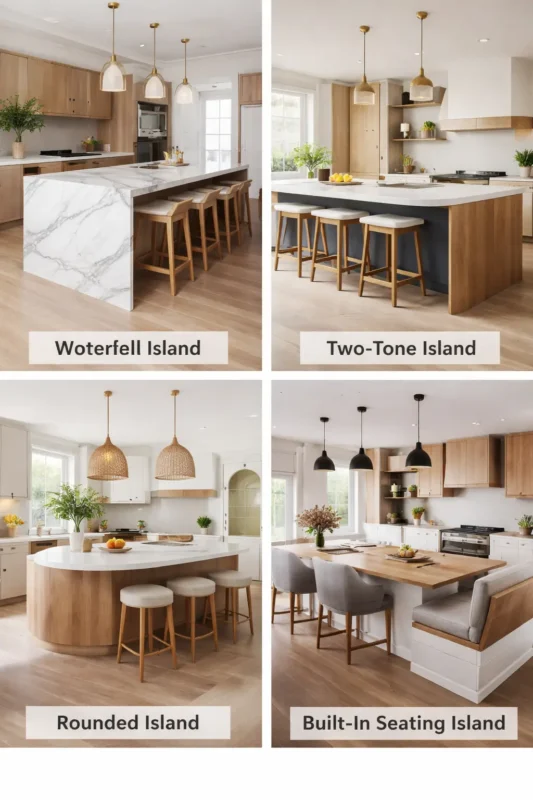
What is Kitchen Island Design
A kitchen island design is the planning and styling of a freestanding work surface in the middle of a kitchen. In modern homes, it isn’t just an extra counter; it’s a multifunction hub where you prep food, cook, store cookware, and even sit down for casual meals. Designers consider how the island fits with the room’s layout, traffic flow, and style so it looks intentional instead of just filling space. Materials, finishes, and built-in features are chosen to match your home’s character and daily needs.
N.B. Do you need kitchen Island installation service in Brooklyn? Call SR General Construction NYC for free estimate!
Top Kitchen Island Design Ideas
| Waterfall‑Edge Islands |
| Storage‑Focused Islands |
| Panel‑Ready & Appliance‑Integrated Islands |
| Tech‑Ready Islands |
| Curved & Soft‑Edge Islands |
| Slim‑Profile Countertop Islands |
| Peninsula‑Island Hybrids for Galley & Railroad Kitchens |
| Warm Wood‑Tone Islands |
| Kitchen Island Table Hybrids |
| Stainless Steel Islands |
Waterfall‑Edge Islands
A waterfall‑edge island uses a single slab of stone that flows vertically down the sides, turning the island into a sculptural centerpiece. This continuous surface highlights the veining or pattern of quartz, marble, or granite, making the island feel like a monolithic block. In small kitchens, the vertical drop adds a sense of height and visually enlarges the space.
- Continuous stone down the sides: The countertop material wraps over the edge and down to the floor, creating a seamless look that sets it apart from a conventional island.
- Showcases natural patterns: Waterfall edges highlight veining, color variations, and textures in premium materials such as marble or quartzite.
- Protects cabinetry: The stone slab shields cabinet sides from scuffs and water damage, offering durability in busy households.
- Modern statement piece: The dramatic drop delivers a sophisticated, contemporary aesthetic that elevates simple kitchens.
- Suited to small spaces: The uninterrupted flow makes compact kitchens appear larger and more open.
- Versatile style: Works with modern, transitional, or industrial designs and pairs well with minimalist cabinetry.
Cost range (Brooklyn): Expect $8 k–$20 k for a waterfall‑edge island in Brooklyn. America’s Advantage notes that a waterfall island typically costs $3 k–$10 k plus $500–$2 k per side for the waterfall edge in NYC.
Storage‑Focused Islands
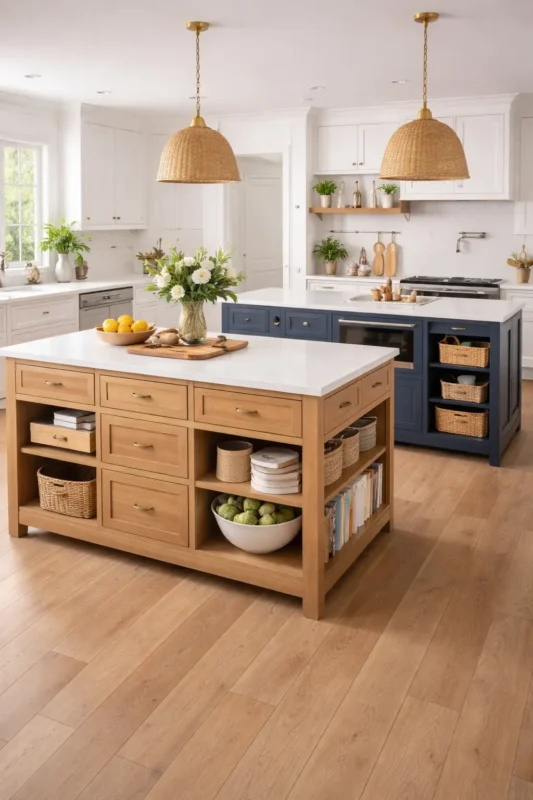
Storage‑focused islands turn every inch into usable space. They often feature deep drawers, pull‑outs, and vertical dividers to keep cookware organized and the counter clutter‑free. In open‑concept Brooklyn apartments, this approach maintains an orderly look while adding handy prep zones.
- Deep drawers for pots and pans: Big drawers with organizers make it easy to access heavy cookware without bending.
- Vertical dividers: Upright slots neatly store baking sheets, cutting boards, or trays.
- Pull‑out bins: Hidden trash, recycling, or compost bins tuck away messes while keeping bins close at hand.
- Snack prep zones: Dedicated compartments for lunch boxes, plates, and snacks keep daily essentials within reach.
- Hidden pantry drawers: Shallow drawers on the back of the island store rarely used dishes or holiday items.
- Integrated wine racks or spice pull‑outs: Small features like wine cubbies or spice pull‑outs maximize vertical space.
Cost range (Brooklyn): A storage‑packed island with custom cabinetry typically runs $8 k–$15 k, based on MyHome’s mid‑range custom islands. Upgrades such as slide‑out bins or specialty organizers can push costs to $20 k or more.
Panel‑Ready & Appliance‑Integrated Islands
Panel‑ready islands hide appliances behind matching cabinet fronts for a seamless look. Dishwashers, refrigerators, and microwave drawers can all be built into the island, freeing up wall space and creating a clean, continuous finish. This style suits modern Brooklyn apartments where open layouts demand uncluttered lines.
- Seamless integration: Panel‑ready refrigerators and dishwashers blend with cabinetry, so appliances disappear into the island.
- Built‑in microwave drawers: Locating a microwave in the island keeps countertops free, and places heat near prep zones.
- Wine coolers & beverage fridges: Under‑counter fridges store drinks and wine, turning the island into an entertaining hub.
- Improved resale value: High‑end buyers expect panel‑ready appliances, boosting your home’s appeal.
- Customized finish & hardware: Choose panels and handles that match your cabinets for a bespoke look.
- Efficient space planning: Placing appliances on the island keeps perimeter walls clear for storage or art.
Cost range (Brooklyn): Expect $15 k–$30 k or more. Panel‑ready fridges alone can cost $6,000, and customizing cabinetry around them can double that price.
Tech‑Ready Islands
Tech‑ready islands turn your kitchen into a command center. Hidden wireless chargers, pop‑up outlets, and induction cooktops keep gadgets powered without clutter. Under‑counter LEDs and motion sensors add ambiance and safety.
- Wireless charging stations: Qi‑enabled pads embedded in the countertop discreetly charge phones and tablets.
- Pop‑up outlets & USB ports: Retractable outlets provide power when needed and hide away when not in use.
- Smart faucets & digital cooktops: Touch‑activated faucets and flush‑mounted induction cooktops integrate technology seamlessly.
- LED strip lighting: Motion‑sensor LED strips under the island create mood lighting and brighten prep zones.
- Hidden cord storage: Concealed compartments keep chargers and cords organized.
- Sustainable tech: Induction cooktops and motion‑sensor lights save energy and reduce heat output.
Cost range (Brooklyn): A tech‑focused island generally costs $12 k–$25 k+, depending on how many gadgets you integrate.
Curved & Soft‑Edge Islands
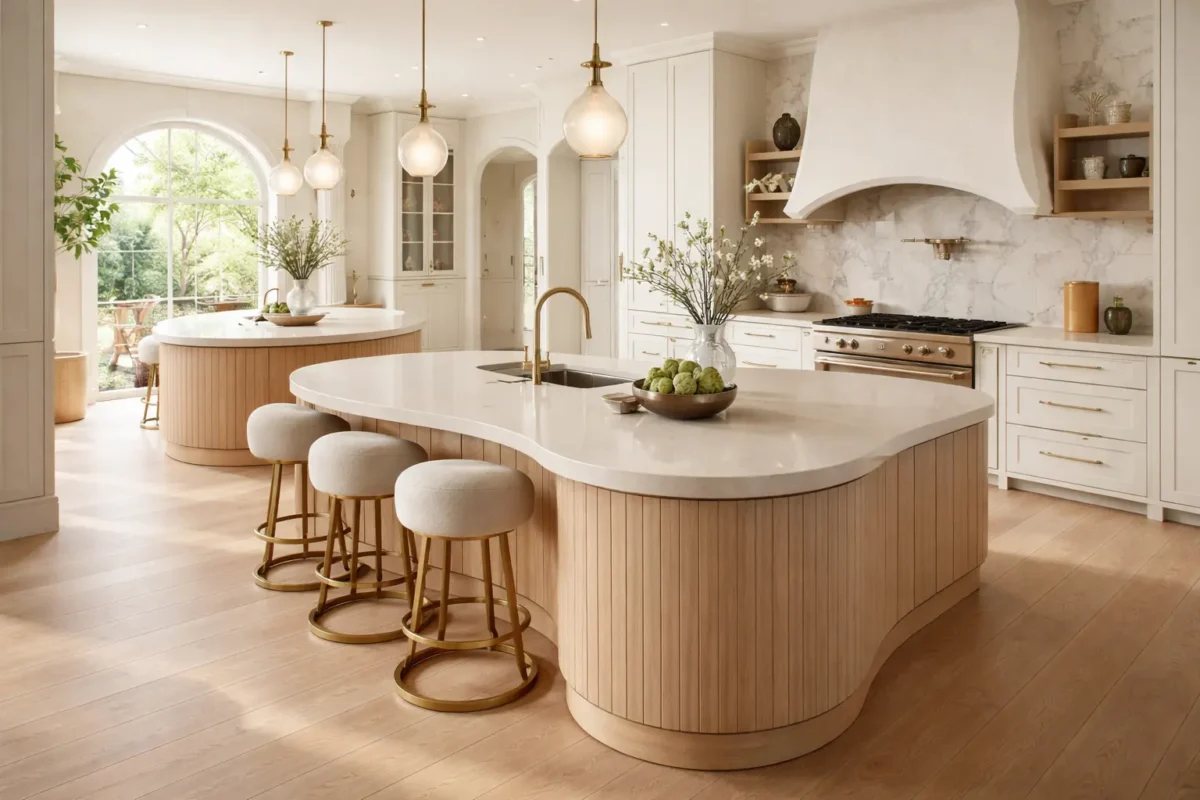
Curved islands replace sharp corners with graceful lines. Rounded ends or oval shapes improve flow and safety by eliminating hard edges. They create an inviting focal point that encourages conversation and can double as a dining zone.
- Smooth, rounded edges: The island’s edges curve instead of forming right angles, reducing bumps and making navigation safer.
- Improved circulation: Soft shapes promote a better flow through high‑traffic kitchens and work well in both large and small layouts.
- Enhanced social interaction: The curved form encourages a circular seating arrangement, allowing guests to see and talk to one another.
- Versatile shapes: Options include semicircular, crescent, or fully round islands; some designs curve only the countertop while keeping a rectangular base.
- Defined zones: A crescent island can offer a work surface on the straight side and a dining area on the curved side.
- Customizable features: Curved islands can accommodate sinks, hobs, or built‑in storage just as rectangular islands do.
Cost range (Brooklyn): Because they require custom fabrication, curved islands often cost $10 k–$25 k+, which is higher than for straight‑edge versions.
Slim‑Profile Counter‑top Islands
Slim‑profile islands emphasize lightness and openness. These designs use slender countertops and legs so the island feels more like a piece of furniture than a block of cabinetry. They’re perfect for small Brooklyn kitchens or lofts where too much mass would disrupt traffic flow.
- Slender legs for an airy feel: Thin, powder‑coated metal or wood legs create a streamlined silhouette ideal for tight spaces.
- Minimal cabinetry: Instead of a bulky base, these islands often feature open shelves or a light frame with just a drawer or two.
- Slim countertops: Thin stone or wood slabs reduce visual weight while still providing a durable work surface.
- Multi‑purpose use: The design works as a dining table, prep station, and laptop workspace, making it versatile for small apartments.
- Easy to move: Some slim islands are designed to be mobile or freestanding, offering flexibility in small kitchens.
- Mix of materials: Combining stainless steel legs with a butcher‑block top adds warmth and texture.
Cost range (Brooklyn): A slim‑profile island can be budget‑friendly if you choose a ready‑made table with an added countertop, costing $700–$3 k. Custom versions with stone tops and tailored legs typically fall between $5 k and $10 k.
Peninsula‑Island Hybrids for Galley & Railroad Kitchens
In long, narrow Brooklyn kitchens, a full island often won’t leave enough room to move. A peninsula, an island attached at one end to a wall or cabinet, provides extra workspace and seating without blocking the walkway. Designers recommend at least 900 mm (36 in) of clearance around the peninsula for comfortable circulation.
- Extra workspace at one end: A peninsula extends the counter, adding prep space without crowding the center.
- Space for appliances: It can accommodate a wine fridge or microwave, using the anchored side for utility.
- Bar‑stool seating: A short overhang accommodates two or three stools for casual dining or homework.
- Preserves walkway clearance: Designers suggest maintaining a 900 mm to 1 m (approx. 36–40 in) clearance around the peninsula to ensure smooth traffic flow.
- Movable alternatives: In very tight spaces, a small rolling island can be pulled in and out when extra counter space is needed.
- Double‑use options: Some peninsulas feature a dining table or banquette at the end, providing a formal eating area without taking up more floor space.
Cost range (Brooklyn): Building a peninsula is usually less expensive than a freestanding island. Expect $7 k–$12 k for a basic peninsula with cabinetry; adding appliances or custom seating raises costs to $15 k or more.
Warm Wood‑Tone Islands
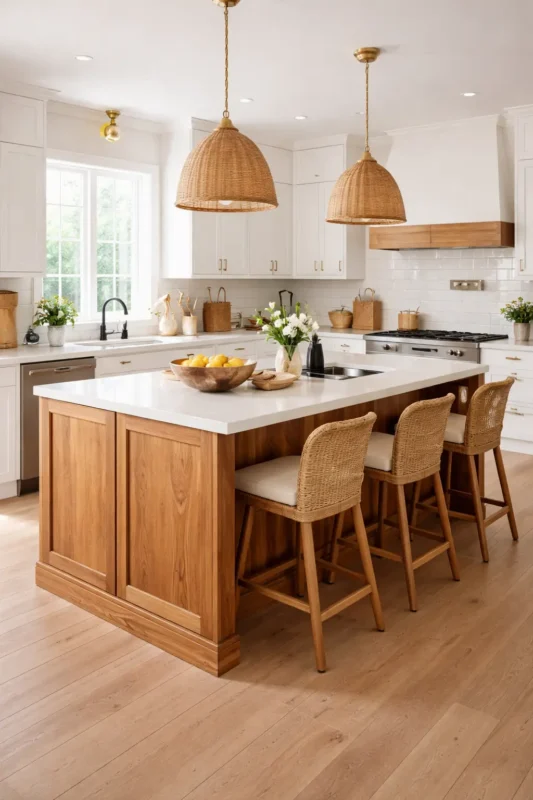
Wood‑tone islands bring natural warmth and texture into kitchens. Species like oak, walnut, and mixed woods soften the look of white or stone‑heavy spaces. Wood also creates a psychological sense of comfort and connection to nature.
- Natural warmth: Oak, walnut, and maple add cozy color and grain patterns that feel welcoming.
- Species and grain choice: Selecting species with grains that echo or contrast nearby cabinets helps tie the room together.
- Stain vs. clear finish: Finishes affect how the wood ages; natural oil or clear finishes allow the wood to develop a patina, while stains add color.
- Durable hardwoods: Hardwoods like oak and maple are strong and wear-resistant, while walnut offers a luxurious yet softer option.
- Bridges living areas: Wood islands create a smoother transition between the kitchen and adjacent dining or living rooms.
- Pairs with various countertops: Warm wood bases look good with stone, quartz, or even stainless tops, allowing design flexibility.
Cost range (Brooklyn): Wood‑tone islands usually cost $8 k–$20 k, depending on species and finish. Premium walnut or custom detailing pushes costs upward.
Kitchen Island Table Hybrids
Island table hybrids blur the line between a dining table and a kitchen island. They use slimmer tops, open legs, and a lighter frame so the piece feels like furniture rather than cabinetry. These hybrids are popular in lofts and row houses where one surface must handle prep, meals, and laptop work.
- Slimmer countertop: A thin stone or wood slab provides ample prep space without adding bulk.
- Open leg frame: Legs or trestle supports give the island a table‑like appearance and keep the floor visible.
- Balanced prep and dining: Designers carefully plan legroom, stool height, and storage to support both cooking and dining.
- Lightweight feel: The airy frame suits rooms where width is tight and heavy cabinets would crowd the space.
- Hidden storage: Drawers or shelves under the tabletop provide storage without turning the island into a heavy box.
- Ideal for multi‑tasking: Serves as a breakfast bar, work desk, and serving table all in one, fitting urban lifestyles.
Cost range (Brooklyn): A table‑style island typically ranges $5 k–$12 k, depending on materials. Using soapstone or marble tops or adding built-in storage increases the price.
Stainless Steel Islands
Stainless steel islands bring a professional, industrial vibe to the home kitchen. The material is durable, heat‑resistant, and non‑porous, making it easy to clean and hygienic. Stainless surfaces work well with modern flat‑panel cabinets and suit cooks who do heavy searing or high‑heat work.
- Durable work surface: Stainless steel handles heavy pots, high heat, and frequent cleaning without warping.
- Non‑porous & hygienic: Smooth, welded surfaces don’t trap crumbs or moisture, making them appealing to allergy‑sensitive households.
- Integrated sinks & splashbacks: Islands can include welded sinks and short splash guards for a continuous surface that’s easy to wipe down.
- Modern aesthetic: Brushed or matte finishes give a sleek, industrial look that pairs with minimalist cabinets.
- Reflective surfaces: Stainless steel reflects light, helping small kitchens feel brighter and more open.
- Fingerprint‑resistant coatings: Newer coatings minimize smudges and maintain a polished appearance.
Cost range (Brooklyn): Stainless steel islands span a wide range. A utilitarian stainless table from a restaurant supply store can be $700–$3 k, while a custom island with integrated sinks, cabinets, and thick steel surfaces runs $10 k–$20 k.
Which materials are most durable for Brooklyn kitchen islands
Even in a Brooklyn kitchen, you need a work surface that can handle daily wear, heat, and the occasional spill. Here are the materials that stand up best on kitchen islands, backed by durability data and recommendations from renovation experts:
- Engineered stone (quartz) – exceptionally heat‑, stain‑, and scratch‑resistant, and non‑porous.
- Granite – a natural stone that resists high heat and offers unique patterns, but needs periodic sealing.
- Soapstone – naturally non‑porous and highly resistant to heat and water.
- Solid‑surface (Corian) – heat‑ and stain‑resistant, moldable into custom shapes.
- Butcher‑block wood – warm and forgiving on knives; durable hardwoods like maple and oak are commonly used.
- Laminate – budget‑friendly and available in many looks, though less rugged than stone.
- Stainless steel – extremely resilient, anti‑bacterial, and water‑proof
How can a multi‑functional island replace the dining table in a compact NYC apartment?
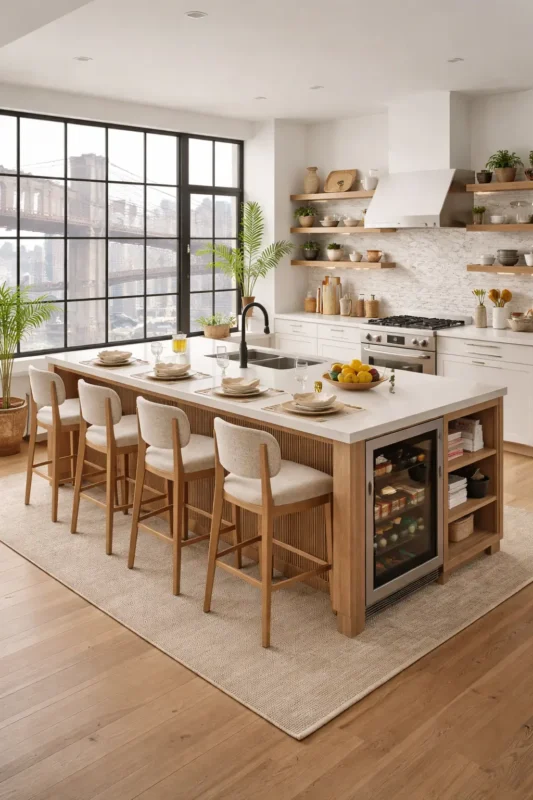
When square footage is tight, a well‑designed island can serve as a substitute for a traditional dining table. Many small apartments use narrow islands with slide‑out or drop‑leaf tables that seat two, providing a compact dining bar that tucks away when not in use. By extending the countertop and adding an overhang for stools, the island doubles as a breakfast bar, homework station, and laptop desk while leaving the main floor open. Built‑in drawers and shelves store dishware and utensils so you don’t need a separate dining hutch. With good lighting and a comfortable stool height, the island becomes the kitchen’s social hub without sacrificing valuable space.
Where to Find the Best Brooklyn Contractors
Are you looking for an expert contractor in Brooklyn, NYC? SR General Construction has you covered! Our business is located at 8807 Avenue B, Brooklyn, NY 11236, United States, in the Canarsie area.
Additionally, we offer services at Rockaway Parkway and Ralph Avenue, providing fast access to Flatlands, East Flatbush, Bergen Beach, Brownsville, and the Spring Creek section of East New York.
FAQ
1. How much clearance do you need around a kitchen island?
Designers recommend at least 42 inches of open space around all sides of an island for comfortable movement, increasing to 48 inches for larger kitchens. This ensures two people can work back‑to‑back without feeling cramped.
2. What is the minimum size of a kitchen island?
For functionality and seating, the smallest practical island is about 4 feet long and 2 feet wide. Anything smaller won’t provide enough workspace or room for stools.
3. How is a kitchen island different from a peninsula?
A true island stands free on all sides, while a peninsula attaches to a wall or cabinet at one end. In long, narrow kitchens, a peninsula often makes more sense because it provides extra counter space and seating without blocking the walkway.
4. Why are waterfall‑edge islands popular?
Besides their dramatic look, waterfall edges make small kitchens feel taller and more open. The continuous slab also adds durability by shielding the island sides from wear.
5. How much does a kitchen island cost in Brooklyn?
In New York, a basic prefabricated island typically costs $4 k–$7 k, mid‑range custom islands run $8 k–$15 k, and high‑end custom islands with built‑in appliances and plumbing can exceed $16 k–$25 k. Premium materials, integrated sinks, and appliances significantly raise the price.