

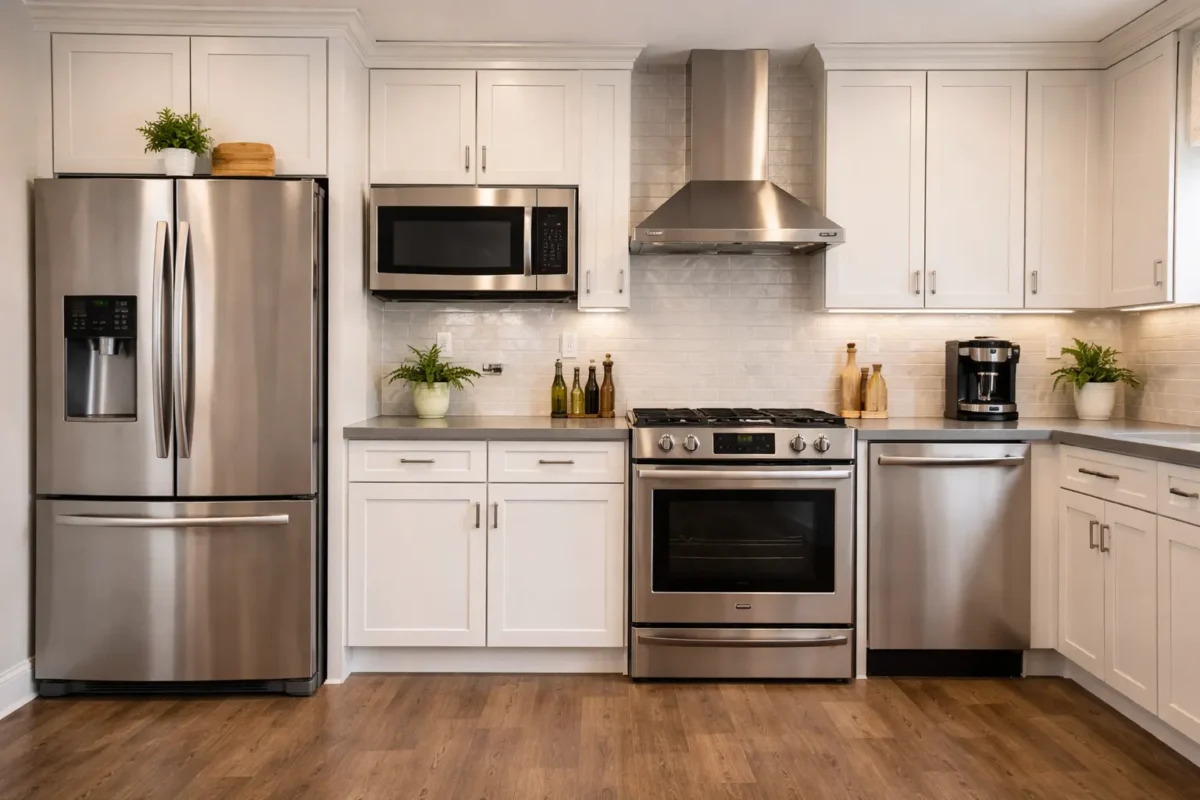
What is a kitchen appliance, and why do these everyday tools matter so much in a Brooklyn home?
From storing fresh food to cooking quick meals and keeping your kitchen clean, kitchen appliances play a key role in daily life. Yet many people are unsure what truly counts as a kitchen appliance and how different types serve different needs. In this guide, we will clearly explain what a kitchen appliance is and how it fits into modern kitchens.
What is a Kitchen Appliance
A kitchen appliance is a device that helps you do kitchen jobs like storing food, cooking, and cleaning up. In simple terms, it’s a machine that makes everyday kitchen work faster and easier; think fridge, stove, or dishwasher. “Appliances” are usually different from basic fixtures (like a sink) because they run on electricity or fuel to perform their functions.
What Qualifies as a Kitchen Appliance
A kitchen appliance usually qualifies if it supports a kitchen task such as food preservation, cooking, or dishwashing. It often plugs in, hardwires, uses gas, or connects to water, which is why it’s treated differently from a simple plumbing fixture. Many major appliances aren’t easily moved and may need special electrical, gas, plumbing, or ventilation connections, so they “live” in one planned spot. In Brooklyn apartments, that’s why measuring space and knowing your hookups matter before you buy.
Electric, Gas & Water Hookups
Most kitchen appliances need one (or more) of three basics: power, fuel, and water. If you understand these hookups first, you’ll avoid surprise costs during installation, especially in NYC buildings.
- Electric power: Many appliances use standard household power, and some (like refrigerators) are recommended to be on a properly grounded, dedicated 115/120-volt circuit.
- High-power electric (240V): Large heating appliances, such as electric ranges, often use 240-volt circuits with dedicated receptacles.
- Gas supply: In NYC, a licensed master plumber must pull a permit to install or alter gas appliances or gas piping, typically filed through DOB NOW.
- Water supply: Dishwashers and fridges with ice/water need a clean water feed, and refrigerator water lines should have their own shut-off valve tied into the home’s cold water line.
- Drainage + ventilation: A dishwasher setup involves drain, water, and electrical connections, and cooking appliances often work best with proper ventilation (ducted vents outside; ductless filters and recirculates air).
Major vs Small Kitchen Appliances
Here’s the easiest way to think about it: major appliances are the big, usually fixed machines, and small appliances are the portable countertop helpers. Major appliances are often harder to move and may need more serious hookups, while small appliances are usually plug-and-play.
| Point | Major Kitchen Appliances | Small Kitchen Appliances |
|---|---|---|
| Simple meaning | Large, non-portable or semi-portable machines used for core household tasks. | Portable or semi-portable machines are usually used on countertops for specific tasks. |
| Common examples | Refrigerator, range/oven, dishwasher (often “white goods”). | Microwave, kettle, toaster, coffee maker, food processor. |
| Where it sits | Usually on the floor and planned into the kitchen layout. | Usually on a counter, table, or shelf. |
| Hookups | May need special electrical, gas, plumbing, or ventilation connections. | Typically plugs into a standard outlet and doesn’t need plumbing. |
| Install effort | Often requires measuring, leveling, and sometimes a licensed pro. | Usually easy to set up yourself—unbox, place, plug in. |
Categories of Kitchen Appliances
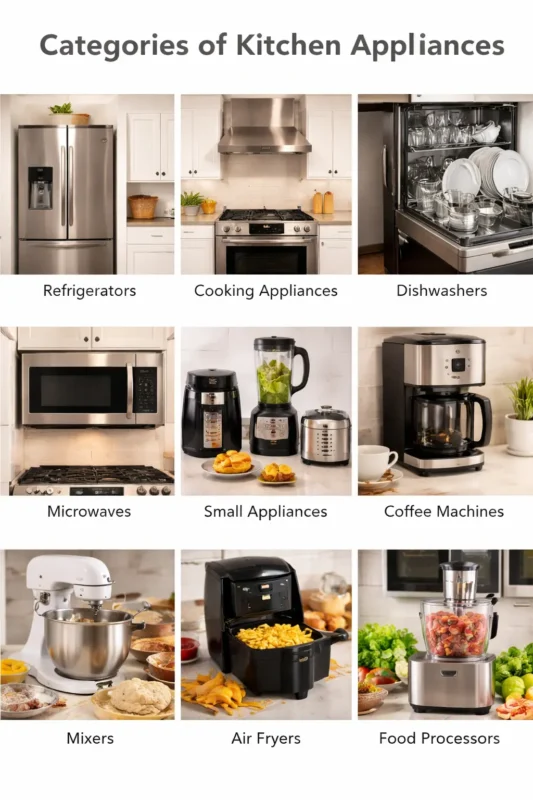
When you group appliances by what they do, it becomes much easier to choose what you actually need. Think of your kitchen as a few “zones” like storage, cooking, cleanup, and air control.
- Food storage appliances (refrigeration): This category includes refrigerators and freezers, essential appliances for keeping groceries safe and fresh. In many Brooklyn kitchens, choosing the right size (counter-depth vs deeper models) matters as much as the features.
- Cooking & baking appliances: These are your heat tools; ranges and ovens are the classic examples, and they can be gas or electric. If you cook a lot, your choice here shapes everything from cooking speed to the ventilation you’ll need.
- Cleanup appliances: This is where dishwashers and related helpers save serious time and water compared to hand-washing for many households. Dishwashers also require real planning because they involve water, drain, and electrical connections.
- Ventilation appliances: Range hoods help manage smoke, grease, and cooking smells and can be ducted or ductless, depending on your building setup. Ducted hoods vent air outdoors, while ductless models filter and recirculate air back into the kitchen.
- Countertop & specialty appliances: These are the smaller tools that handle specific tasks, such as microwaves, kettles, toasters, coffee makers, and food processors. They’re great for small spaces because you can store them away when you’re not using them.
Other concealed appliances
Ever notice how some modern Brooklyn kitchens look “clean,” even with lots of gear? That’s often because the appliances are designed to hide inside cabinetry so your kitchen feels calm and uncluttered.
- Microwave drawers — These slide out instead of swinging open, so they tuck neatly under a counter or island.
- Undercounter wine coolers/beverage centers — They fit below the counter and keep drinks organized without taking up your fridge space.
- Built-in coffee makers behind panels — You can hide the machine behind matching doors, so it feels like part of the cabinets.
- Warming drawers — They blend into the lower cabinetry and keep plates or food warm without extra countertop clutter.
- Hidden range hoods + panel-ready appliances — Some kitchens use concealed ventilation and panel-ready fronts so the “appliance look” almost disappears.
Smart & Connected Kitchens
A smart & connected kitchen is one where appliances connect to your home Wi-Fi and let you monitor or control key functions from your phone. Think of it as your kitchen giving you updates instead of you constantly checking on it.
- Remote control from your phone — You can change settings and control supported appliances without standing in front of them.
- Alerts and notifications — Your appliance can send messages like “cycle done” or “status update,” which is super handy on busy days.
- Live monitoring (status + time remaining) — For some appliances (like dishwashers), you can check cycle time and status right from the app.
- Voice control compatibility — Some smart systems support voice commands, which feels great when your hands are messy from cooking.
- Smarter troubleshooting — Features like Smart Diagnosis can help detect issues and guide you toward fixes faster.
Energy Efficiency & Indoor Air Quality

This topic is about two things you feel every day: lower utility bills and cleaner air while you cook. The right appliances (and good ventilation habits) can reduce wasted energy and help control cooking-related air pollutants.
- Choose ENERGY STAR when possible — ENERGY STAR dishwashers can save significant water over their lifetime, which also reduces energy used to heat water.
- Use your range hood properly — ENERGY STAR notes that vented range hoods (to the outdoors) reduce cooking-related pollutants, and the EPA recommends using them every time you cook.
- Consider induction or electric cooking — Research comparing gas vs induction cooking shows differences in indoor pollutant levels, and ventilation choices matter too.
- Run full loads and avoid “half-empty” cycles — With dishwashers, you usually get the best efficiency by running full loads instead of frequent small ones.
- Keep appliances maintained — Clean filters (dishwashers/hoods) and perform basic upkeep to help them run efficiently and prevent performance drops over time.
Planning & Measuring Your Space
Planning & measuring means you figure out what will fit, how the doors will open, and whether the appliance can even fit in your kitchen before you hit “buy.” In Brooklyn, this step saves you from the classic headache of a fridge that won’t clear the doorway or a dishwasher that blocks a cabinet.
- Measure height, width, and depth — Measure the space top-to-bottom, left-to-right, and front-to-back so you’re shopping with real numbers.
- Measure at the narrowest point — Baseboards, trim, and molding can steal space, so don’t assume the opening is perfectly square.
- Plan for door swing and clearance — Make sure you have room for doors to open fully and for you to stand comfortably while using the appliance.
- Allow space for hinges, airflow, and ventilation — Some appliances need extra room around them for safe operation and proper airflow.
- Check the delivery path — Confirm the appliance can fit through your building entry, hallway turns, and kitchen doorway before delivery day.
How to install a kitchen appliance
Kitchen appliance installation is the process of installing the appliance, connecting the required utilities (power/gas/water), and testing it to ensure it runs safely. The key rule: follow the manufacturer’s installation instructions and don’t DIY anything that requires a license or permit in NYC.
- Step 1: Read the manual first — The manual tells you the exact clearance, hookups, and safety rules for your model.
- Step 2: Measure and confirm the fit — Verify the cutout/opening size and confirm doors can open without hitting anything.
- Step 3: Prep the area — Clear the space, protect floors, and gather basic tools (level, wrench, screwdriver).
- Step 4: Shut off utilities before you connect anything — Turn off power at the breaker and shut off water at the valve when you’re working with water lines.
- Step 5: Move the appliance into position (carefully) — Slide it in slowly so you don’t pinch hoses, kink cords, or scratch floors.
- Step 6: Connect water supply (if needed) — Dishwashers and fridges with dispensers/ice makers typically connect to a cold-water line with a shut-off valve.
- Step 7: Connect the drain (if needed) — Dishwashers require a drain hose to safely discharge wastewater.
- Step 8: Connect power (plug-in or hardwired) — Use the correct outlet/circuit for the appliance and follow the manual’s requirements.
- Step 9: Gas appliances = hire a licensed pro in NYC — NYC311 states a licensed master plumber must get a permit to install or alter gas appliances or gas piping, submitted through DOB NOW.
- Step 10: Level and secure the appliance — Leveling helps prevent vibration, noise, and leaks (especially for dishwashers and washers).
- Step 11: Test everything — Run a short test cycle (or power-on test) and watch for leaks, odd noises, or error codes.
- Step 12: Register the appliance + keep paperwork — Registering helps with warranty support and future service.
Typical cost ranges for Kitchen appliances in Brooklyn, NYC
Brooklyn prices usually track the same NYC showroom and big-box pricing you see online, so it helps to budget by appliance type. Typical retail ranges right now look like this: refrigerators $200–$5,000; stove/range $530–$3,000; cooktops $230–$3,000; wall ovens $460–$5,400; dishwashers $400–$3,000; microwaves $60–$2,000; range hoods $50–$1,650; wine fridges $150–$2,800; chest freezers $190–$2,200; upright freezers $160–$2,900. If you shop premium built-ins or pro-style lines, the ceiling can jump higher (for example, ranges up to about $7,500 and refrigerators up to about $10,600). Also, plan a little extra for delivery, installation, and haul-away, since those fees are often not included in the sticker price.
Integrated vs. freestanding appliances
If you’ve ever toured Brooklyn apartments, you’ve seen both styles—one tries to “disappear” into cabinets, and the other stands on its own. The main difference is how they install and how they look day to day in your kitchen.
| Feature | Integrated / Built-in | Freestanding |
|---|---|---|
| Look | Blends with cabinetry for a unified, “built-in” finish. | Appliance front is visible (stainless, white, black, etc.). |
| Installation | Needs tighter planning for sizing, clearances, and cabinet fit. | Simpler swap in/out if hookups match. |
| Flexibility | Less flexible—built around your cabinet layout. | More flexible—easier to move or replace later. |
| Maintenance access | Can be harder to pull out for service. | Usually easier to access for repairs. |
| Best for | Clean design, open-plan spaces, tighter kitchens. | Rentals, quick replacements, value-focused upgrades. |
Which kitchen appliances are essential for a small Brooklyn apartment?
For most small Brooklyn kitchens, the essentials are the appliances that replace multiple tools without eating your counter space—think a solid microwave, a toaster oven, and a rice cooker (they can cover a surprising amount of daily cooking). If your unit has a compact range or cooktop, add a good ventilation fan/hood habit (even a window plus the fan helps). And if you’re tight on space, choose one “workhorse” countertop appliance (like a toaster oven that also bakes/air-fries) instead of stacking single-use gadgets.
How can I dispose of an old refrigerator or stove in Brooklyn in accordance with DSNY rules?
For a refrigerator (or any cooling appliance), you must make a CFC/Freon removal appointment first; DSNY removes the refrigerant, puts on a sticker, and then you leave it at the curb for recycling pickup. For a stove/range/oven, treat it like a large metal item—set it out with recycling following DSNY’s large-item rules (no appointment for regular bulk pickup). DSNY also notes you can usually set out up to 6 large items per collection day, so it’s smart to check your Brooklyn collection schedule before you drag anything to the curb.
Where to Find the Best Brooklyn Contractors
Are you looking for an expert contractor in Brooklyn, NYC? SR General Construction has you covered! Our business is located at 8807 Avenue B, Brooklyn, NY 11236, United States, in the Canarsie area.
Additionally, we offer services at Rockaway Parkway and Ralph Avenue, providing fast access to Flatlands, East Flatbush, Bergen Beach, Brownsville, and the Spring Creek section of East New York.
FAQ
1. What counts as a “large appliance” for DSNY pickup?
Items like dishwashers, microwaves, ovens, and ranges fall under DSNY’s “large appliances” guidance. Most are set out as bulk items (often with recycling if mostly metal).
2. Why does a refrigerator need a special appointment in NYC?
Because many cooling appliances contain CFC/Freon, DSNY needs to remove it first for safe recycling. After removal, DSNY places a sticker, and you leave it out for recycling collection.
3. What if my fridge has flammable refrigerant (R600a/R32)?
DSNY warns that some newer appliances with R600a or R32 can’t be collected. In that case, you’ll need to contact the manufacturer or a private service for disposal options.
4. How long do kitchen appliances usually last?
A practical rule is 10–15 years, depending on the appliance and how hard you run it. Good maintenance (cleaning filters, checking seals, not overloading) helps you get the longer end of that range.
5. What’s a realistic “starter budget” for a basic appliance package?
A common package (fridge, microwave, range, dishwasher) often lands around $2,100–$5,400 before delivery/installation. Going high-end pushes the total much higher.
References:
Circus Casino Einzahlung https://s3.amazonaws.com/